
![previous page: 1. Amaranthus [Tourn.] L. Sp. Pl. 989. 1753. Part 5](../../../images/nav/page_prev.gif)


2. Acnida L. Sp. 1027. 1753
Description
This section is from the book "An Illustrated Flora Of The Northern United States, Canada And The British Possessions Vol2", by Nathaniel Lord Britton, Addison Brown. Also available from Amazon: An Illustrated Flora of the Northern United States, Canada and the British Possessions. 3 Volume Set..
2. Acnida L. Sp. 1027. 1753
Annual, erect or decumbent, glabrous branching herbs, similar to the dioecious Amaranths, with alternate petioled thin pinnately veined leaves. Flowers small, green, 1-3-bracted, in terminal and axillary, continuous or interrupted spikes, or clustered in the axils. Stami-nate flowers consisting of 5 scarious erect I-nerved mucronate sepals longer than the bracts, and as many stamens; filaments subulate, distinct; anthers 2-celled. Pistillate flowers without a calyx; ovary ovoid or subglobose; stigmas 2-5, papillose or plumose, short or elongated. Utricle fleshy and indehiscent, or membranous and bursting irregularly or circumscissile; seed erect, smooth and shining. [Greek, without nettle.]
About 6 species, natives of eastern North America and the West Indies. Type species: Acnida cannabina L.
1. | A. cannabina. | |
Utricle membranous, irregularly dehiscent or circumscissile; plants of fresh water swamps. | ||
Utricle circumscissile. | 2. | A. tamartscina. |
Utricle irregularly dehiscent. | 3. | A. tuberculata. |
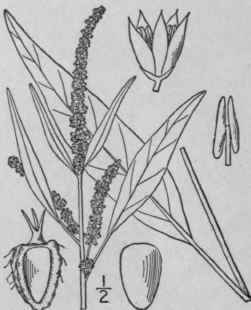
1. Acnida Cannabina L. Salt-Marsh Water-Hemp
Fig. 1670
Acnida cannabina L. Sp. Pl. 1027. 1753.
A. rusocarpa Michx. Fl. Bor. Am. 2: 234, pl. 50. 1803.
Succulent, stem stout or slender (sometimes 1' in diameter at the base), usually much branched, 1°-10° tall, the branches ascending. Leaves lanceolate, acuminate but generally blunt-pointed and apiculate at the apex, 2'-6' long, 1/4'-1 1/4' wide, narrowed at the base, entire or slightly undulate; petiole usually shorter than the blade; staminate spikes 1'-5' long, usually dense; sepals oblong-lanceolate or ovate-oblong, acute, acuminate or obtusish, cuspidate or mucronate; fertile spikes dense or loose; stigmas slender, papillose-hispid, i" long; utricle fleshy, indehiscent, 3-5-angled, subglobose or obovoid, 1"-2" long when mature, becoming black, much longer than the bracts.
In salt and brackish marshes, and up the rivers to fresh water, New Hampshire to Florida. Water-leaf. July-Aug.
Acnida floridàna S. Wats. Proc. Am. Acad. 10: 376, a more slender plant, of the southern Atlantic coast, with narrower slender-petioled leaves, the flowers in elongated interrupted spikes, and a smaller utricle, may occur in southern Virginia.
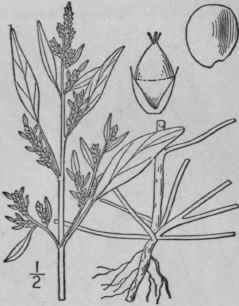
2. Acnida Tamariscina (Nutt.) Wood. Western Water-Hemp
Fig. 1671
Amarantus tamariscinus Nutt. Trans. Am. Phil. Soc. (II.)
5: 165. 1833-37. Acnida tamariscina Wood, Bot. & Fl 289. 1873.
Similar to the preceding species, much branched, erect, the branches usually slender, erect-ascending. Leaves lanceolate or ovate-lanceolate, 2'-6' long, mostly long-acuminate., but sometimes obtuse at the apex and mucronate or cuspidate-tipped, narrowed at the. base, the petioles commonly shorter than the blades; spikes mostly loose or interrupted, often 5' long; sepals lanceolate, subulate-acuminate; stigmas plumose, rather short; utricle membranous, not angled, 1/2"-1" long, cir-cumscissile; bractlets lanceolate, cuspidate.
In swamps, Illinois to South Dakota, Texas and New Mexico. July-Sept.
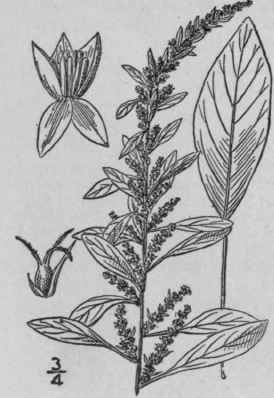
3. Acnida Tuberculata Moq. Rough-Fruited Water-Hemp
Fig. 1672
A. tuberculata Moq. in DC. Prodr. 132: 278. 1849.
A. tamariscina subnuda S. Wats, in A. Gray, Man. Ed. 6, 429. 1890. A. tamariscina concatenata Uline & Bray, Bot. Gaz. 20:
158. 1895. A. tamariscina prostrata Uline & Bray, Bot. Gaz. 20:
158. 1895.
Erect ascending or prostrate, sometimes 10° high, the branches flexuous. Leaves lanceolate to rhombic-spatulate, acute or obtuse, 6' long or less; inflorescence spicate, or glomerate in the axils; utricle ovoid, often tubercled. irregularly dehiscent, about 1/2" long.
Swamps and river shores, Quebec to North Dakota, south to Kentucky, Louisiana and Missouri. Consists of several races, differing in size and habit. July-Sept.
Celòsia argéntea L., a tall glabrous herb with white or pink flowers subtended by a bract and bractlets in a long dense spike, having 5 sepals, filaments adnate at the base, and the ovary with several ovules, widely distributed in tropical regions, has been found as a waif in Montgomery County, Pennsylvania.
Continue to:


My Books

