


2. Cerástium L. Sp. Pl. 437. 1753. Part 2
Description
This section is from the book "An Illustrated Flora Of The Northern United States, Canada And The British Possessions Vol2", by Nathaniel Lord Britton, Addison Brown. Also available from Amazon: An Illustrated Flora of the Northern United States, Canada and the British Possessions. 3 Volume Set..
2. Cerástium L. Sp. Pl. 437. 1753. Part 2
2. Cerastium Semidecandrum L. Small Or Five-Stamened Mouse-Ear Chickweed
Fig. 1764
Cerastium semidecandrum L. Sp. Pl. 438. 1753. Cerastium vulgatum var. semidecandrum A. Gray, Man. Ed. 5, 94. 1867.
Low, tufted, erect or decumbent, annual, 2'-6' high, finely viscid-pubescent. Leaves ovate, or the lower spatulate, 2"-4" long, obtuse; bracts scarious, membranous; inflorescence cymose; pedicels at length longer than the calyx; flowers 1"-1 1/2" broad; sepals lanceolate, acute, scarious-margined, slightly exceeding the emarginate petals; capsule narrow, nearly straight; stamens often 5.
In dry, sterile soil, Massachusetts to Virginia. Naturalized from Europe. Called also spring mouse-ear. April-May.
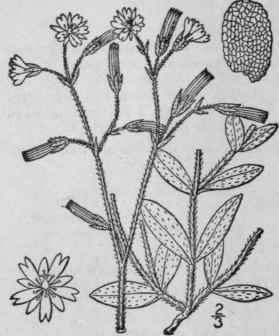
3. Cerastium Vulgàtum L. Larger Mouse-Ear Chickweed
Fig. 1765
Cerastium vulgatum L. Sp. Pl. Ed. 2, 627. 1762.
Cerastium triviale Link, Enum. Hort. Ber. 1: 433. 1821.
Biennial or perennial, viscid-pubescent, tufted, erect or ascending, 6'-18' long. Lower and basal leaves spatulate-oblong, obtuse; upper leaves oblong, 6"-12" long, 3"-5" wide, acute or obtuse; bracts scarious-margined; inflorescence cymose, loose, the pedicels at length much longer than the calyx; sepals obtuse or acute, about equalling the 2-cleft petals, 2"-3" long; capsule curved upward.
In fields and woods, nearly throughout our area. Naturalized from Europe. Often a troublesome weed. Occcurs also in the Southern and Western States, and is native in northern Asia. Mouse-ear. May-Sept.
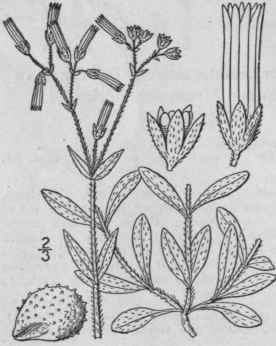
4. Cerastium Longipedunculàtum Muhl. Nodding Chickweed. Powder-Horn
Fig. 1766
C. longipedunculatum Muhl. Cat. 46. 1813. Cerastium nutans Raf. Prec. Decouv. 36. 1814.
Annual, bright green, stem weak, reclining or ascending, diffusely branched, 6'-24' long, striate, finely clammy-pubescent to glabrate. Lower and basal leaves spatulate, obtuse, petioled, 1/2'-1' long, those of the middle part of the stem lanceolate or oblong, 1'-2' long, 3"-4" wide, the upper similar, acute, sessile, gradually smaller; inflorescence loosely cymose; pedicels slender, in fruit several times the length of the calyx; flowers 2"-3" broad; sepals lanceolate, obtuse or acutish, about one-half the length of the 2-cleft petals; pods nodding, 5"-9"' long, curved upward, much exceeding the calyx.
In moist, shaded places. Nova Scotia and Hudson Bay to North Carolina, west to British Columbia, Nevada and northern Mexico. The plant sometimes produces capsules from apparently apetalous flowers. Ascends to 2200 ft. in Pennsylvania. Clammy chick-weed. April-June.

Continue to:


My Books

