


2. Corèma Don, Edinb. New Phil. Journ. 15: 63. 1826-27
Description
This section is from the book "An Illustrated Flora Of The Northern United States, Canada And The British Possessions Vol2", by Nathaniel Lord Britton, Addison Brown. Also available from Amazon: An Illustrated Flora of the Northern United States, Canada and the British Possessions. 3 Volume Set..
2. Corèma Don, Edinb. New Phil. Journ. 15: 63. 1826-27
[Oakesia Tuckerm. in Hook. Lond. Journ. Bot. 1: 445. 1842.] Low, much branched shrubs, with narrowly linear leaves crowded on the branches, and small dioecious or polygamous flowers in terminal heads. Corolla none. Staminate flowers with 3 or sometimes 4 long-exserted stamens, occasionally with a rudimentary or perfect pistil. Pistillate flowers with a 2-5-celled (mostly 3-celled) ovary and a slender 2-5-cleft style, the stigmatic branches very slender, sometimes toothed. Drupe globose, usually with 3 nutlets. [Greek, a broom, in allusion to the bushy habit.]
Two species, the following of the eastern United States, the other, the generic type, of southwestern Europe, the Azores and Canaries.
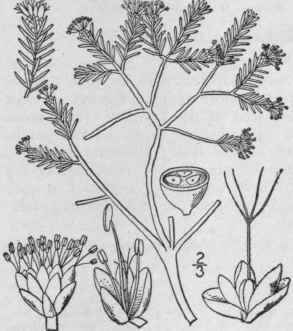
1. Corema Conràdii Torr. Conrad's Broom Crowberry
Fig. 2774
Empetrum Conradii Torr. Ann. Lye. N. Y. 4: 83.
1837. C. Conradii Torr.; Loudon, Encycl. Trees 1092. 1842.
Much branched, 6'-2° high, the young twigs puberulent and densely leafy, the branches minutely scarred by the persistent pulvini. Leaves 2"-3" long, rather less than i ' wide, obtuse, glabrous when mature, bright green; flowers numerous in the terminal sessile heads, the pistillate ones almost concealed by the upper leaves, the staminate conspicuous by the exserted purple stamens; drupes nearly dry, less than 1" in diameter.
In rocky or sandy soil, Newfoundland to Massachusetts and New Jersey, mostly near the coast; but occurring in one station on the Shawangunk Mountains in Ulster Co., N. Y. Local. Usually growing in large patches. April-May. Brown or Plymouth crowberry. Poverty-grass.
Continue to:


My Books

