


23. Alliaria Adans. Fam. Pl. 2: 418. 1763. Continued
Description
This section is from the book "An Illustrated Flora Of The Northern United States, Canada And The British Possessions Vol2", by Nathaniel Lord Britton, Addison Brown. Also available from Amazon: An Illustrated Flora of the Northern United States, Canada and the British Possessions. 3 Volume Set..
23. Alliaria Adans. Fam. Pl. 2: 418. 1763. Continued
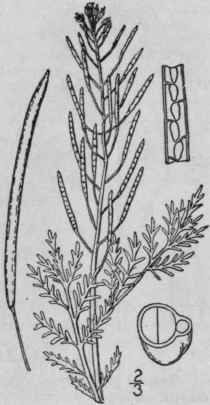
1. Sophia Sophia (L.) Britton. Flixweed. Herb-Sophia
Fig. 2051
Sisymbrium Sophia L. Sp. Pl. 659. 1753.
Descurainia Sophia Webb; Prantl in Engler & Prantl, Nat. Pflf. 32: 192. 1892.
Sophia Sophia Britton, in Britt. & Brown, 1ll. Fl. 2: 144. 1897.
Minutely hoary-canescent, stem usually much branched, 1°-2 1/2° tall, quite bushy. Leaves 2-3-pinnatifid into narrowly linear or linear-oblong segments; flowers very numerous, about 3" long; pedicels ascending, very slender, 6"-8" long, glabrous or nearly so; pods narrowly linear, 8"-12"long, 1/2" thick, ascending, curved upwards; seeds in 1 row in each cell of the pod.
In waste places, New Brunswick to Ontario, Washington, Oregon, New York, Illinois, Nebraska and Utah. Naturalized from Europe. Native also of Asia. June-Aug. Fine-leaved hedge-mustard. Flaxweed.
2. Sophia Pinnàta (Walt.) Howell. Tansy-Mustard
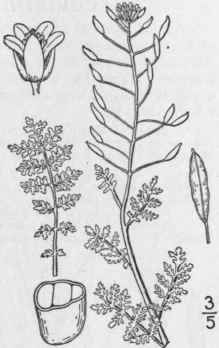
Fig. 2052
Erysimum pinnatum Walt. Fl. Car. 174. 1788. Sisymbrium canescens Nutt. Gen. 2: 68. 1818. Descurainia pinnata Britton, Mem. Torr. Club 5: 173. 1894. S. pinnata Howell, Fl. N. W. Am. 1: 56. 1897. Sophia brachycarpa (Richards.) Rydb.; Britton, Man. 462. 1901.
Densely canescent nearly all over, to glabrate; stem erect, branched, 8'-24' tall, slender, the branches ascending. Leaves 2'-4' long, oblong in outline, 2-pinnatifid into very numerous small toothed or entire obtuse segments; pedicels very slender, spreading nearly or quite at right angles to the axis, 5"-7" long, usually longer than the pods; flowers 1"-1 1/2" broad; pods horizontal or ascending, oblong or linear-oblong, compressed, 3"-4" long, 1" wide, glabrous or somewhat canescent; style minute; seeds plainly in 2 rows in each cell.
In dry soil, Pennsylvania to Florida, Iowa, North Dakota, Colorado, California and Texas. May-July.
3. Sophia Incisa (Engelm.) Greene. Western Tansy-Mustard
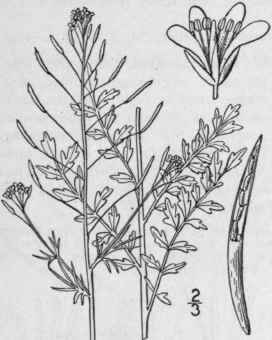
Fig. 2053
Sisymbrium incisum Engelm.; A. Gray, Mem. Am. Acad.
4: 8. 1849. Descurainia incisa Britton, Mem. Torr. Club 5: 173. 1894. Sophia incisa Greene, Pittonia 3: 95. 1896. Sophia intermedia Rydb. Mem. N. Y. Bot. Gard. 1: 184.
1900.
Resembles the preceding species, but is greener, nearly glabrous, or the pubescence is mixed with short glandular hairs. Leaves pinnately divided, and the pinnae 1-2-pinnatifid into linear-oblong entire or toothed segments; fruiting pedicels widely ascending, filiform, 5"-10" long, usually longer than the pods; pods 4"-7" long, about 1" thick, somewhat swollen, erect or ascending; seeds in 1 row or indistinctly in 2 rows.
In dry soil, Minnesota to Saskatchewan and British Columbia, south to Tennessee, Kansas, Texas and California. May-Aug.
4. Sophia Hartwegiàna (Fourn.) Greene. Hartweg's Tansy-Mustard
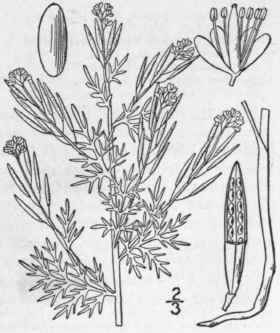
Fig. 2054
Sisymbrium Hartwegianum Fourn. Sisymb. 66. 1865. Sisymbrium incisum var. Hartivegianum Brew. &
Wats. Bot. Cal. 1: 41. 1876. Descurainia Hartwegiana Britton, Mem. Torr. Club 5: 173. 1894. Sophia Hartwegiana Greene, Pittonia 3: 95. 1896.
Similar to the two preceding species, densely minutely canescent or puberulent, stem 1°-2° tall, the branches slender, ascending. Leaves usually less finely dissected, pinnately divided into 5-7 pinnae, which are pinnatifid with obtuse segments and lobes; fruiting pedicels erect-appressed or closely ascending, 1 1/2"-4" long, shorter than or equalling the pods; pods erect or nearly so, linear, 4"-5" long, about 1/2" thick; seeds in 1 row.
In dry soil, Minnesota to Saskatchewan, British Columbia, Colorado, Utah, Mexico and California. May-July.
Continue to:


My Books

