
![previous page: 26. Astragalus [Tourn.] L. Sp. Pl. 755. 1753. Part 4](../../../images/nav/page_prev.gif)

![next page: 26. Astragalus [Tourn.] L. Sp. Pl. 755. 1753. Part 6](../../../images/nav/page_next.gif)
26. Astragalus [Tourn.] L. Sp. Pl. 755. 1753. Part 5
Description
This section is from the book "An Illustrated Flora Of The Northern United States, Canada And The British Possessions Vol2", by Nathaniel Lord Britton, Addison Brown. Also available from Amazon: An Illustrated Flora of the Northern United States, Canada and the British Possessions. 3 Volume Set..
26. Astragalus [Tourn.] L. Sp. Pl. 755. 1753. Part 5
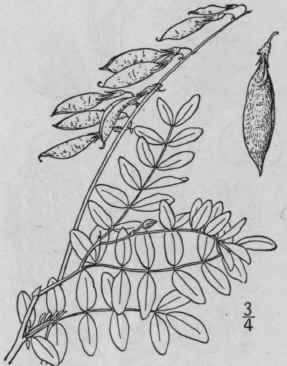
11. Astragalus Blàkei Eggleston. Blakes Milk Vetch
Fig. 2544
A. Robbinsii occidentalis S. Wats. Bot. King's Exp. 70. 1871.
A. Robbinsii Jesupi Eggleston & Sheldon, Bull. Geol. Nat. Hist. Surv. Minn. 9: 155. 1894.
A. Blakei Eggleston, Bot. Gaz. 20: 271. 1895.
A. Jesupi Britton, Man. 1048. 1901.
Similar to the two preceding species, but stem rather stouter, erect or nearly so, up to 20' high, sparingly pubescent. Leaflets 9-15, oblong to elliptic, obtuse or emarginate, glabrous above, pubescent beneath; corolla whitish or bluish purple, 5"-6" long; pod 1' long or less, pubescent, swollen, somewhat triangular in section.
Rocky banks and cliffs. Maine and Vermont. May-June. Also in the Rocky Mountains.

12. Astragalus Distórtus T. & G. Bent Milk Vetch
Fig. 2545
Astragalus distortus T. & G. Fl. N. A. 1: 333. 1838.
Sparingly pubescent or glabrate, diffuse or ascending, much branched from the base, stems 8'-15' long. Leaflets 11-25, obovate or oval, emarginate or rounded at the apex, narrowed at the base, 2"-5" long; flowers purple, 4"-6" long, in loose short spikes; pod sessile in the calyx, I-celled, slightly inflated, linear-oblong, coriaceous, strongly curved, glabrous, grooved on the under side, 1'-1 1/2' long.
In dry soil, Illinois to Iowa, south to West Virginia, Mississippi and Texas. March-July.
13. Astragalus Lotiflórus Hook. Low Milk Vetch
Fig. 2546
Astragalus lotifiorus Hook. Fl. Bor. Am. 1: 152. 1833.
Phaca lotiflora T. & G. Fl. N. A. 1: 349. 1838.
Astragalus elatiocarpus Sheld. Bull. Geol. Nat. Hist. Surv.
Minn. 9: 20. 1894. Phaca elatiocarpa Rydb. Bull. Torr. Club 32: 665. 1906. A. nebraskensis Bates, Torreya 5: 216. 1906.
Pubescent, with long white hairs, branched from the base, nearly acaulescent, or with stems 1'-3' long. Stipules ovate, acuminate, 1 1/2"-2" long; leaflets 7-15, oval or oblong, obtuse and sometimes mucronulate at the ape.-:, narrowed at the base, 5"-8" long; flowers few, yellow, 4"-6" long, in rather dense short spikes; calyx campanulate, its teeth subulate; peduncles shorter than or equalling the leaves, sometimes very short; pod I-celled, sessile, villous-pubescent, ovoid-oblong, coriaceous, somewhat inflated, pointed, dehiscent, keeled along the straight dorsal suture.
Prairies and plains. Manitoba to South Dakota, Missouri, Nebraska, Texas, British Columbia and Colorado. June-July.


Continue to:


My Books

