


3. Forestiera Poir. M Lam. Encycl. Suppl. A: 664. 1811. [Adelia P. Br. CIV. & Nat. Hist. Jam. 361, Hyponym. 1756.]
Description
This section is from the book "An Illustrated Flora Of The Northern United States, Canada And The British Possessions Vol2", by Nathaniel Lord Britton, Addison Brown. Also available from Amazon: An Illustrated Flora of the Northern United States, Canada and the British Possessions. 3 Volume Set..
3. Forestiera Poir. M Lam. Encycl. Suppl. A: 664. 1811. [Adelia P. Br. CIV. & Nat. Hist. Jam. 361, Hyponym. 1756.]
Shrubs with opposite simple serrulate or entire deciduous or persistent leaves (punctate in some southern species), and small yellow or greenish dioecious or polygamous flowers, fascicled, short-racemose or paniculate from scaly buds produced at the axils of the preceding season, appearing before or with the leaves. Calyx wanting, obsolete, or minute and 4-toothed or 4-parted. Corolla wanting, or of 1 or 2 small deciduous petals. Stamens 2-4; anthers ovate or oblong. Ovary ovoid, 2-celled; ovules 2 in each cell, pendulous; style slender; stigma 2-lobed. Fruit an oblong or subglobose drupe with 1 or rarely 2 seeds. [In honor of Charles Le Forestier, a French physician.]
About 15 species, natives of America. Besides the following, which is the type species, about 7 others occur in the southern and southwestern United States.
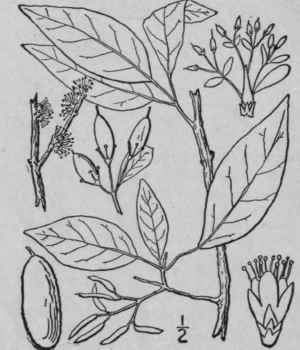
1. Forestiera Acuminata (Michx.) Poir. Adelia
Fig. 3323
Adelia acuminata Michx. Fl. Bor. Am. a: 225. pl. 48.
1803. Forestiera acuminata Poir. in Lam. Encycl. Suppl. 2:
664. 1811.
A shrub or small tree, sometimes reaching a height of 300 and a trunk diameter of 8', the branches somewhat spiny, the foliage glabrous. Leaves ovate, lanceolate or oblong, acuminate or acute at both ends, finely denticulate, 1'-4' long, 1/2'-2' wide; petioles slender, 4"-12" long; staminate flowers fascicled; pistillate flowers short-paniculate; calyx obsolete; drupe narrowly oblong when mature, about 1/2' long, when young fusiform and often curved.
River-banks, Indiana to Georgia, west to Missouri, Arkansas and Texas. Wood heavy, soft, not strong, yellowish brown; weight per cubic foot 40 lbs. March-April.
Continue to:


My Books

