
![previous page: 30. Rosa [Tourn.] L. Sp. Pl.491. 1753. Part 2](../../../images/nav/page_prev.gif)

![next page: 30. Rosa [Tourn.] L. Sp. Pl.491. 1753. Part 4](../../../images/nav/page_next.gif)
30. Rosa [Tourn.] L. Sp. Pl.491. 1753. Part 3
Description
This section is from the book "An Illustrated Flora Of The Northern United States, Canada And The British Possessions Vol2", by Nathaniel Lord Britton, Addison Brown. Also available from Amazon: An Illustrated Flora of the Northern United States, Canada and the British Possessions. 3 Volume Set..
30. Rosa [Tourn.] L. Sp. Pl.491. 1753. Part 3
4. Rosa Pratincola Greene. Arkansas Rose
Fig. 2310
Rosa pratincola Greene, Pittonia 4: 13. 1899.
Erect, low, 1°-2° high. Stems densely prickly with very slender bristles; infrastipnlar spines none; stipules rather narrow, sometimes toothed above; leaflets 7-11, oval or obovate, sessile or nearly so, obtuse at the apex, narrowed or often cuneate at the base, seldom over 1' long, simply and sharply serrate, glabrous on both sides; flowers corymbose or rarely solitary, about 2' broad; sepals lanceolate, acuminate, sparingly glandular-hispid or glabrous, or sometimes lobed, persistent and spreading or reflexed; styles distinct; fruit globose or nearly so, 4"-6" in diameter, glabrous or bristly.
Prairies, Manitoba to Minnesota, Iowa, Missouri, Nebraska, Colorado, Texas and New Mexico. June-July. Confused in our first edition with Rosa arkansana Porter.
Rosa spinosissima L., scotch rose, with densely prickly stems, small roundish leaflets glabrous or nearly so, small pinkish or white flowers and globose black fruit, is locally escaped from cultivation. It is native of Europe and Asia.
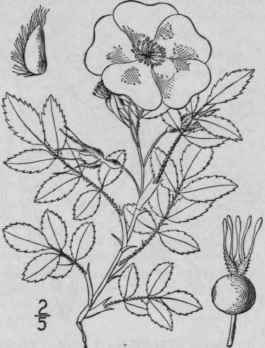
5. Rosa Woódsii Lindl. Woods' Rose
Fig. 2311
Rosa Woodsii Lindl. Mon. Ros. 21. 1820.
Rosa Fendleri Crepin, Bull. Soc. Bot. Belg. 15: 91. 1876.
Low, bushy, 1°-3° high, armed with slender mostly straight spines, or naked above. Infrastip-ular spines commonly present; stipules rather broad, entire; leaflets 5-9, oval or obovate, short-stalked or sessile, obtusish at the apex, narrowed or cuneate at the base, 5"-18" long, simply and sharply serrate, somewhat glaucous beneath; flowers 1'-2' broad, corymbose or solitary, short-pedicelled; sepals lanceolate, acuminate, laterally lobed or entire, erect and persistent on the fruit; styles distinct; fruit globose or globose-ovoid, 4"-5" in diameter, glabrous, sometimes glaucous.
Pra'ries, Minnesota to Missouri, the Northwest Territory, New Mexico and Colorado. June-July.
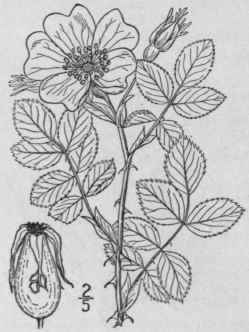
6. Rosa Canina L. Dog Rose. Canker Rose. Wild Brier. Hip-Tree Or -Rose
Fig. 2312
Rosa canina L. Sp. Pl. 491. 1753.
Branches erect or straggling, sometimes 10° long, armed with stout short hooked spines, not bristly but sometimes glandular. Stipules broad, glandular; leaflets 5-7, ovate or oval, rather thick, generally obtuse at each end, usually simply and sharply serrate, sometimes pubescent beneath, glabrous or nearly so above, 1'-l 1/2' long; flowers solitary or few, pink varying to white; calyx-lobes much lobed, lanceolate, reflexed; styles distinct; fruit long-ovoid, 6"-9" long, usually glabrous.
In waste places, especially along roadsides, Nova Scotia to western New Jersey and eastern Pennsylvania, Virginia and Tennessee. Naturalized or adventive from Europe; native also in northern Asia. Cat-whin. Canker-blooms (Shakspere). Bramble-brier or brere-rose. Lawyers (i. e. an old thorny stem). Soldiers. Hedge-peak. Dog-thorn. Horse-bramble. Bird-brier. Bedeguar. June-July.
Continue to:


My Books

