


7. Oenothera L. Sp. Pl. 346. 1753. Continued
Description
This section is from the book "An Illustrated Flora Of The Northern United States, Canada And The British Possessions Vol2", by Nathaniel Lord Britton, Addison Brown. Also available from Amazon: An Illustrated Flora of the Northern United States, Canada and the British Possessions. 3 Volume Set..
7. Oenothera L. Sp. Pl. 346. 1753. Continued
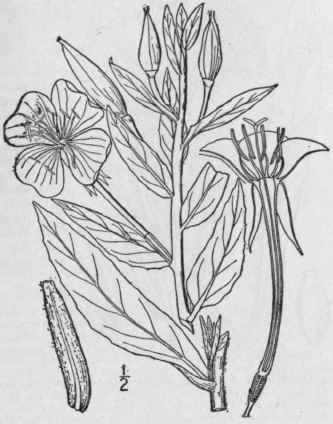
2. Oenothera Biennis L. Common Evening-Primrose. Night Willow-Herb
Fig. 3038
Oenothera biennis L. Sp. Pl. 346. 1753.
Erect, generally stout, biennial, simple and wand-like or branched, 1°-6° high, more or less hirsute-pubescent, rarely gla-brate. Leaves lanceolate to ovate-lanceolate, acute or acuminate, narrowed and sessile at the base or the lowest petioled, repand-denticulate, 1'-6'long; flowers opening in the evening, 1'-2 1/2' broad; calyx-tube slender, much longer than the ovary, the lobes linear, contiguous at the base, re-flexed; capsules oblong, narrowed above, erect, pubescent, 3/4'-1 1/2' long, 2 1/2"-3" thick, nearly terete, longer than the deciduous upper bracts.
Usually in dry soil, Labrador to Florida, Minnesota, Arkansas and Texas. Large tampion. Tree-primrose. Four-o-clock. Coffee- or fever-plant. King's-cure-all. Scurvish or scab-ish. June-Oct.
Oenothera grandiflòra Ait., of the Gulf States, is taller and has much larger flowers, up to 4' broad. Large-flowered races of the preceding species have been mistaken for it.
Oenothera Lamarckiàna Ser., a large-flowered plant, in some features intermediate between O. biennis and O. grandiflora, not definitely known in the wild state, but frequently cultivated, apparently originated in Old World gardens over one hundred years ago.
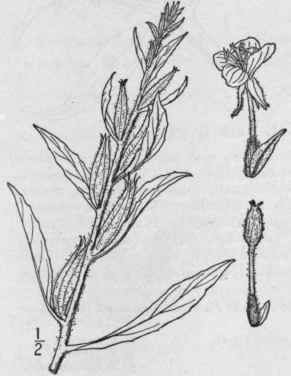
3. Oenothera Muricàta L. Northern Evening-Primrose
Fig. 3039
Oenothera muricata L. Syst. Ed. 12, 263. 1767.
Similar to the preceding species, usually simple, 3° high or less, the stem puberulent and with longer hairs enlarged at the base. Leaves lanceolate, mostly narrower than those of O. biennis, entire, or slightly repand-denticulate; flowers l'-2' broad; capsules hirsute, narrowly oblong-cylindric, about 1' long, shorter than the persistent bracts.
Sandy and gravelly soil, Newfoundland to southeastern New York and New Jersey. July-Sept.
4. Oenothera Oakesiàna Robbins. Oakes' Evening-Primrose
Fig. 3040
Oenothera biennis var. Oakesiana A. Gray, Man. Ed.
5, 178. 1867. Oenothera Oakesiana Robbins; S. Wats. Bibl. Index 1: 383. 1878. Onagra Oakesiana Britton, Mem. Torr. Club 5: 233.
1894.
Resembling the two preceding species, usually annual, dull green, pubescent with appressed velvety hairs. Stem 1°-4° tall, mostly simple; leaves narrow, the basal narrowly oblanceolate, 3'-10' long, the cauline lanceolate or linear-lanceolate, all acute, distantly dentate, sessile or shorf-petioled; flowers yellow, nocturnal, l'-1 1/2' broad; spikes 4'-2o' long; calyx villous, its tube about l' long, its segments linear-lanceolate, one-half as long as the tube, rather prominently ap-pendaged below the tip; petals obovate, 1/2'-3/4' long; capsule linear-pyramidal, gradually narrowed to the summit, 1 1/4'-1 1/2' long, 4-sided, curved; seeds prismatic, about 1" long, the faces reticulated.
Sandy soil, Massachusetts to Long Island. Summer.
Oenothera strigòsa Rydb. (O. canovirens Steele), of the Central States, ranging eastward to Illinois; resembles O. Oakesiana but has some long hairs and unappendaged calyx-segments. It may not be distinct from O, biennis.

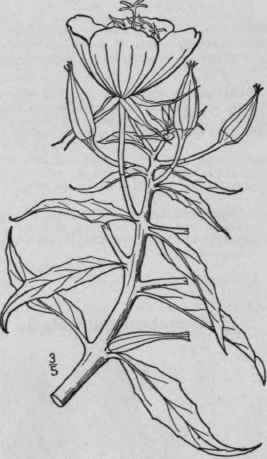
5. Oenothera Argillicola Mackenzie. Narrow-Leaved Evening-Primrose
Fig. 3041
Oe. argillicola Mackenzie, Torreya 4: 56. 1904.
Onagra argillicola Mackenzie, Torreya 4: 57. 1904.
Stems several from the same root, finely puberu-lent, 3°-4 1/2° high. Rosette-leaves oblanceolate, 2 1/2'-6' long, 8" wide or less, acute, sinuate, tapering into long petioles; stem-leaves linear-lanceolate, 2 1/2'-3 1/2' long, glabrous, or slightly puberulent; calyx-tube very slender, glabrous, 1 1/4'-1 3/4' long; petals obcordate, crenulate, 1 1/4'-1 3/4' long; capsules glabrous, gradually tapering upward from the base, about 1' long.
In rocky soil, Virginia and West Virginia. July-Sept.
Continue to:


My Books

