


9. Tissa Adans. Fam. Pl. 2: 507. 1763
Description
This section is from the book "An Illustrated Flora Of The Northern United States, Canada And The British Possessions Vol2", by Nathaniel Lord Britton, Addison Brown. Also available from Amazon: An Illustrated Flora of the Northern United States, Canada and the British Possessions. 3 Volume Set..
9. Tissa Adans. Fam. Pl. 2: 507. 1763
[Buda Adans. Fam. Pl. 2: 507. 1763.]
[Spergularia Pers. Syn. 1: 504. 1805.]
Low annual or perennial herbs, mostly with fleshy linear or setaceous leaves, often with others clustered in the axils, and small pink or whitish flowers in terminal racemose bracted or leafy cymes. Stipules scarious. Sepals 5. Petals the same number, rarely fewer, or none, entire. Stamens 2-10. Ovary I-celled, many ovuled; styles 3. Pod 3-valved to the base. Seeds reniform-globose or compressed, smooth, winged or tuberculate. [Name unexplained.]
About 20 species, of wide geographic distribution, most of them inhabitants of saline shores or salt marshes. Type species: Arenaria rubra L.
Species of salt marshes or sea beaches; leaves very fleshy. | ||
Pedicels 1 I/2-2 times the length of the sepals; flowers pink. | 1. | T. marina. |
Pedicels 2-4 times the length of the sepals; flowers pale or white. | 2. | T. canadensis. |
Species mostly of dry sandy soil; leaves scarcely fleshy. | 3. | T. rubra. |
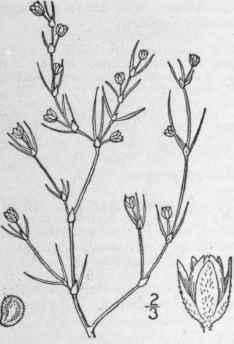
I. Tissa Marina (L.) Britton. Salt-Marsh Sand Spurry
Fig. 1795
Arenaria rubra var. marina L. Sp. Pl. 423. 1753. Spergularia salina Presl, Fl. Cech. 95. 1819. Buda marina Dumort. Fl. Belg. no. 1827. Spergularia media A. Gray, Man. Ed. 5, 95. 1867. Tissa marina Britton, Bull. Torr. Club 16: 126. 1889. Buda marina var. minor S. Wats. in A. Gray, Man. Ed. 6, 90. 1890.
Annual or biennial, erect, ascending or nearly prostrate, 4'-8' high, freely branching, glabrous or glandular-pubescent. Stipules ovate; leaves linear, terete, very fleshy, 1/2'-1 1/2' long, 1/2"-1" wide, often much fascicled in the axils; pedicels spreading or ascending, 2"-5" long; flowers numerous, pink; sepals ovate, acute or obtuse, 1"-3" long; capsule a little longer than the calyx; seeds smooth, or roughened with projecting processes, wingless or winged.
In salt marshes, New Brunswick to Florida and locally in the interior. Also in those of the Pacific Coast, and of Europe and northern Asia. Sea-side or bed-sandwort. Summer.
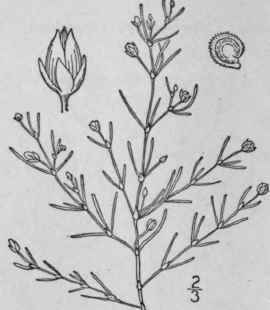
2. Tissa Canadénsis (Pers.) Britton. Northern Sand Spurry
Fig. 1796
Arenaria canadensis Pers. Syn. I: 504. 1805.
Tissa salina Britton Bull. Torr. Club 16: 127. 1889.
Not Spergularia salina Presl. Buda borealis S. Wats, in A. Gray, Man. Ed. 6, 90. 1890. Tissa canadensis Britton, Mem. Torr. Club 5: 152. 1894.
Annual, slender, diffuse and spreading, entirely glabrous, 2'-$' high. Leaves linear, fleshy, teretish, 5"-8" long, mainly obtuse, generally simply opposite and not fascicled; stipules broadly ovate; pedicels slender, spreading, 3"-6" long, at length much exceeding the calyx; sepals 1" long; flowers pale or white; capsule twice the length of the calyx; seeds smooth or papillose, usually wingless.
On muddy shores, Labrador to Rhode Island. Bed-sandwort. Summer.
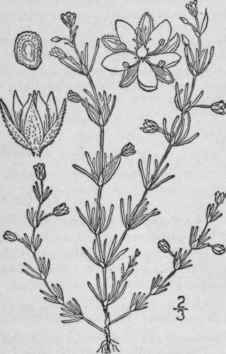
3. Tissa Rùbra (L.) Britton. Sand Spurry. Purple Sandwort
Fig. 1797
Arenaria rubra L. Sp. Pl. 423. 1753. Buda rubra Dumort. Fl. Belg. no. 1827. Spergularia rubra Presl, Fl. Cech. 93. 1819. Tissa rubra Britton, Bull. Torr. Club 16: 127. 1889.
Annual or biennial, depressed or ascending, very leafy up to the inflorescence, glabrous or sparingly glandular-pubescent above, 2'-6' high, often forming dense little mats. Leaves linear, flat, scarcely fleshy, 2"-4" long; flowers bright pink, 1"-1 1/2"broad; stipules ovate-lanceolate, acuminate; sepals ovate-lanceolate, acutish; pedicels slender, spreading, 2"-4" long; pods about equalling the calyx; seeds wingless, rough with projecting points.
In waste places and along roadsides, or sometimes maritime, Nova Scotia to Pennsylvania, western New York, Ohio and Virginia. Apparently adventive from Europe in large part, but perhaps indigenous northward. Also introduced in California and Oregon. Native of Europe and Asia. Bed-sand-wort. Summer.
Continue to:


My Books

