


Ammiaceae Presl, Delic. Prag. 1. 1822. Carrot Family. Continued
Description
This section is from the book "An Illustrated Flora Of The Northern United States, Canada And The British Possessions Vol2", by Nathaniel Lord Britton, Addison Brown. Also available from Amazon: An Illustrated Flora of the Northern United States, Canada and the British Possessions. 3 Volume Set..
Ammiaceae Presl, Delic. Prag. 1. 1822. Carrot Family. Continued
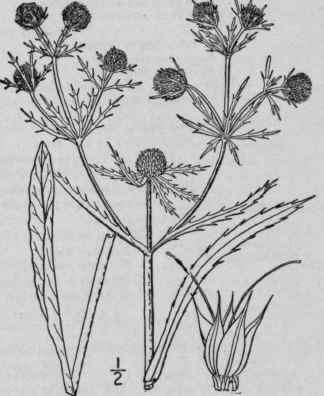
1. Eryngium Aquàticum L. Rattlesnake-Master. Button Snakeroot
Fig. 3096
Eryngium aquaticum L. Sp. Pl. 232. 1753.
E. yuccaefolium Michx. Fl. Bor. Am. 1: 164. 1803.
Stout, 2°-6° high, glabrous; stem sriate, simple, or branched above. Leaves elongated-linear, acuminate at the apex, mostly clasping at the base, finely parellel-veined, the lower sometimes 3o long and 1 1/2' wide, the upper smaller, all with bristly margins, the bristles rather distant; heads stout-peduncled, globose-ovoid, 6"-10" long, longer than the ovate or lanceolate cuspidate bracts; bractlets similar to the bracts but smaller; calyx-lobes ovate, acute; fruit scaly, about 1" long.
In wet soil or upland, Connecticut to New Jersey, Illinois, South Dakota, Florida, Kansas and Texas. The name aquaticum is properly applied to this species, ascertained by a study of the Linnaean type specimen. June-Sept. Water-eryngo. Corn-snakeroot. Rattlesnake-flag or -weed.
2. Eryngium Virginiànum Lam. Virginian Eryngo
Fig. 3097
E. virginianum Lam. Encycl. 4: 759. 1797.
Stem slender, erect, glabrous, branched above, striate, 1°-3° high. Upper stem-leaves linear, acuminate, sessile and clasping at the base, 2'-8' long, spiny-toothed or rarely lacin-iate, reticulate-veined; basal and lower leaves long-petioled, the blade linear-oblong, often obtuse, entire, or remotely denticulate; heads subglobose, 4"-7" long, equalling or shorter than the lanceolate spiny-toothed or entire reflexed bracts; bractlets usually 3-cuspidate with the middle cusp longest; calyx-lobes lanceolate, cuspidate; fruit scaly.
In marshes near the coast, New Jersey to Florida, west to Texas. July-Sept.
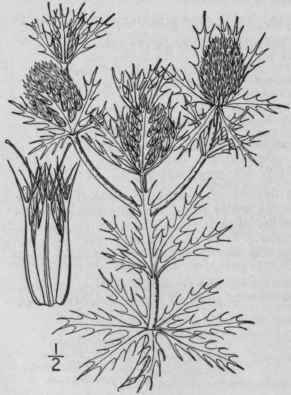
3. Eryngium Leavenwórthii T. & G. Leavenworth's Ervngo
Fig. 3098
E. Leavenworthii T. & G. Fl. N. A. 1: 604. 1840.
Stout, glabrous, 1°-3° high, branched above. Stem-leaves sessile, or somewhat clasping at the base, palmately pinnatifid into narrow spiny-toothed segments; basal and lowest leaves ob-lanceolate, mostly obtuse, spinose-denticulate; heads peduncled, ovoid-oblong, 1'-2' long, nearly 1' thick, equalling or longer than the spinose bracts; bractlets 3-7-cuspidate, those of the upper part of the heads large and resembling the bracts; calyx-lobes pinnatifid, longer than the fruit.
In dry soil, Kansas and Arkansas to Texas. July-Oct. Briery thistle.
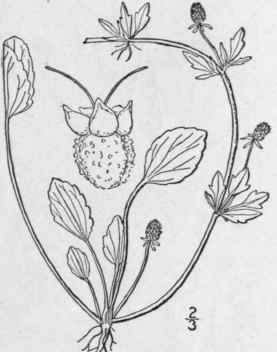
4. Eryngium Prostràtum Nutt. Prostrate Eryngo
Fig. 3099
Eryngium integrifolium Walt. Fl. Car. 112. 1788?
E. prostratum Nutt.; DC. Prodr. 4: 92. 1830.
Prostrate, diffusely branched, rooting from the nodes, the branches very slender, sometimes 18' long. Lower and basal leaves slender-petioled, oval or oblong, mostly obtuse, entire, or crenate-dentate; stem-leaves smaller, often clustered at the nodes, ovate, few-toothed, or entire or some of them 3-parted; heads ovoid-oblong, dense, about 3" long, mostly shorter than the lanceolate reflexed bracts; bractlets very small; fruit about i" long, tuberculate.
In low grounds, Kentucky to Missouri, south to Florida and Texas. Summer.
Continue to:


My Books

