


Estimation Of Small Amounts Of Benzene In Alcohol
Description
This section is from the book "Alcohol, Its Production, Properties, Chemistry, And Industrial Applications", by Charles Simmonds. Also available from Amazon: Alcohol: Its Production, Properties, Chemistry, And Industrial Applications.
Estimation Of Small Amounts Of Benzene In Alcohol
The following method is due to Holde and Winterfeld.1
1 Chein. Zeit., 1908, 32, 313; (Abst.) Analyst, 33, 242,
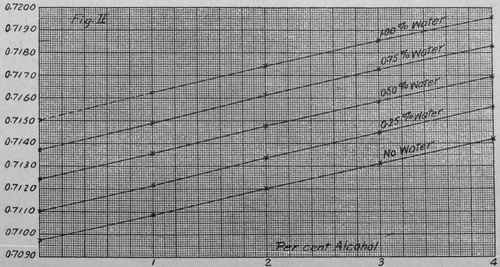
Fig. 31.- graph for ether, alcohol, and water mixtures (Perkin).
It is based upon the fact that on distillation the whole of the benzene passes over in the first 10 per cent. of the distillate, and appears as an oily layer floating on the surface.
One hundred c.c. of the alcohol under examination, diluted with sufficient water to bring the alcoholic strength to 24.7 per cent. by weight, are distilled, and the first 10 c.c. of the distillate collected in a flask cooled with ice-cold water. On diluting this distillate with 10 to 20 c.c. of water and transferring it to a measuring cylinder or a burette, the proportion of separated benzene may be read directly. The benzene remaining dissolved in the turbid lower layer amounts to about 0.3 per cent. by volume, and is practically constant whether the original quantity of benzene be 0 5 or 5 per cent.
A modification of this method, due to Wolff,1 can be used for the determination of ether in alcohol, as well as benzene.
One hundred c.c. of the sample are diluted until the specific gravity is 096, and distilled into a graduated cylinder (100 c.c. capacity) until 20 c.c. have been collected. The delivery-tube of the condenser should dip at least 3 cm. into the cylinder.
To the distillate 80 c.c. of a concentrated sodium chloride solution are added, the mixture shaken vigorously twenty times, and allowed to stand. The volume of the upper layer gives the proportion of ether (or benzene) in the sample.
Bubbles of ether entrained by the sodium chloride are easily freed by turning or tapping the cylinder. The error of experiment is usually less than 0 5 per cent. If the alcohol contains more than about 12 to 13 per cent, of ether, 50 or 25 c.c. are taken for distillation, instead of 100 c.c.
Continue to:


My Books

