


Practical Yield of Alcohol From Different Raw Materials
Description
This section is from the book "Alcohol, Its Production, Properties, Chemistry, And Industrial Applications", by Charles Simmonds. Also available from Amazon: Alcohol: Its Production, Properties, Chemistry, And Industrial Applications.
Practical Yield of Alcohol From Different Raw Materials
Assumed content of starch or sugar. | Gallons of absolute alcohol produced per ton. | Percentage of theoretical yield. | |
Cane molasses ............ . | 57.7% total sugars (as dextrose). | 69 | 83 |
Beet molasses.................. | 50% sucrose. | 63 | 83 |
Potatoes.............................. | 20% starch. | 30* | 77* |
Beet roots .... | 15.4 sucrose. | 20 | 87 |
Maize........................................ | 60% starch and sugar with 8% of malt. | 84 | 87 |
Rice................................. | 75% starch. | 80 to 90 | - |
Wood sawdust ........... | - | 28 to 45 | - |
Nipa-palm sap ............. | 14-16% sucrose. | 5-6% by volume. | 74 |
* Given thus in the original, but one or other of the numbers is incorrect.
1 Enzyklop. der Techn. Chemie, I, 752.
2 J. Soc. Chem. Ind. 1915, 34, 338.
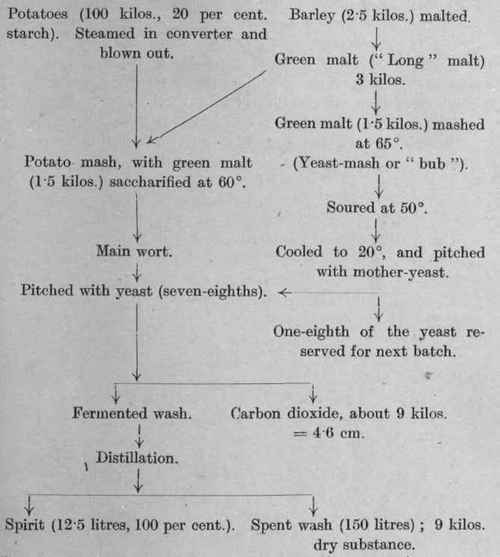
H. Ost1 gives the following scheme showing the operations in a distillery using potatoes: -
The "Amylo"-process of fermentation. - It has already been mentioned under "Yeast" (p. 56) that certain of the moulds secrete amylase (diastase) and also fermentation-enzymes. This property has been utilised in a process of combined saccharification and fermentation, whereby the use of malt is dispensed with in obtaining alcohol from starchy materials. The method in question is employed on a large scale in Belgium, France, Hungary, Italy, and Spain.
The mould originally employed was the mucor Amylomyces Rouxii, from which the "amylo"-process took its name. This organism, however, was later on supplanted by other moulds,
1 Lehrb. Chem. Technologie, 1914, p. 528.
Mucor-β, Mucor-γ, and Rhizopus Delemar, which were found to produce less acid than A. Rouxii.
In addition to obviating the use of malt, another feature of the process is the adoption of pure-culture principles for the operations. The mash is sterilised, and the conversion and fermentation are carried out in closed vessels. As regards this, however, it may be noted that a special culture mould (Mucor Boulard No. 5) has recently been introduced, which is stated to act so vigorously that there is no longer any necessity for the adherence to aseptic conditions: bacterial development is suppressed when this organism is used.
Calmette isolated A. Rouxii in 1892 from Chinese rice-ferment, and he, with M. Boidin, worked out the industrial process, which was first tried at a distillery near Lille in 1898.
Although the moulds employed can not only convert gelatinised starch into dextrose, but can ferment this sugar into alcohol, the fermentation stage is a slow one. Hence, in practice, yeast is added in order to hasten and complete the fermentation. The yeast generally employed is Saccharomyces anamensis ("Annamite" yeast), which acts best at the same temperature as that at which the moulds develop, namely, 35-38°.
The chief materials used for mashing are maize, rice, potatoes, manioc, dari, and millet. A mash of sp. gr. about 1 060 is prepared by steaming the material under pressure, in essentially the same manner as already described under "Mashing."
The fermenting vessel is a vertical iron cylinder with dome-shaped ends, closed, and of capacity about 22,000 gallons, or more. An outlet is provided at the bottom for the fermented mash. This outlet serves also for passing in a current of aseptic air during the early stages of the fermentation. Near the top is an inlet for the steamed mash, a vent for escape of air and carbon dioxide, and tubules which allow of the introduction of the mould-culture and the yeast, as also of the withdrawal of samples to observe the progress of the operations.
The hot mash having been passed from the steamer or "cooker" into the fermenting vessel, a current of air, filtered through sterilised cotton wool to free it from micro-organisms, is injected into the mash whilst the latter cools, since the mould requires a certain amount of oxygen for its proper development. The cooling is done by running water down the outside of the vessel from a perforated tube passing round the top: it requires ten or twelve hours with a vessel of the size mentioned. When the temperature is down to 40°, the mash is inoculated with the mould, of which a culture has been prepared by growing the organism on sterilised rice until a copious production of spores is obtained. The spores are distributed in sterilised water and the mixture added to the mash, precautions against bacterial infection being taken during the addition.
The current of air keeps the mash in motion, and the spores are soon distributed throughout the starchy material. They develop very rapidly, and in the course of twenty to twenty-four hours the mash is permeated by the growing mycelium. No saccharification goes on during this first stage, whilst the mould is developing. After about twenty-one hours, however, the conversion of starch into sugar begins; and at the end of another eight hours or so, when the saccharification is well under way, the requisite quantity of yeast is added.
About twenty-four hours are required for the yeast to develop sufficiently to set up a vigorous fermentation. The current of air is then stopped, and the operation proceeds until the fermentation is complete and the wash ready for distillation. In this later stage, the two processes of saccharification and fermentation go on side by side, the mould finishing the transformation of the starch into sugar, and the yeast converting the sugar into alcohol. About four days are required for the saccharifying and fermenting operation, but this time can be shortened by employing a "bub" of the mould.1
Advantages claimed for the amylo-process are a better yield of alcohol, a purer product, and economy of malt, as compared with the ordinary method. Since the conditions of working exclude bacterial contamination, there are no bacterial side-fermentations, and the spirit contains fewer impurities - less foreshots and tailings, and less fusel oil. As regards the malt, a single gram of the mould suffices to convert 25 tons of maize. Compared with operations where 10 or 12 per cent, of malt is used, when this 1 gram of mould is employed there is a saving of about 3 tons of malt, and, in addition, of another ton of starch which is used up and lost in making that quantity of malt.
Some published figures show a yield in the amylo-process of 40 5 litres of alcohol per 100 kilos, of maize, and 42.3 litres per 100 kilos of rice, equivalent, respectively, to 7.92 and 827 gallons of proof spirit per cwt.2
There is a legal obstacle to the use of the amylo-process in this country. It is a statutory requirement that the specific gravity of distillers' wort before fermentation shall be ascertained by means of the saccharometer, and this, as will be gathered from the description given, is impracticable in the amylo-process. That such an obstacle exists is unfortunate. It prevents advantage being taken of any benefits which the process may offer, or of any developments to which it may give rise. In short, it impedes progress.
1 O. Grove, J. Inst. Brewing, 1914, 20, 248.
2 Grove, loc. cit., p. 259.
Continue to:


My Books

