


Synthesis Of Alcohol. Continued
Description
This section is from the book "Alcohol, Its Production, Properties, Chemistry, And Industrial Applications", by Charles Simmonds. Also available from Amazon: Alcohol: Its Production, Properties, Chemistry, And Industrial Applications.
Synthesis Of Alcohol. Continued
The views of the three microscopists, however, were very strongly contested by the most distinguished chemists of the period - Berzelius and von Liebig. Berzelius regarded fermentation as a catalytic process. On Liebig's view, ferments are unstable nitrogen-containing substances, formed by the action of air upon plant juices containing sugar. These easily-decomposable ferments are in a condition of constant degradation or decay; by their decomposition a corresponding chemical motion is imparted to the atoms of the sugar; and thus the sugar is itself decomposed, with production of alcohol. This, it will be seen, embodies Stahl's theory.
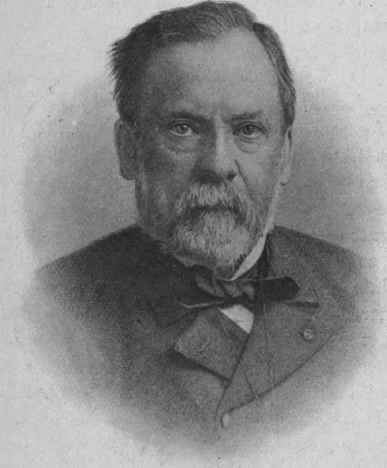
Fig. 13. - louis pasteur, 1822-1895.
1 Ann. Chim. Phys., 1838, 68, 206.
2 Pogg. Ann., 1837, 41, 184.
A sort of reconciling link between the two opposed views - the vitalistic and the chemical - was put forward by Mitscherlich (1841). He regarded fermentation as produced by a vegetable organism (yeast), but through a sort of contact-action, not through the vital activities of the yeast.
By about the middle of the century more and more evidence had accumulated in favour of the vegetative nature of yeast, and even Berzelius had now become satisfied of this. Liebig's authority, however, was very great in the scientific world, and opinion was still divided between the vitalistic and the purely chemical theory of fermentation.
Eventually, through Pasteur's researches, the former view prevailed. Liebig's theory - that yeast arises by the action of atmospheric oxygen on some special nitrogenous constituent of the fermenting liquid - Pasteur disproved by growing a crop of yeast in a synthetic culture medium containing an ammonium salt as the sole nitrogenous constituent. Also he showed that whenever fermentation occurred there was a simultaneous growth of yeast in the liquid. Moreover, alcohol and carbon dioxide were not, as Liebig had assumed, the only products of fermentation; succinic acid and glycerol were also produced. Pasteur showed. further, that each kind of fermentation (alcoholic, lactic, butyric, etc.) required its special kind of micro-organism. Alcoholic fermentation, he concludes, is an act correlated with the life and organisation of the yeast-cells, not with their,death and decay. Nor is it a mere contact-phenomenon, for then the transformation of the sugar would take place without anything being either given up to the yeast or taken away from it; whereas experiment showed definitely that something was given up to the yeast by the sugar. "No fermentation without life," was Pasteur's verdict. But he also said: "If I am asked in what consists the chemical act whereby the sugar is decomposed and what is its real cause, I reply that I am completely ignorant of it."
Later on, the aphorism, "no fermentation without life," proved to be, in strictness, untenable. The idea that alcoholic fermentation was due to an enzyme elaborated by the yeast-cell, and not immediately to the life-processes of the cell itself, had been put forward by Traube as early as 1857. Liebig himself had referred to the possibility, and Pasteur saw no objection to it.1 No satisfactory evidence of this, the true explanation, was, however, forthcoming until towards the close of the century, when Buchner, as mentioned later on, succeeded in supplying the proof. But the aphorism is only too wide by a single stage. " Without life no enzymes, and without enzymes no fermentation ' would be true, so far as our present knowledge goes.
1 See "Studies on Fermentation," p. 327 (English edition, 1879).
Pasteur's work, however, was fundamental, and of much wider import than the settlement of this particular controversy. It has had an outstanding influence upon the development of the brewing and distilling industries. Not only so; it was destined to have a far-reaching effect upon the welfare of the whole human race, and to this aspect of the matter a few words may now be specially devoted.
In 1854, Pasteur was appointed Dean of the newly-established Faculte des Sciences at Lille, in which town distilling had then become an important industry. About two years later he was consulted by a distiller, M. Bigo, in reference to certain difficulties and disappointments that had been met with in the manufacture of alcohol from beetroot. This fortunate circumstance it was which directed the genius and acumen of Pasteur to those studies of fermentation which have helped to make his name immortal. It is a matter of common knowledge that to Pasteur is due the explanation of alcoholic fermentation as a process correlative with the life and organisation of the yeast-cell. But it is perhaps less generally recognised that by these "Etudes sur la Biere" and "Etudes sur le Vin," and their subsequent ramifications and extensions, the boundaries of natural science have been advanced beyond all that could have been foreseen, and that incalculable benefits have thereby been conferred upon humanity. Pasteur's researches upon alcoholic fermentation, at first concerned with the "maladies" of beer, wine, and vinegar, led directly to the more definitely pathological investigations of silkworm disease and anthrax. The proof that these are bacterial ailments was followed by the production of ' vaccines," and by those further studies of infectious diseases and the nature of immunisation which have had so enormous an influence upon the development of medicine, surgery, and sanitation. Pasteur's later work was the direct outcome of his researches on alcoholic fermentation; it was in large measure rendered possible by the experience and technique acquired in those researches; and it laid the foundation of the subsequent wonderful developments which have taken place in the spheres of preventive medicine and hygiene. "Modern surgery, like preventive medicine, is a child of the fermentation industries."1
1 Dr. H. T. Brown, J. Inst. Brewing, 1916, 22, 301.
Nor was this result a mere lucky consequence, accidental and unexpected. Pasteur, at all events, foresaw the possible future application of his new ideas to the etiology of infectious and contagious diseases. "Man has it in his power to cause parasitic diseases to vanish from the face of the earth," he wrote in his studies of the silkworm disease. He foresaw this possibility, and he laboured towards its attainment; and on the foundations which he laid, developed and extended by other workers, the whole superstructure of modern bacteriology has been erected.
If the abuse of alcohol as a beverage has been fraught with much misery to the world, on the other side of the account may well be put the indisputable and inestimable benefits which have accrued to the human race through the reduction or elimination of disease by discoveries which had their origin in the study of alcoholic fermentation.
Of the developments which have occurred since Pasteur's researches, Buchner's account of "Alcoholic Fermentation without Yeast-cells," published in 1897, is one of the outstanding phases.1 It is so, because of the evidence it affords that fermentation is not, or is not necessarily, a direct outcome of the vital action of yeast-cells, but rather a chemical action due to an intermediate, nonliving product (enzyme) first elaborated by the living cell, but separable from it. Buchner proved that juice pressed out from yeast, and containing none of the cells, can induce alcoholic ferment a tion in solutions of sugar, and that during the process there is no growth of yeast-cells in these solutions. Further important studies of the enzymes, leading to suggestive theories as to their mode of action, their molecular correspondence with the substances they act upon (Fischer's "lock and key ' analogy), and their bearing upon the mechanism of immunisation from disease (Ehrlich) are of wide general interest; but they belong to the domain of physiology rather than to that of alcohol production. One further name, however, may be mentioned here, namely, that of E. C. Hansen, who from the year 1879 onwards investigated the life-history of individual alcohol-producing yeasts, and developed the method of procuring a pure yeast by cultivation from a single mother-cell.
Recalling the numerous developments in science and industry which directly or indirectly have followed from the study of alcoholic fermentation; remembering their present importance, and realising their implications of future progress; we may justifiably acquiesce in, and indeed applaud, the remark of the enthusiast: Omnis scientia ex cerevisia.
1 Ber., 1897 to 1900; vols. 30 to 33.
Continue to:


My Books

