


Traditional Types
Description
This section is from the book "A Manual Of Home-Making", by Martha Van Rensselaer. Also available from Amazon: A Manual of Home-Making.
Traditional Types
It may truly be said that the problem of the American farm-house is still unsolved. For the building of new appropriate farm dwellings, there is almost no precedent to guide one. Most of the rural houses now standing are failures as farm-houses because they were not planned for farm conditions. In fact, many of them were not planned at all. They were merely built, and built in about the following fashion: an outer shell was constructed and roofed over, the inside was divided into rooms, and somewhere a kitchen was attached. If the house became too small, more rooms were added to fit the growing needs of the family. With each addition to the house, the kitchen retreated to the rear of the structure, where, by its very distance from the living-rooms, it confined the housewife to her post of duty. As the family decreased in numbers and helpers became few, the front part of the house was closed and home life was centered within the radius of the kitchen and its activities.
Such of these old structures as are soundly built are worth replanning and equipping with running water, electric light, sound floors, and a good heating system. Alteration should be undertaken only after the complete project has been worked out on paper.
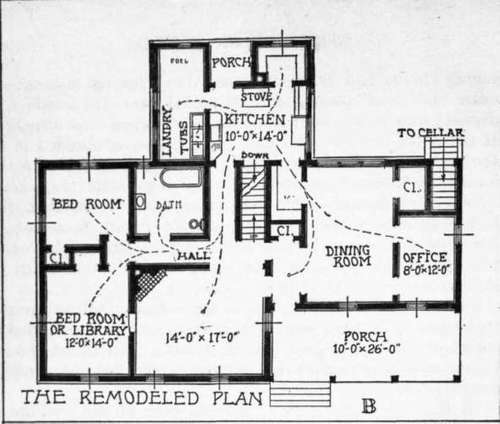
In Fig. 5 is illustrated a rambling plan of the traditional farmhouse of the upright-and-wing type previously described. The original and the remodeled arrangement are shown in A and B, respectively. The main faults of the old plan, A, are two: first, the plan is deficient in correctly located hall space; second, the distance from the kitchen to the front of the house is too great. Since a person must pass through one room in order to reach another, the whole floor virtually becomes a passageway. This condition destroys privacy, interrupts work, and entails much extra cleaning. The correct amount of hall area placed in the heart of the plan would give separate entrance to each room and would save the whole house. Hall space should be regarded as the developer of the plan. If the plan is compactly arranged and the hall centrally placed, great service may be obtained from even a small allowance of hall space. The presence of five, six, or seven doors in a room indicates poor hall-planning, and therefore poor house-planning. It is well to remember that the number of doors in a room diminishes in proportion to the excellence of the plan.
In plan B there is introduced enough central hall area to give direct access to each of the rooms. The kitchen is placed centrally at the rear of this hallway. This brings the kitchen nearer the living rooms and shortens all working distances. If the distances from the center of the kitchen to the center of each room in plans A and B are computed, it is found that the remodeled plan saves an average distance of fifteen feet a round trip over the old plan.
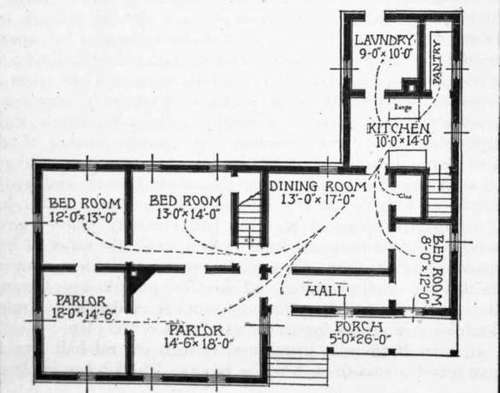
The Old Plan A.
In the remodeled plan, such modern improvements as heat, light, and running water have been added; closets also have been provided. The whole plan is now arranged so as to encourage wholesome living.
Under the old plan the house contained two cellars, one under the square upright and one under the kitchen, with an unexcavated area under the dining-room. A long journey was thereby involved in going from one excavated part to the 'other. The new plan simplified this difficulty by excavating under the dining-room.wing.
A study of new types.
Attention must now be focused on more economical arrangements. The plan of any building is based primarily on its needs. Broadly speaking, family life makes three demands on a house plan: that it shall provide living area, working area, and sleeping area. The living area includes such parts as sitting-room, dining-room, library, office, and porch; the working area includes kitchen, pantry, laundry, hall, and stairs; the sleeping area includes bedrooms and bath. It is the function of a good plan to organize these three elements into a compact arrangement, allowing each requirement an area to itself. Spaciousness must be expressed in the living area, compactness in the working area, and privacy in the sleeping area.
The farm cottage shown in Figs. 6 and 7 aptly illustrates these principles. Here is a compact plan with its three areas clearly defined. In the living area a feeling of spaciousness is obtained by the use of wide doorways and groups of windows through which vistas are seen indoors and out. No interior, however small in actual dimensions, need appear cramped if long vistas are planned for. Good interior design is also evident in Fig. 6. It is indicated by the balanced arrangement of the structural parts of each room. On the rear wall of the living-room is seen a central fireplace flanked by broad doorways of equal width, while the front wall opposite expands into a generous bay window centrally placed, with built-in bookshelves to right and left. These features so unite as to make of the living-room a composition at once so dignified, so orderly, and so effective that little furniture is needed to complete it. In the dining-room, balanced design is expressed by the long flower-box, the bay window, and by the central door on the opposite wall, flanked by diagonal corner features of equal width. In general, diagonal corners should be avoided; except where they are a practical necessity or where they are deliberately used for reasons of design, as in Fig. 8.

Fig. 6. - First floor plan, showing living area and working area.
Of the working area (Fig. 6), the kitchen, pantry, and stairs are the parts most constantly used by the woman of the house. Hence they are compactly grouped and are placed next to the living space. Woodroom and washroom are of intermittent use to the housewife but of constant use to the farmer. Consequently they are placed away from the living rooms in the direction of driveway and barns.

Fig. 7. - Second floor plan, showing sleeping area.


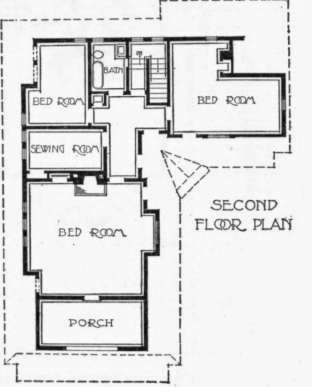
Fig. 8. - A farmhouse plan, showing diagonal corners used deliberately for purpose of design.
The sleeping area provides one bathroom and three bedrooms, each of the latter with its closet. Their position on the second floor renders them quiet and private.
Briefly stated, economy of plan is expressed in the grouped chimney arrangement, in the condensed hall and stair arrangement, and in the small kitchen. The kitchen arrangement is weak, however, in some respects. It has only one outside wall and is therefore lacking in cross-ventilation. Moreover, the position of the door between dining-room and kitchen, being in line with the kitchen range, would surely prove a nuisance from considerations of sight, sound, and smell. It is unfortunate, too, that the path of travel from the rear to the front of the house leads through the kitchen.

Fig. 9. - Plan showing simplicity of living area and completeness of working area.
In Fig. 9 is represented another well-planned farmhouse. It is characterized chiefly by the simplicity of the living area and by the completeness of the working area. Each area occupies about one-half of the floor plan.
The living area is unique and spacious. Instead of two separate rooms, each of which would be small, living-room and dining-room are combined into one large apartment. A group of three glass doors connects this generous living-room with an unusual porch arrangement, called on the plan an "arbored terrace." This terrace, which is cement-paved under foot and vine-covered overhead, is in reality an open-air continuation of the living-room, which adds materially to the comfort of the family in summer. Here meals may be served while sunlight and garden are enjoyed. The position of window groups on both ends of the large room creates a long, unbroken vista, so that all the living space is appreciated all the time.
Centrally placed on the long outer wall of the living-room is a fireplace alcove, or inglenook. This feature increases the actual width of the room and provides two outdoor vistas in new directions. Inglenooks, however, should be used with great reserve unless they are generous in width and develop naturally on the plan. Many times the excellence of an entire plan is sacrificed to the use of a feature of this nature.
The completeness of the working area is best appreciated by observing that each kind of work has its allotted place. The kitchen is intended for cooking; the pantry, for food storage; the pass pantry, for dishes; the woodroom, for fuel; the hall and stairs, for passage; the two recessed porches gather entrance to the house in a common passage that serves all rooms.
The kitchen arrangement shown in Fig. 9 excels that in Fig. 6 in at least three particulars. The introduction of a pass pantry serves to seclude the kitchen from the living-room; good cross-ventilation takes place between the windows over table and sink; and the path of travel from the rear porch to the front of the house does not cross the kitchen.

Fig. 10. - Plan showing well-organized arrangement.
Continue to:


My Books

