


1045. - Potato Flour - 1049. - To Brown Potatoes
Description
This section is from the book "The New Cyclopaedia of Domestic Economy, and Practical Housekeeper", by Elizabeth Fries Ellet. Also available from Amazon: The New Cyclopaedia of Domestic Economy, and Practical Housekeeper.
1045. - Potato Flour - 1049. - To Brown Potatoes
1045. - Potato Flour
Rasp the potatoes into a tub of cold water, and change it repeatedly until the raspings fall to the bottom like a paste; then dry it in the air, pound it in a mortar, and pass it through a hair sieve. It is nearly as nutritive, and much lighter than wheaten flour; it is, therefore, preferable for making puddings and pastry for infants and invalids; a portion of it also improves the appearance of household bread, and dealers constantly pass it off as arrowroot. If kept dry, it will remain good for years.
Jelly is made from the flour; only boiling water must be poured upon it, but care must be taken that it be absolutely boiling or the complete change into jelly will not take place. It does not take many minutes to thus change a raw potato into this substance, which is not only highly nutritive, but extremely agreeable to the palate, when flavored with a little sugar, nutmeg, and white wine.
1046. - Potato-Wall
Or edging, to serve round fricassees, forms also a pretty addition to a corner dish. - Mash in a mortar as many boiled potatoes as you may want, with a good piece of butter; then, with the bowls of two silver spoons, raise a wall of it two and a half inches high within the rim of the dish to be used. Let the upper part be a little thinner than the lower; smooth it; and, after brushing it all over with egg, put it into the oven to become hot and a little colored. Before egging it, the outside may be ornamented with bits of paste cut into shapes.
1047. - To Mash Potatoes
Let them be thoroughly boiled; peel them, and take out all the specks, and little hard lumps which are sometimes found. Beat them till quite fine in a wooden bowl or mortar, or break them thoroughly with a three-pronged fork; sprinkle a little salt, and mix them up smoothly with butter or boiling milk. Take care that the potatoes shall not be too wet, or they will become heavy and watery; great smoothness, lightness, and a rich taste are required in mashed potatoes: if required to be very fine, rub them through a colander or sieve before adding the boiling milk and butter.
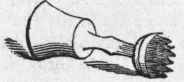
(Potato Masher.)
1048. - Potato-Loayes
Are very nice when eaten with roast beef or mutton, and are made of any portion of the mashed roots, prepared without milk, by mixing with them a good quantity of very finely minced raw shalot, powdered with pepper and salt; then beating up the whole with a little butter to bind it, and dividing it into small loaves of a conical form, and placing them under the meat to brown, that is, when it is so nearly done as to impart some of the gravy along with the fat.
1049. - To Brown Potatoes
While the meat is roasting, and an hour before it is served, boil the potatoes and take off the skins; flour them well, and put them under the meat, taking care to dry them from the dripping, before they are sent to table. The kidney potatoes are best dressed in this way. The flouring is very essential.
Potatoes, when boiled, if either waxy, or to be eaten with cold meat should be peeled and put whole upon the gridiron until nicely browned.
Potatoes should always be toiled a little before being put into stews, etc, as the first water in which they are cooked is of a poisonous quality.
Fried Potatoes may be cut from raw potatoes, pared round and round like an apple; cut them in slices one half inch thick; fry quickly, in plenty of hot fat, and with as little color as possible; dry them well from the grease, and sprinkle with salt. "When nicely done and piled up properly, fried potatoes make a beautiful side dish, which is always eaten with great relish.
Continue to:


My Books

