


Carving
Description
This section is from the book "The New Cyclopaedia of Domestic Economy, and Practical Housekeeper", by Elizabeth Fries Ellet. Also available from Amazon: The New Cyclopaedia of Domestic Economy, and Practical Housekeeper.
Carving
Ladies ought especially to make carving a study; at their own houses, they grace the table, and should be enabled to perform the task allotted to them with sufficient skill to prevent remark or the calling forth of eager proffers of assist ance from good-natured visitors near, who probably would not present any better claim to a neat performance.
Carving presents no difficulties; it requires simply knowledge. All display of exertion or violence are in very bad taste; for, if not an evidence of the want of ability on the part of the carver, they present a very strong testimony of the toughness of a joint or the more than full age of a bird: in both cases they should be avoided. A good knife of moderate size, sufficient length of handle, and very sharp, is requisite; for a lady it should be light, and smaller than that used by gentlemen. Fowls are very easily carved, and joints, such as loins, breasts, fore-quarters, etc. The butcher should have strict injunctions to separate the joints well.
The dish upon which the article to be carved is placed should be conveniently near to the carver, so that he has full control over it; for if far off, nothing can prevent an ungraceful appearance, nor a difficulty in performing that which in its proper place could be achieved with ease.
In serving fish, some nicety and care must be exercised; here lightness of hand and dexterity of management is necessary, and can only be acquired by practice. The flakes which, in such fish as salmon and cod are large, should not be broken in serving, for the beauty of the fish is then destroyed, and the appetite for it injured. In addition to the skill in the use of the knife, there is also required another description of knowledge, and that is an acquaintance with the best parts of the joint, fowl, or fish being carved. Thus, in a haunch of venison, the fat, which is a favorite, must be served with each slice; in the shoulder of mutton there are some delicate cuts in the under part. The breast and wings are the best parts of a fowl, the trail of a woodcock on a toast is the choicest part of the bird. In fish a part of the roe, melt, or liver should accompany the piece of fish served; the list, however, is too numerous to mention here; and, indeed, the knowledge can only be acquired by experience. In large establishments the gross dishes are carved at the buffet by the butler, but in general they are placed upon the table.
Fish is served with a fish-slice, or the new fish-knife and fork, and requires very little carving, care being required, however, not to break the flakes, which, from their size, add much to the beauty of cod and salmon. Serve part of the roe, melt, or liver, to each person. The heads of carp, part of those of cod and salmon, sounds of cod, and fins of turbot, are likewise considered delicacies.
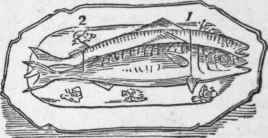
Should be deprived of the head and tail by passing the slice across in the direction of lines 1 and 2; they should then be divided down the back, so as to assist each person to a slice; but if less is required, the thicker end should be given, as it is more esteemed. If the roe is asked for, it will be found between 1 and 2. Barbel, Carp, Haddock, Herring, Perch, Whiting, etc, should be helped the same as Mackerel; remembering that the head of the Carp is esteemed a delicacy.
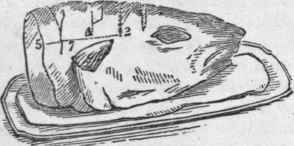
Cod's Head and Shoulders.
Pass the fish-slice or knife from 1 to 6 down to the bone; then help pieces from between 1- 2, and 3 - 4, and with each slice give a piece of the sound, which lies under the back-bone, and is procured by passing the knife in the direction 4-5. There are many delicate parts about the head, particularly the oyster, which is the cheek, below the eye; and a great deal of the jelly kind, which lies about the jaws. The tongue and palate are considered delicacies, and are obtained by passing the slice or a spoon into the mouth.
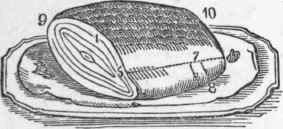
Salmon.
Give a portion of the back and belly to each person, or as desired. If a whole salmon is served, remember that the choice parts are next the head, the thin part is the next best, and the tail the least esteemed. Make an incision along the back, 9 to 10, and another from 1 to 2, and 3 to 4; cut the thickest part, between 5-6. 10-2, for the lean; and 7-8 for the fat. When the fish is very thick, do not help too near the bone, as the flavor and color are not so good.,
Although carving with ease and elegance is a very necessary accomplishment, yet most people are lamentably deficient not only in the art of dissecting winged game and poultry, but also in the important point of knowing the parts most generally esteemed. Practice only can make good carvers; but the directions here given, with accompanying plates, will enable any one to disjoint a fowl, and avoid the awkwardness of disfiguring a joint.
In the first place, whatever is to be carved should be set in a dish sufficiently large for turning it if necessary; but the dish itself should not be moved from its position, which should be so close before the carver as only to leave room for the plates. The carving-knife should be light, sharp, well-tempered, and of a size proportioned to the joint, strength being less required than address in the manner of using it. Large solid joints, such as ham, fillet of veal, and salt beef, cannot be cut too thin; but mutton, roast pork, and the other joints of veal, should never be served in very slender slices.
A Bound (Buttock) Or Aitch-Bone Of Beef
Pare off from the upper part, of either, a slice from the whole surface, of about half an inch thick, and put it aside; then cut thin slices of both lean and fat, in the direction from a to b. The soft fat, which resembles marrow, lies at the back of the aitch-bone, below c, but the firm fat must be cut in slender horizontal slices at a, and is much better than the soft when eaten cold.
Continue to:


My Books

