


Chapter XII. Decanting, Straining, And Filtering Of Liquids
Description
This section is from the book "The New Cyclopaedia of Domestic Economy, and Practical Housekeeper", by Elizabeth Fries Ellet. Also available from Amazon: The New Cyclopaedia of Domestic Economy, and Practical Housekeeper.
Chapter XII. Decanting, Straining, And Filtering Of Liquids
The decanting of liquids is, under ordinary circumstances, an operation sufficiently simple to require no explanation; but the ease and certainty with which it can be performed, depend entirely upon the form of the vessel from which the liquid is poured; the adhesion existing between liquids and solids giving rise to a tendency in the former to run down the outside of the vessel; and if the latter is nearly full, or very large in circumference, or the sides approach the perpendicular direction, this accident almost always occurs. The difficulty of returning a glass of wine to the decanter, or of pouring from one full tumbler into another, are well known examples of this inconvenience.
Advantage may, however, be taken of the adhesion of liquids to solids, and by it the former may be led into the required direction. This cannot be better illustrated than by a description of the means by which a glass of wine may be returned, without spilling, to the decanter. If a teaspoon is dipped into the wine, so as to become wetted with it, and then held perpendicularly with the bowl downwards, and the point over, but not touching, the entrance into the decanter, and the edge of the glass be made to touch the back of the spoon, it will be found, on inclining the former, that the wine, having a perpendicular solid body to adhere to and run down, will do so in preference to trickling along the oblique outer surface of the wineglass; and in this mode a liquid may be poured steadily out of any similar vessel with so little disturbance as not to agitate any sedi-ment that may exist in it. In the laboratory of the chemist, a piece of glass rod is usually employed for this purpose; but a spoon, or pencil, or any similar substance having a surface capable of being wetted by the liquid, answers equally well
If however, the vessel out of which it is wished to decant is large, very full, or the sides, on pouring, are nearly perpendicular, the plan is not successful; thus, it could not be employed in aiding the transfer of the liquid from one full tumbler to another. Even this may be accomplished without the aid of a funnel, or without spilling, by preventing the adhesion of the liquid to the edge or side of the vessel out of which it is poured, which may be readily done by greasing the rim, when it will be found, quite practicable to pour out of a nearly full tumbler without spilling.
In many instances, the employment of a syphon in decanting will be found very advantageous, particularly when the containing vessel is large, and cannot be readily moved, or when there is any sediment which it is desirable not to disturb. The most simple form of this instrument consists of a tube, bent as in Fig. 1, with one leg shorter than the other; this may be made of glass, pewter, or, in fact, of any kind of stiff tubing that will retain its form - a piece of gutta percha pipe, carefully bent by a moderate warmth, whilst a piece of stout cord is in the interior to prevent the sides closing together, answers very well. Before use, the syphon must be filled with liquor; this is best accomplished by turning it upside down, with the opening to the short leg raised on a level with that of the long one, when the liquid should be poured into the former. When both legs are filled, they should be closed with the fingers; the shorter leg introduced into the liquid it is wished to draw off'; and the opening of the longer leg brought to a lower level than that of the shorter, and on removing the fingers the liquid will flow as in Fig. 1, until it is below the level of the short leg. If the syphon is made of small tubing, or is lessened at the opening so as not to exceed one quarter of an inch in diameter, there will be no occasion to close the end of more than one leg with the finger, as the liquid will not flow when it is brought to the proper position unless both orifices are open; and thus the necessity of plunging the finger into the liquid is obviated, and the syphon can also be used with a narrow-necked bottle, into which the hand could not be passed.

Fig. 1.
To do away with the necessity of filling the syphon before use, the instrument is usually made with a sucking tube, as in Fig. 2; in this case, all that is requisite is, to introduce the short leg, close the opening to the long one, and by the action of the mouth, draw up the liquid until both legs are full, when on removing the finger, the stream will flow. A very ingenious syphon of this kind is described by the German chemist Mohr; it is thus constructed:- Take a long Eau de Cologne bottle, and, with a file and turpentine, make a deep notch across, about an inch and a half from the bottom; then, with a charcoal point or pastile, or hot iron produce a crack, and cut off the bottom, grinding it smoothly; then take a tube bent at an angle of forty-five degrees, and, by means of a good cork, perforated with a rat-tail rasp, fit it tightly in the bottom of the bottle, and add also another piece of tubing for a suction tube; the whole will then have the appearance represented in Fig. 3, and will form an exceedingly useful, and very convenient syphon.
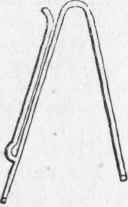
Fig. 2.

Fig. 8.
In emptying large stone bottles or carboys, the following plan may be had recourse to:- Perforate a sound cork with two openings by a rat-tail rasp, and fit, air-tight, two tubes bent as in Fig. 4. On blowing through the upper, the liquid will be forced to ascend and run over the bend of the other, which will then act as a syphon. This plan is exceedingly useful in emptying carboys of corrosive liquids as oil of vitriol, etc.; and if all the joints are - as they should be - air-tight, the flow may be arrested by closing the upper tube with the finger. In the figure the outer leg of the syphon is shortened to save space; in practice it must be of sufficient length to be lower than the inner leg within the vessel.
Continue to:


My Books

