


Daily Work. Continued
Description
This section is from the book "The New Cyclopaedia of Domestic Economy, and Practical Housekeeper", by Elizabeth Fries Ellet. Also available from Amazon: The New Cyclopaedia of Domestic Economy, and Practical Housekeeper.
Daily Work. Continued
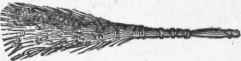
Feather Duster.
The breakfast is then to be prepared the cloth laid, the breakfast service properly arranged, the ham or eggs, or whatever it may be, cooked, the toast,made, the butter set in clear, fresh water, the coffee prepared and the milk boiled.

Brushes for Cleaning.
The servant next proceeds to the bedrooms, opens the windows, lays the bedclothes back to air, and turns up the mattresses or feather-beds in each room; then empties the slops, cleanses and rinses all basins, ewers, bottles, etc, wipes up all slops, and brings fresh water to supply all wants in each room. The beds are then to be made, and the rooms dusted. On cleaning day, which should come for each room once a-week, the chamber utensils must all be well washed in warm water, the carpets taken up and shaken, the floor scrubbed, the curtains shaken, and the furniture cleaned. During the summer the floor under the bed should be washed over three times a-week at least, to remove all dust and flue.
Before all this can be finished, the breakfast will have had to be removed, and this should be methodically done; the china being gathered on a tray without either fuss or rattle, the crumbs brushed from the cloth, and this latter doubled up in its original folds, and any crumbs which may have fallen on the floor swept up into a dust-pan.
The servant will now get her own breakfast, and then wash up and put away all the breakfast things, having first set aside all the eatables, giving the scraps to the cat, and taking care that nothing is wasted.
The up-stairs work having been done, the candlesticks and lamps should be cleaned and trimmed; and then the knives cleaned. Where only one servant is kept, she will ere this have had to think about dinner, and manage so as to make the earlier preparations for that important matter between whiles. A mistress should always inform her domestic charged with such duties, what she intends having for dinner, when the girl is removing the breakfast things, otherwise she cannot possibly arrange her daily duties so as to attend to the cooking without neglecting them; and the mistress should, as far as possible, endeavor to arrange her dinner so as to suit the household duties of the particular day for which she is catering. For each day should have its special duties; as, Monday, the wash for towels, dusters, servants' clothes, etc, and looking up the clothes for the laundress; Tuesday, cleaning the attics; Wednesday, the best bed-rooms; Thursday, the drawing-room; Friday, the dining-room and plate; and Saturday, the hall, staircase, and kitchen, covers, etc. Such regulations once laid down, the servant will know what duties each day requires of her; and the mistress, being aware what has to be done, will be able to give her orders accordingly, - for nothing can be done without good management in a small household. Both mistress and servant must exercise forethought, or the whole day will be one scene of hurry, scurry, and discomfort.
The next thing, then, is dinner, and this meal having been served and removed, the servant must, if the family are in the habit of retiring to the drawing-room, run up and see that all is right there; the fires burning and curtains let down, if in winter, or any little customary summer arrangements made. Then comes washing up the dinner things, and preparing for tea, and serving that at the proper hour.
While the family are at tea is the best time for the servant to go up to the bedrooms, turn down the beds, close windows, light fires, or perforin any other customary or necessary duty.
The tray has to be removed, and cups used at that meal, washed and put away. The tea leaves should be squeezed tolerably dry. and put away in an old dish or basin, for sweeping. All window shutters should be closed and doors bolted at dusk, both in winter and summer. If supper is taken, it is usually carried up on a tray covered with a cloth; after that comes the putting out of all fires and lamps, the fastening the hall door, and then to rest.
Any one who takes\the trouble to reflect upon the multifarious occupations of a female domestic, in a family where but one is kept, cannot but perceive the absolute necessity of a regular plan of proceedings, and also of the need there is for consideration, patience, and kindness. With all the activity and good-will in the world, it is physically impossible that a girl can be in two places at once; and yet she may be just performing soms nice operation in cookery while a visitor may be knocking at the door, and her mistress ringing impatiently to have something done towards tidying herself or the apartment. How is this to be managed? It can only be settled quietly by the mistress bestirring herself, and aiding in smoothing the difficulty. Where two or more servants are kept, one should always be tidy and ready to answer the door, and the lady of the house and her apartments should always be mis a quatre epingles, or, in other words, in such order that a visit from royalty itself would scarcely create any bustle. Indeed, the test of a well-arranged establishment is the absence of all fuss. The advent of relatives from the country bent on finding a home and a bed there, the arrival of unexpected guests to dinner, or any such unexpected events, will, of course, slightly derange the economy of a household, especially if it be a small one; but our housewife will not allow this to be visible. Quietly and without confusion she will take opportunities of giving the necessary orders; and if her servants are regularly trained, they will comprehend and second her at once. In every house spare sheets, blankets, and bed-clothes should always be kept aired, in case of their being required on any sudden emergency, and this can be done by laying them between the palliasse and mattress of any bed in regular use. We have before spoken of the advantage of always having the store-closet well supplied. It is a great mistake to fancy that anything is saved by purchasing articles that will keep, in small quantities, and certainly the loss of time incurred by having constantly to send out for trifles, is both a great waste and a great inconvenience. No servant can get through her work properly if she has repeatedly to run out on errands, or if she is called off frequently on frivolous pretexts. A mistress is quite right in exacting from her servants a regular and proper fulfilment of all their duties; but on her part she must give them time and opportunity to do this. If she sees they want method, she must try to teach them; and through all must remember how defective their early education has too often been, how little preparation they Lave received for the path of life they have to follow, and be patient with them. The great social evil of the present age is, that females are rarely trained with reference to their probable duties. This evil pervades all classes, from the lowest to the highest. The daughter of the millionnaire is seldom taught to consider how great are the social responsibilities her wealth and position impose upon her, - to regard herself as a steward of the Almighty, a medium through which His blessings may flow to those poor and unfortunate one3, whose lot is cast so far apart from hers. If she learns at all that "to whom much is given, much will be required," she probably imagines that much to be in the way of style, dress, and accomplishments; which, to a certain extent, is not far wrong, for the circulation of money is a commercial advantage, and those elevated in position should also be elevated in mental and moral attributes; but this is not all required of them. There is a duty to the poor, the duty of kindness, charity, and mercy. If all who have it in their power would but attend to this a little, how much good might be done! and what sits so gracefully on woman as such gentle deeds and holy virtues?
Then, as we have before said, the daughters of the working class are hardly prepared for their position as wives, mothers, and housewives; and the children of the poor have too often a still worse bringing up, being reared amid misery, poverty, dirt, and vice, if not in their own families, at least in many of those around them.
Vast as has been the general spirit of progression in this age, it is marvellous that these every-day matters have been, practically speaking, so totally overlooked. There is much theory, but the greater part of it is speculative and Utopian. We are not advocates of systems, but would recommend good common sense instead; for systems can only be applied to certain parties and in certain ways, whereas common sense will cull the best parts of many systems, and adapt them to suit the peculiar position or character it has to deal with, - and thus give to that character a firmness and freedom from conventional prejudices which will, when strengthened by right principles, make it good and useful.
Continue to:


My Books

