


10. The Garden
Description
This section is from "Every Woman's Encyclopaedia". Also available from Amazon: Every Woman's Encyclopaedia.
10. The Garden
Cut the plants down to half their height at about the beginning of June, in order that four breaks may be made from every shoot, and a good display of bloom be thus ensured. Stake carefully before any sign of toppling is visible.
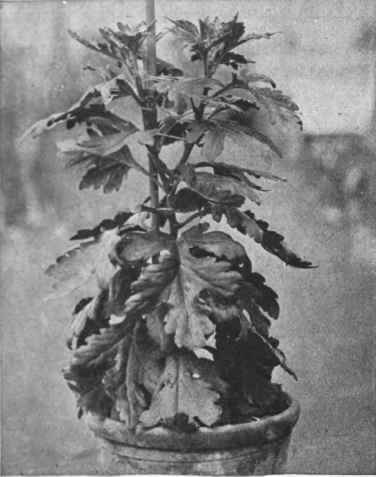
Chrysanthemum A young plant. The early flowering varieties of this species are quite hardy out of doors, and bear transplanting very well Copyright, Wells, Merstham
In planting out cuttings or divisions keep the ball of soil well below the surface, and make the soil round it quite firm with the handle of the trowel.
When planted out, the young stock will need comparatively little attention, unless disbudding is practised for obtaining specially fine blooms. To do this, single shoots are examined, and those which cluster below a flower-bud are removed.
Where three shoots have started from the main, remove two of them, and finally the small buds which form around the flower-bud when it appears. A single good bloom will thus be obtained. If a spray is preferred, leave all three shoots. When the buds begin to swell, remove the side-shoots formed along the main.
Transplanting
Early flowering chrysanthemums are remarkable for the safety with which they can be transplanted up to the moment of flowering. They can be lifted from out of doors, potted up in soil or ashes, planted in ashes or conservatory staging, or be banked up with ashes to form beds in the corners of the conservatory. Fresh relays can be brought in as the first batches fade, beautiful harmonies or contrasts in colour can be arranged. The single varieties which have recently become so popular, are charming subjects for such arrangement
Propagation of these can be affected yearly by cuttings. If already you have a stock of plants, cut them down as soon as the flowers are over, and place them under glass at a temperature of 6o°, if possible. Healthy basal shoots, having no roots attached and showing no flower-buds, must be chosen as soon as the new growth is made. Make the cuttings carefully, and treat them in the same way as those of outdoor varieties until rooted.
Cuttings
Late kinds should be rooted late in December, medium ones in January, early ones in February. Propagation in April suits certain varieties. If a new stock of cuttings is being purchased, a reliable grower will be found ready to give information as to treatment, should need arise. Unrooted cuttings cost from Is. gd. to 5s. per dozen, or 12s. 6d. to 363. per hundred. Young plants cost from 2s. 6d. to 10s. per dozen, or 16s. 6d. to 72s. per hundred.
Keep the cuttings fresh by occasional overhead sprinklings of tepid water. Wipe the glass when moist inside. The cuttings must not flag, but never water them unnecessarily. Shade from bright sunshine and keep close until rooted.
For the first potting use a good compost, adding some horse manure and wood ashes. Do not make the plants very firm until later stages, when the harder growth is desired. Keep them close for several days, then admit air gradually.
Watch for aphides, and exterminate them with a vaporiser or with tobacco-powder. Mildew can be checked by giving more air and drier conditions, also by dusting the plants with powdered sulphur. Burn at once any leaved attacked by leaf-blight. If chrysanthemum rust appears, burn the parts badly affected, and dip any others in a solution of sulphate of potassium.
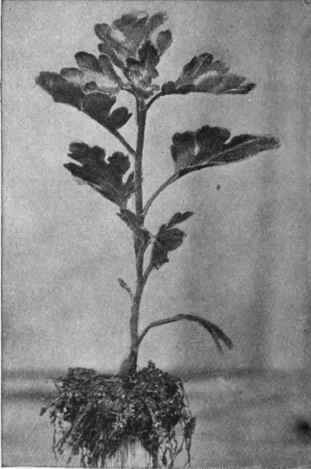
Cuttings must be shaded from bright sunshine and kept close until rooted
Copyright, Wells
Continue to:


My Books

