


4. How To Choose A House
Description
This section is from "Every Woman's Encyclopaedia". Also available from Amazon: Every Woman's Encyclopaedia.
4. How To Choose A House
Domestic Ventilation - Doors, Windows, and Chimney Flues - Mica Ventilators and their Usefulness
Domestic ventilation may be summed up as "doors, windows, and chimneys."
It must be admitted, under ordinary circumstances, that these openings provide for the entrance of a sufficiency of outside air, and when windows are ill-fitted, of more than is always comfortable. Also the chimney flue manages, in a fashion, to dispose of the vitiated air. Thus by accident rather than design are our rooms ventilated.
To be sure that the windows will contribute effectively to this result, it should be seen whether the top sashes can be opened. In some old houses they are fixed.
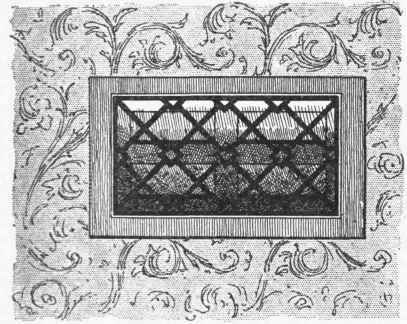
Mica Flap Outlet
To expect a scientific system of ventilation in a house of moderate size would be regarded as unreasonable by even the most accommodating of landlords. No doubt a time will come when the subject will receive more attention at the hands of architects and builders than it does at present.
Reference was made in the second instalment of these articles to the air-brick, the principal function of which is to ventilate the spaces below the floorboards, and thereby to prevent dry-rot of the joists. Incidentally it contributes to the ventilation of the rooms, as floors are never entirely air-proof at the joints of the boarding.
Having regard to the role played by the window as a ventilating device, it should be noted that the nearer the window-top approaches to the ceiling, the more efficient it will be in assisting the ventilation of the room.
It is in old houses that one has to be on the alert to detect deficiencies of the kind under consideration, and it is well to do so at the outset, since then it is possible to induce the landlord to make such alterations as the circumstances may dictate. Once the house is taken, he may shift the expense on to the tenant's shoulders.
Possibly the best device for dealing with an ill-ventilated room is a mica ventilator inserted in the chimney breast near the ceiling.
This, in effect, is a valve which allows air to pass from the room into the flue, but prevents the smoke from the flue passing in the reverse direction into the room.
Its construction and mode of action is very simple, and is clearly shown in the sectional diagram, the course of the foul air being indicated by arrows.
The mica flaps, being very light, rise from their seatings with the very slightest outward air current, and as readily close again as soon as there occurs the smallest tendency for the air movement to take the opposite direction.
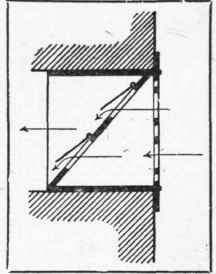
Action of the mica flap ventilator
The ornamental grid protects the mica valves from injury, and also largely conceals them from view.
It will be seen that this very admirable little device is quite automatic in its action, and very actively so when a fire is burning in the grate, because at that time the chimney draught is most energetic, and its upward movement draws with it the air that passes from the room through the mica flaps.
Thus, in winter, when the need for ventilation is greatest, the mica flap ventilator becomes more efficient.
Continue to:


My Books

