


Accommodation for Hats
Description
This section is from "Every Woman's Encyclopaedia". Also available from Amazon: Every Woman's Encyclopaedia.
Accommodation for Hats
The guests should always have plenty of room for their clothes, and the wardrobe should be well provided with coat hangers.
A large bag made of the chintz or cretonne used for the furnishings of the room should also be hung in the wardrobe as a receptacle for soiled linen. This occupies less space, is much prettier, and, in addition, is less expensive than the wicker basket which is usually provided. Large hats will not go into an average sized wardrobe. It is an excellent plan, therefore, to provide a large cardboard hat-box covered with chintz. The chintz is folded over the edge of the box on the inside, and secured with long staple pins. The lid is treated in the same way, after it has been lined with plain-coloured glazed lining. The lining of the lower part of the box should be made separately, and secured to the chintz around the edges with a few gold safety-pins or press buttons. Such a box will prove both useful and ornamental.
A comfortable chair should on no account be omitted from the guest-chamber, and if covered with plain linen adds considerably to the cosy effect of the room. Linen, moreover, keeps clean longer than does light cretonne. Early-morning tea is greatly appreciated, and gives scope for a very dainty outfit. The china should repeat the prevailing tone of the room, and the linen or muslin tea-cosy cover can be embroidered with a
"Good-morning" in the same shade. Teacups and saucers are made for this occasion with a place sunk in the saucer, so that the cup cannot upset. Most people prefer bread-and-butter with their tea, but for those who do not a box of biscuits should be placed by the bedside.
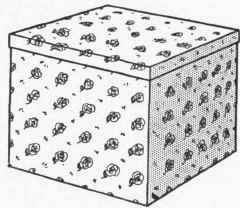
A large cardboard hat-box covered with chintz
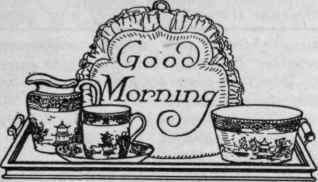
A tea-tray for early morning
Motoring visitors often come with very little luggage, and a spare room dressing-gown, therefore, is a capital idea. A most picturesque and inexpensive garment can be made of house flannel in a kimono shape, edged with narrow bands of the material and embroidered with coloured washing silk. Here, again, the prevalent shade of the room may be repeated, and in a flower-room the actual blossom may be used if a small one, like a daisy or pansy, has been chosen. Bath slippers in the same style, bound with ribbon and mounted on soft woolly soles, may also be made.
House flannel likewise is an excellent fabric to employ for the hot-water can cosy. This may have a design on it in an applique of linen done in an appropriate shade for the room.
It is a mistake to spoil a room, otherwise pretty, by using it as a dumping-ground for all the china atrocities in the house. This also applies to pictures. Unless these things beautify a room, it is far better to leave the mantelshelf and walls bare. However, some pretty ornaments cost only a few shillings, and add greatly to the general effect.
Quaint green pots that will, if necessary, hold flowers, or a little blue and white Oriental china, according to the colour scheme of the room, will always look pretty on the mantelshelf. On the walls may be hung a few good photogravures or prints of landscape paintings by well-known artists. These are more suitable than subject pictures for a bedroom, and give an air of cheerfulness. The last finishing touch, which proclaims the hostess's individual thought for the particular guest, is the little vase of flowers on the dressing-table.

Cosy for the hot-water can
Continue to:


My Books

