


Beautiful Women In History. Lady Sarah Lennox. Continued
Description
This section is from "Every Woman's Encyclopaedia". Also available from Amazon: Every Woman's Encyclopaedia.
Beautiful Women In History. Lady Sarah Lennox. Continued
She was about the only person at the English Court who was not scheming on the vexed question of the King's marriage. She took it all quite naturally, and when one day we find the King talking to her in the usual terms of affection and tender courtship, and the next announcing his betrothal to a German Princess, although Lady Sarah certainly felt that she had been made a fool of, she showed no resentment. The death of a pet squirrel gave her far more concern than his Majesty ever did.
According to Horace Walpole, when Lady Sarah acted as bridesmaid to the ugly little brown Princess from Germany who married King George, the deserted maiden, far from wearing the willow, "was the chief angel of them all."
Lord Westmorland's Mistake
Old Lord Westmorland, who was very short-sighted, plumped on his knees, and kissed her hand as she stood at the head of the bridesmaids. Lady Sarah blushed, and exclaimed hastily, "I am not the Queen, sir!" - an incident which naturally in the circumstances caused a good deal of amusement at Court.
Throughout the ceremony the King stood gazing at his lady love, who was certainly watching him married to some one else with disconcerting composure. Even her liking for him had been shaken by the duplicity of his conduct. If he had to marry Princess Charlotte, it was disgusting that he should make love to Lady Sarah as he had done.
But by this time Lady Sarah had every reason to look radiant, for she was happily in love with a sporting, racing, hunting squire, very good-looking, and fairly well off, and to him she was married a few months after the King. Thus she became My Lady Bunbury at the age of seventeen, and wife of the man who was afterwards known less as the husband of a historic beauty than as the "Father of the Turf," and owner of the first Derby winner, Diomed. For a time she was very happy, but Sir Charles was more interested in his horses than in anything else, and after a few years he neglected his beautiful wife, and left her to the attentions of others.
"The Lovers' Walk"
Of these she took no notice until her cousin, Lord William Gordon, fell passionately in love with her, and she returned his affection. At last she yielded to him, and left her husband's house. For three brief months they wandered together through the grounds of a lovely old house in the North Country, where they christened their favourite path "The Lovers' Walk," and planted two thorn-trees which, as they grew, intertwined their branches. At the end of the summer, however, Lady Sarah, with her little daughter, overcome by remorse, went back to her brother at Goodwood House, and here for twelve years she devoted herself to bringing up her little girl.
During this time the brilliance of her spirits changed to a very touching and beautiful humility, and it is no wonder that Sir Charles Bunbury, going frequently to see her, as frequently begged her to marry him again, and regretted bitterly that he had divorced her.
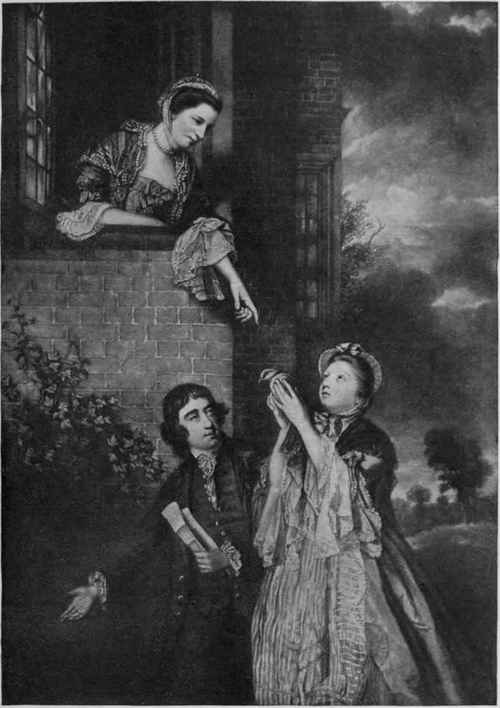
Lady Sarah Bunbury with Lady Sarah Fox Strangeways and Charles James Fox
After Reynolds
At the age of thirty-six we find her beautiful, gracious, witty, and humble; a model mother and a submissive sister, being wooed by the Honourable George Napier, who, as she writes to Lady Susan, declared that he could not understand why no one had thought of proposing to her before.
In spite of opposition from many quarters, the soldier-lover had his way. He had very little money, but poverty she did not mind now that she had found a peace for which she had long given up hoping. She married him in 1781. He was six foot two, exceedingly handsome, and as clever as he was good-looking. By him she had five sons and three daughters. Three of the
I I sons afterwards became famous in the Peninsular War. To bring up this family Sir George and Lady Sarah never had more than a thousand a year; but the high-spirited girl who, "if she had had a grain of artfulness in her," would have been Queen of England was quite content to manage and do without for the sake of her devoted husband. Napier died in 1804, and left her absolutely broken-hearted. She was poor, too, until the King granted a pension of 800 a year to his old love in recognition of Napier's services.
A Model Mother
She was adored by her children as few mothers are, but all her life she had the art of winning people's affections. This is not surprising, for her letters reveal a singularly charming character. She wrote all her thoughts and feelings to Lady Susan, who was her staunch friend even when her family were most displeased with her. When the King's informal proposal for her hand had been related to her, and she was to go to Court the next day primed with the proper thing to say - which, as we have seen, she flagrantly did not say! - she writes to Lady Susan "that the very thought of it makes me sick already," a plain and graphic description of a feeling which in these days we mask under the polite name of "feeling nervous."
When he had made her look foolish by treating her as his future wife until the very day of the announcement of his engagement, Lady Sarah writes: "If it is true that one can vex anybody with a reserved, cold manner, he shall have it, I promise him!" (And he got it!) Her wisdom, however, even at that early age, is quite remarkable; for in begging Lady Susan not to talk of the King's proposal, she says, "He will hate us all anyway, for one generally hates people that one is in the wrong with." When Napier is wooing her she writes to Lady Susan: "I think myself such an old fool to marry at all, that I have not the courage to take one single step about it." Fortunately, Napier was ready to take them all.
At the age of sixty-five, although her beauty never deserted her, Lady Sarah went blind. It is curious that she and George III. should both have lost their sight in old age, and a touching story is related of the blind King. The great-niece of his old love, also called Lady Sarah Lennox, was going to Court, and those about the King thought it well to prepare him for the advent of her namesake. The King asked if there was any likeness to the Lady Sarah Lennox of his youth, and was told "Yes." Whereupon he asked that she be presented to him privately. And when she came he begged permission to pass his hand over her features.
It was a far cry from the days when the lovely girl-child in rustic dress had played at hay-making in the grounds of Holland House when the gallant young King was to ride by, to these days of age and darkness.
Lady Sarah Napier died in 1826, leaving behind her an adoring family, and 'records of exceptional beauty and charm of character. From the singing-bird of the great blue china jar to the stately, beautiful, blind old lady of eighty-one, she was ever not only charming but lovable.
A Romantic Life
She came into the world in a romantic year and on a romantic day - St. Valentine's Day in the year of the 45. Save for three months, when she left a cold and neglectful husband for a young and ardent lover, her conduct was irreproachable; and if the early part of her life was frivolous and fickle, in the latter part she showed the constancy and the tenderness of a saint.
Continue to:


My Books

