


Clothes for Children
Description
This section is from "Every Woman's Encyclopaedia". Also available from Amazon: Every Woman's Encyclopaedia.
Clothes for Children

By Mrs. F. Lessels Mather, Central Midwives' Board, A.r.san.i.
Author 0/ "Health and Home Nursing," "Hygiene and Temperance," "Home Nursing," etc.
The Day-gown - Bootees - Bibs - Head Flaanel - Night Clothes - Clothes for Outdoor Wear
Day-gown with Panel Front
The illustration (No. 4) shows a pretty design in white cashmere, with a panel front. It fastens on the shoulder and down the front, under the edge of the panel, with small unbreakable buttons and worked loops. The panel and sleeves are embroidered in thick white silk.
The embroidery can quite easily be done at home by using any good transfer papers f01 the pattern. The silk used should be "Flannel Embroidery" silk.
No. 5 shows a pretty gown in embroidered cambric, fastening down the back. At the neck a soft ribbon should be used, but unbreakable linen buttons may be put on the skirt. The christening robe is usually a very handsome one, made of fine silk or cambric, hand embroidered, and elaborately trimmed with real lace. It is often an heirloom, used only on special occasions, and handed down from one generation to another. Woollen bootees should be roomy and warm. They can be either knitted or crocheted, or may be bought very r e a sonably made of silk or wool. When baby is taken out these should be replaced by woollen bootakins, which come well up the legs for protection. (See illustration No. 6.)
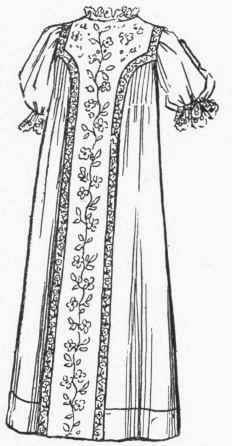
Fig. No 4. Day'gown with embroidered front
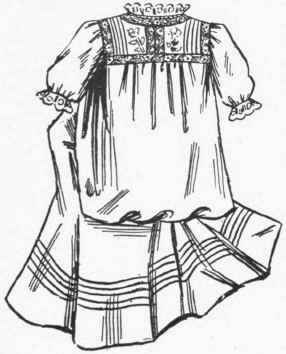
Fig. No. 5. A pretty gown, fastening at the back, finely tucked and embroidered
Bibs are made from all sorts of materials, from the elaborately trimmed silk and lace affair for best, down to the home-made one of soft Turkish towelling. These are really very good, and can be made quite pretty by scalloping and buttonholing the edges. (See illustrations Nos. 7 and 8.)
Napkins are best made of soft Turkish towelling, though some mothers may prefer the older-fashioned diaper. Both wash and wear well, and are comfortable for baby.
The pilch is a triangular piece of flannel, usually cut from a 27-inch square. The edges are either buttonholed or worked in herringbone stitch. A cheap flannel will serve, as the pilch needs frequent renewals.
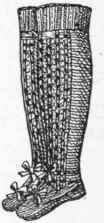
Fig. No. 6. -Bootakins should be of wool in crochet or knitting, and must not fit tightly
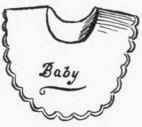
Fig. No. 7
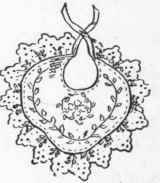
Fig. No. 8
Bibs may be of softest Turkish towelling with simple buttonholed edge, or of embroidered silk, trimmed with lace
The Head Flannel
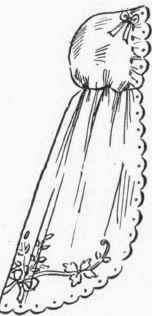
Fig. No. 9. Head flannel ornamented with hand embroidery, and drawn to. shape of head with ribbon
The head flannel may be as simple or as elaborate as the mother wishes. It is usually made from a 30-inch square of very fine flannel. The edges may be simply bound, or may be scalloped and worked in buttonhole stitch.
The little illustration will show how the garment is made. The hood and corners may be embroidered in washing silk. (See illustrations Nos. 9 and 10.)
A pretty, soft, small woollen shawl may be used instead of the head flannel, and can be either home knitted or crocheted.
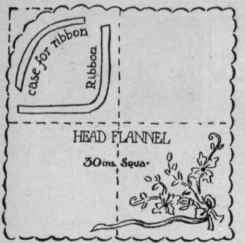
Fig. No. 10. Showing how to cut and arrange the casing for the ribbon in the head flannel. Scallop the edges, which finish with buttonhole stitch. Ornament with embroidered design
Nothing should be worn at night that has been in use during the day. A binder, a long night flannel, and a nightgown are usually worn.
Clothing for the Night
The material used for the nightgown will depend on the season of the year, but even in summer it is often advisable to have this garment made of some form of woollen material, such as nuns' veiling. If baby is healthy and robust, then nainsook or long-cloth may be used.
In winter, natural flannel is very serviceable. About two and a quarter yards of 36-inch-wide material is wanted, and the only trimming is generally a little edging at the neck and cuffs. The garment is usually fastened down the back and finished with a sash, into which the fulness is gathered in front. The sash is then taken round to the back, crossed over, and brought round to the front, where it is tied. (See illustration No. 11.) The foot may be finished with a drawstring, to pull up and so form a sleeping bag; or the back may be made 6 inches longer than the front, and the extra length turned over, and buttoned on to the front. (See illustration No. 12.) In both cases baby's feet and legs are not left unprotected should the bedclothes be kicked off or disarranged during the night.
Later, when baby is a little older, sleeping-suits are excellent for the same reason. They are usually a long combination garment of woven wool, with or without feet. These garments are not very easy to make, and can be purchased quite reasonably in either natural or pink shades.
Clothes for Outdoor Wear
For outdoor wear a carrying cloak is needed. Thisis very seldom made at home, as very pretty and dainty cloaks with capes can be bought at prices to suit all purses.
The cloaks are strings attached to the front, crossed
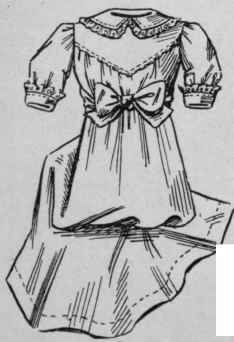
Fig. No. 11. A nightgown, with behind, and tied in front usually of fine cream or white cashmere, either with soft frills or trimmed with silk lace. They may also be very handsomely appliqued in silk. (See illustration No. 13.)
Fig. No. 12. A suggestion for keeping baby s feet warm. Make the back longer than the front and button over to front
A very handsome cloak can be had in rich Bengaline silk, which lends itself to being tucked and appliqued.
A little woollen jacket with long sleeves is generally put on under the cloak.
The first hood is usually made of the same material as the cloak, and is often trimmed to match. It is generally of fine white cashmere or Bengaline silk, braided or embroidered. For ordinary wear, a homemade one can be knitted of soft white wool, and tied with strings of white washing silk.
A Shetland wool or silk veil to cover baby's face is used with the hood, should the weather be at all windy or cold.
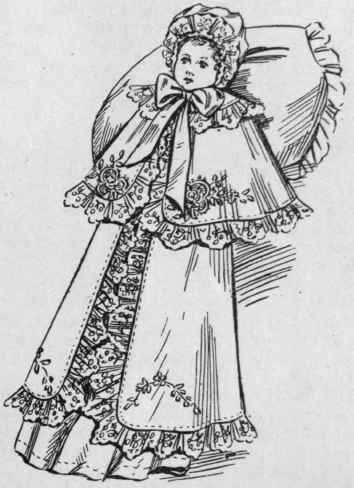
Fig. No. 13. Carrying cloak of cashmere or silk trimmed with embroidery. Hood to match
A large, white, soft woollen shawl is a very nice addition to baby's clothing. It can be used in place of the more elaborate and dressy cloak during a short outing, such as a walk in the garden, or on a damp day, when baby is being carried in a corridor, or even from one room to another. The making of this shawl will form a delightful and congenial occupation for the mother.
It may be either crocheted or knitted. If knitted in Andalusian wool, with No. 9 needles, a pretty "coral" pattern may be selected. To make a shawl one yard square, about five ounces of Andalusian wool will be needed.
A very charming shawl can be quickly crocheted in what is known as " criss-cross " pattern. It is done in rows lengthways, and the work is turned at the end of each row, making the shawl the same on both sides. It is very pretty in Shetland wool, using a No. 8 bone crochet-hook.
Continue to:


My Books

