


Furnishing. No. 2. On the colour-sense in Furnishing. Part 2
Description
This section is from "Every Woman's Encyclopaedia". Also available from Amazon: Every Woman's Encyclopaedia.
Furnishing. No. 2. On the colour-sense in Furnishing. Part 2
Remember that you cannot make a note of vivid colour as effective in the hall of a flat as a house, because there is no staircase ascending before you, when the quality and colour of the stair-carpeting arrest your attention, and a dead level does not at any time make for beauty.
When we were told to lift up our eyes unto the hills there was more than one sound reason behind that advice, for the eye being carried up and on, instead of depressed and lowered, causes a profound feeling of delight, and teaches its lesson in even so humble a matter as furnishing. Every room, however small, should have some tall object in it. If no pedestal, then one of the old pedestal lamps, with the lamp removed, filled with flowers or greenery, and placed behind a screen, is a graceful object and fulfils the line of beauty that Nature, knowing so well, never made straight.
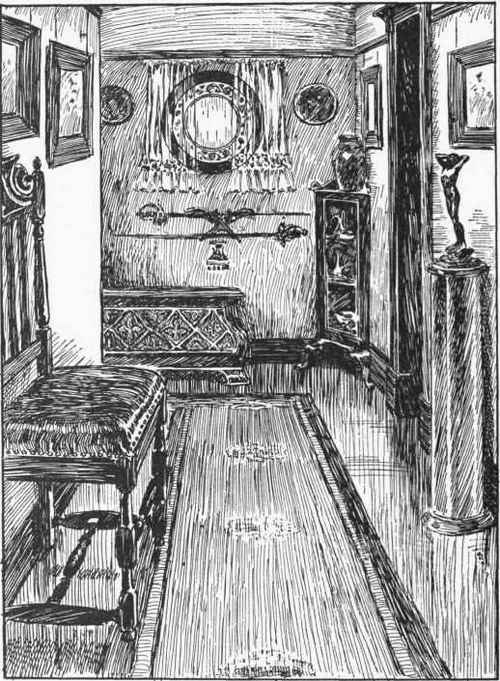
Even a moderately wide passage can be made into an effective hall if taste is displayed in the arrangement of engravings, and a few good pieces of furniture
The Hall Of The Small House
Where a small house is in question, even a moderately wide passage is amenable to treatment, especially if any good engravings are forthcoming, for black and white is essentially the one thing for passages and corridors, just as oils are for a dining, and good water-colours for a drawing and morning room.
Say that you decide on blue stair-carpeting, you will be wise if you tile your outside flower-boxes with vivid blue, so that on entering you get a second note of the colour in the blue Axminster carpet that runs from the front door and covers the staircase, and you might lay this blue carpet down on white linoleum, that washes beautifully and wears longer than dark colours.
Let the walls be white, hang copper engravings, in perfectly plain black frames, and, say, one fine brass on them; then through the open door of the dining-room show a satin-striped white paper; and going upstairs there is only that bright blue and the white all the way up, while at the back of your mind is the vivid blue of those tiles outside.
I am only giving this as an instance of the "one colour" idea, a very unambitious one, and available to anyone, in the smallest of houses, and if you substitute rose-colour stair-carpet for blue you get a good effect; green is especially fresh and dainty, and a deep orange Axminster by no means to be despised.
There are big halls and there are small ones, and there are houses with no halls at all, yet they, or their substitutes, may be made pleasant by the exercise of a little of that taste and love of beauty which is essential to every condition of true living. Most people think that taste is only purchasable by very rich people, that beauty spells luxury, and belongs to show; it does nothing of the sort, it is within the reach of the humblest, and often the best results are got at the smallest cost, because the furnishing has been "mixed with brains." To be continued.

How an Old Chair May be Renovated - Interesting and Valuable Work
It seems not unlikely that once again the woman who is clever with her needle will, like her great-grandmother, turn her attention to tapestry and ornamental decorative needlework. Perhaps with happier results, since the old-fashioned " crewelwork," the pride and glory of the severe drawing-rooms of the Victorian era, was not beautiful.
Often an antique chair or settee of quaint and beautiful design is hidden away in a corner, because its covering is worn and faded. Why, therefore, should one not try to renovate it suitably? Modern brocade seems out of place. The object of this article, therefore, is to give a practical suggestion.
Before beginning work an upholsterer should be allowed to cut the material to the shape of the chair. The embroidery will not then be interfered with later on. Moreover, when the work is completed, it is wiser to let the upholsterer make it up.
The fabric chosen for the work reproduced on this page was biscuit-coloured satin.
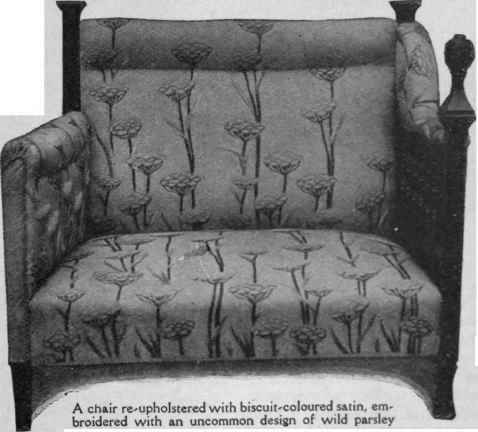
The design is an uncommon one - wild parsley, treated conventionally and giving the idea of the growing plant.
The leaves and stalks are worked in the satin stitch, and shade from the darkest bronze green almost to pale gold. Thus is given the effect of a ray of sunlight falling across the leaves. The wild parsley is embroidered in three shades of raspberry, treated boldly, and worked entirely in French knots. The silk is brought through the fabric, and twisted around the needle, which should be held tightly with the left hand. The needle is then put into the material again near the point where it came out first. Next the silk is drawn through and released with the left hand as it tightens whilst being pulled. After the design has been completed the biscuit satin is literally powdered with the " rice " stitch. This, if done in a soft shade of old gold, further accentuates the idea of sunlight, and gives an embossed appearance to the design.

By Ella G. Grundy
Author of " The House Beautiful," "How to Furnish a Flat." Lighting a Reception-room or Dining-room - Colour Schemes - Lights as Table Decorations
It may seem absurd to emphasise the fact that the main object of lighting arrangements is to give light. A little observation of the average home, however, shows that most fittings seem to be chosen for their material and design rather than for the production and distribution of the light.
Continue to:


My Books

