


Women In Great Social Positions The Wife Of The Prime Minister
Description
This section is from "Every Woman's Encyclopaedia". Also available from Amazon: Every Woman's Encyclopaedia.
Women In Great Social Positions The Wife Of The Prime Minister
"Mrs. Asquith held a private reception yesterday at 20, Cavendish Square.
Among those present were-------"
There is sometimes a world of significance behind this simple announcement which appears periodically in the Press. To the average man or woman it probably conveys nothing more than the idea that the wife of the Prime Minister has been entertaining the friends of her husband and herself, and that while, doubtless, the reception was characterised by much political gossip, the function was purely social and lacked further importance. This may or may not be true. There is an old saying, however, to the effect that the destinies of nations are more often moulded in salons than in Parliament, and the possibilities are that that reception has been held with a view to bringing certain people together who will sway some political event of the day.
That is one of the most important duties of the chief political hostess of the day - to bring people possessing wealth, power, and influence together. It is almost equally as important for her to smooth over, through the medium of social amenities, those dissensions which are bound to arise amongst members of the party outside the House, and by so doing not only prove of the greatest assistance to her husband, but also relieve him of much anxiety and worry.
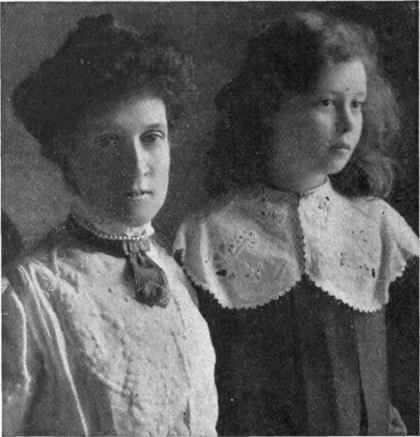
Mrs. Asquith and her daughter Photo, R. Haines
Beaconsfield once remarked that, given a clever wife, the success of a politician was assured. Certain it is that much depends upon the modern political hostess. To be successful as the wife of a Prime Minister, however, a woman must be exceptionally clever, with a great capacity for work. Her day usually starts at 8.30, and more often than not does not end until one or two the following morning. She must necessarily be tactful, shrewd, and discreet. Her words are listened to with almost as much attention as those of her husband, and her actions most closely watched by political friends and foes alike. She must, moreover, be domesticated in the sense of being able to manage successfully a large house, and give those political dinners and parties which are so important a part of the life of a Prime Minister's wife.
It does not, of course, always happen that the wife of a Prime Minister shines to advantage in political circles. Ill-health and a distaste for politics, for instance, kept Lady Campbell Bannerman, the Marchioness of Salisbury, and Mrs. Gladstone somewhat in the background. As an intimate friend of the present Prime Minister's wife once said, Mrs. Asquith " not only loves politics, but loves to mingle in the political battle, and her wit, knowledge, and brilliancy add power to the elbow of her husband."
In such a case, the political work of a Prime Minister's wife does not begin and end with the holding of political meetings in drawing-rooms, or canvassing in boudoirs. She is a regular attendant at the House, and will be found touring the country with her husband at election times. During the General Election of 1910, Mrs. Asquith was her husband's constant companion during his speech-making tours, and whenever an important debate is taking place in the House she is usually to be found behind the grille. Mrs. Gladstone, of course, went down to the House regularly every night with her husband, and generally stayed until the end of the sitting; but it was really only in order to attend to the creature comforts of the G.o.m. with that loving solicitude which was such a beautiful feature of their married life. On the other hand, Mrs. Asquith takes the keenest interest, not only in the delivery of her husband's speeches, but sometimes assists him in their preparation.
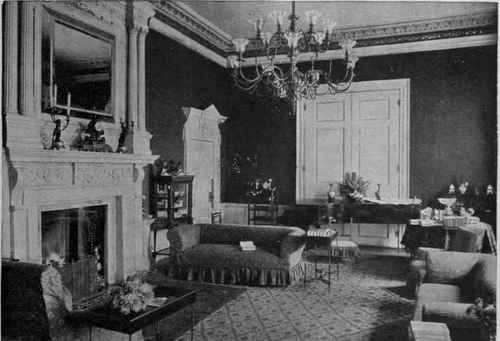
The drawing-room at 10, Downing Street
[Photo, R. Haines
When it is known, however, that the Premier's wife takes such a keen interest in politics as Mrs. Asquith does, she suffers for her enthusiasm by being inundated with letters from people of all classes who have real or imaginary grievances, or who wish for some political favour.
It must be remembered that the Prime Minister has it in his power to recommend to the King any persons eligible for Royal favour and vacant appointments. And there are some misguided people who imagine that they can further their own interests in these directions by writing to the Premier's wife, asking her to use her influence on their behalf.
As a rule, these letters are handed over to the Premier's private secretaries, and they are dealt with according to their merits. Scores of letters, however, are received almost every day by the Prime Minister's wife from women and girls seeking to enlist her sympathy on their behalf, and scores of others from organisations and institutions asking for her patronage and support. These she usually deals with herself.
And it is after this voluminous post-bag has been dealt with that the daily round of receiving and paying calls commences.
Not the least onerous of the duties which fall to the lot of the wife of a Prime Minister is that of meeting foreign ambassadors, their wives and friends. It requires a woman of wide knowledge and consummate tact to meet them all on equal ground, so to speak. It is generally admitted that in this respect Mrs. Asquith is more successful than almost any of her predecessors. This, perhaps, is not surprising when it is remembered how in her early day she was wont to act as hostess for her father, the late Sir Charles Tennant, at his town mansion in Grosvenor Square, and made her drawing-room familiar to all the leading writers, painters, orators, and savants of the day.
Reference has already been made to the appeals which reach the Premier's wife from
E organisations and institutions asking for her patronage and support. And here again she must use considerable discretion in order to avoid giving offence and causing jealousy. If she took an interest in this charity it might be averred that she did so for vote-catching purposes; while if she failed to support that she might lose her husband valuable friends. It is only necessary to recall what a hubbub was caused when it was thought that Mrs. Asquith, some time ago, had used the Premier's official residence, 10, Downing Street, for an exhibition of French dresses, to realise how very careful the Premier's wife has to be if she is to avoid unpleasant squabbles.
Mention of 10, Downing Street reminds one that the Prime Minister may live there if he chooses to do so. Mr. Balfour does so when in office; so did Gladstone and Disraeli. In the case of Mr. and Mrs. Asquith, however, they decided to continue to reside at 20, Cavendish Square - a house more suited to the requirements of their large family. Mrs. Asquith has filled her home with artistic treasures, and it is replete with old books, old pictures, and old furniture. She has been heard to confess with a sigh, however, that since Mr. Asquith became Prime Minister she has had little time to devote to her hobby of collecting, or of indulging in her favourite amusement of hunting. " Pleasurable pursuits must be put on one side," she remarked at a gathering a short time ago. " Even while holiday- making there are a hundred and one duties to attend to. The honour of such a position as Prime Minister's wife, however, brings full compensation." It cannot be said, however, that the privileges attached to the position of Premier's wife are particularly striking. It is true that her husband is in daily communication with the Sovereign, and has his ear at all times, and at all functions is a most honoured guest; but his personality overshadows that of his wife. Although, however, she does not take high precedence amongst the nobility, for instance, the friendship of no woman in the country is more sought after than that of the wife of the man who guides the legislation of Great Britain.
The King. - A letter to the King should be written on thick, white notepaper, and sent in an envelope large enough to take it without it being folded. There are two ways of addressing the King. One is " To His Most Excellent Majesty "; the other, " To His Most Gracious Majesty King George V." The name is included in either of these forms.
There is a formal as well as an informal mode of beginning all such letters. The formal mode is used by all but intimate friends of his Majesty. Such a letter would begin: " Sire, - May it please your Majesty," and refer to " Your Majesty." Informally, the letter may begin: " Dear Sir " or " Honoured Sir." The conclusion of a formal letter would be:
" I have the honour to remain,
Your Majesty's most faithful subject and dutiful servant."
In the case of an informal letter the ending would be according to the degree of intimacy between his Majesty and the writer.
The Queen. - Punctilious persons observe the same rule as in the case of the King with regard to the notepaper being unfolded; but it is not incorrect to have it folded once. The paper should be white, and of a good substance. The mode of address would be: 'to Her Majesty Queen Mary," or " To Her Majesty the Queen," or " To the Queen's Most Excellent Maiesty."
All letters to the Queen or Queen Alexandra begin " Madam," and above this word is written the form of address adopted. The ending of the letter would be: "I have the honour to submit myself with profound respect,
Your Majesty's most faithful subject and dutiful servant."
Royal Princes. - Address: "To his Royal Highness the Prince of Wales," " To
His Royal Highness the Duke of -------."
The abbreviation " H.r.h." is sometimes used on envelopes, but never in the inside of a letter.
Beginning: " Sir," with the title written above it, and refer to as "Your Royal Highness." Ending: "Your Royal Highness's dutiful and obedient servant."
Royal Princesses. - Address: "To Her
Royal Highness the Princess of -------," or
" Duchess," as the case may be. Beginning: " Madam," with the title written over it. Refer to as " Your Royal Highness." Ending: " Your Royal Highness's most humble and obedient servant."
Sons and Daughters of Royal Princes and Princesses. - In cases where the children do not rank as Royal Highnesses, their title is Highness, and the above rules apply with the omission of the word " Royal ' and of the word " most " before "humble" in concluding: a letter.
Continue to:


My Books

