


Wooden-Bead Embroidery
Description
This section is from "Every Woman's Encyclopaedia". Also available from Amazon: Every Woman's Encyclopaedia.
Wooden-Bead Embroidery
Used as Plagues lor Waist Ornament - For Holding Skirt Drapery in Position - Colour of Beads should Harmonise with the Gown
The colours of the wooden beads being shown in the shops are so beautiful and alluring that it is no wonder people are inspired to do embroideries of which they form the motif. As the beads are of a fair size, a very good effect can be gained with little trouble. They are also not at all expensive, the smallest size being obtainable for 6 3/4 d. the row, and larger ones, in an elliptical shape, for 8 3/4d, A row of each would be more than sufficient for any gown, as the embroidery is too striking to em-ploy much on the one dress. If, however, it is desired to introduce a third colour, a further string of beads would be necessary.
The best way to employ the embroidery is in plaques used to form ornaments at the waist, and to catch in any drapery at the sides of the skirt, and perhaps a small one in the centre of the bodice, and on each sleeve.
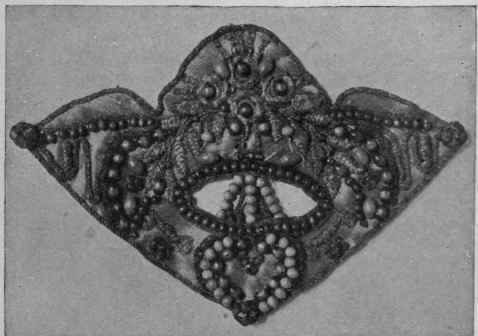
The example shown in our illustration is a waist ornament for an evening gown. It is made of platinum tissue mounted over tailor's canvas. First draw your shape in paper, folding it in the centre and tracing the second half through, so as to be sure to get it quite even. The measurements for this particular ornament are 6 inches deep and 9 inches across. Cut this in tailor's canvas, and cover it with the tissue. If you want to give the tissue the appearance of being embroidered by hand with platinum thread, without having the trouble of doing this, get some metallic lace, cut away the net ground, and apply the design, sewing it neatly down around the edges. The border of the ornament must be outlined with a narrow, gold metallic cord. There is a new kind, which is very supple, similar to the satin rat's tail trimming. The colours of the beads must be chosen to harmonise with the gown, turquoise blue and rose colour being effective with grey.
William Foy
An example of wooden bead embroidery, An ornament to go at the waist of an evening gown

Materials Required - How to Arrange the Cording - Lining the Mult - Decorating it with Roses
The muff of silk or velvet, to wear with a long scarf or stole to match, is very smart this season, and may easily be made at home by the clever needlewoman. The muff seen in our photograph is a good example, and will require 3 yards of soft satin or paillette silk to make it.
The foundation consists of a double layer of wadding. This should be cut 32 inches long and 16 inches wide, and oversewn at the raw edges. Then cut off 1 1/2 yards of the silk for the piped top. This is not, however, sufficiently wide, and a piece must be added on each side 3 inches in width, cut from the remaining 1 1/2 yards of silk. If a double-width silk can be secured, then no join will be necessary, and 1 1/2 yards will be sufficient for the muff.
To do the piping a medium-sized cord should be laid between a fold of the silk, and pinned in place, and then secured with a line of fine running stitches, being careful not to catch the cord itself. Use a sewing silk to match the material for this, and a long millinery needle. For the outer cords fold the silk over the cord, and then lay it flat at the edge of one of the three-inch strips, and tack it in place before sewing it. Cut the cords when the end of each is reached; do not draw them up until all are sewn in. Do the middle cord first, folding the silk in half on the right side to get the centre. Then do the edges. Fold the silk again to find the correct place for the cords between the centre and the edge. In this way you will get them at equal distances with little trouble.
Now draw up all the cords to the length of the cotton-wool padding, arranging the fulness evenly. Put a running thread at the raw edges of the silk on each side. Lay the silk on the wool padding, and turn it over the edges. It will come about an inch beyond the edge on the inside. Draw up the thread at the edge of the silk. Arrange the gathers, and sew them down on to the wool. Cut off a piece of the remaining silk 32 inches long and 15 inches wide for the lining. Turn in the edges to cover the gathers, and slipstitch it in place to within a short distance of each end.
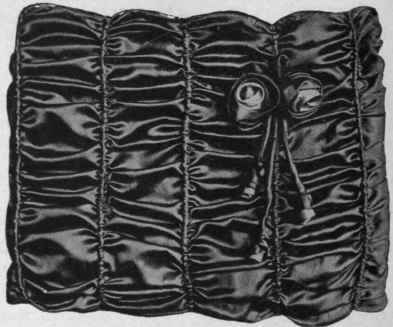
A large muff made of piped silk with silk roses
The muff is at present perfectly flat, in order to facilitate arranging the fulness on the piping-cords, but it will now have to be joined at the ends. First join the piped top on the wrong side. Finish off the cords, and cut them. Then overlap the cotton-wool, and sew it together. Finally, turn in the silk lining over this, and slipstitch the seam. All this is done with the muff held on the wrong side, but it should be turned inside out just to see that the piping-cords are drawn up nicely to fit the muff.
The muff is now complete, except for the little cluster of silk and tinsel roses and buds. Get 1/2 yard of 5-inch-wide platinum ribbon to make the centres. Cut a strip off this on the cross, fold it, and run the raw edges together. Roll this round and round, gathering it only a very little, and sew it securely at the base. This forms the centre. Then cut a piece of silk on the cross, measuring 10 inches by 4 1/2 inches, gather it in the same way, and roll it round the centre.
Make the little buds in a similar fashion on a smaller scale, letting the centre come a little beyond the outer silk. Attach each bud to a piece of piping-cord covered with silk. Sew buds and roses on to a small mount of tailor's canvas, covered with silk and secure to the muff, being careful not to pucker the satin of the muff.
The cost of this muff will be approximately 5s. 9d. for 3 yards of silk, at Is. 11d.; 3d. for the wool; and about 6d. for the platinum ribbon; making 6s. 6d. in all.
A scarf to match can be made of 5 yards of silk drawn up at the ends with groups of piping-cords, and finished with a fringe of buds. A colour to match the gown should be chosen. Grey or amethyst silk would be particularly charming, or a delightful variation would be to use velveteen instead of the silk. In that case the roses should be of satin ribbon to match, with metallic centres.
Continue to:


My Books

