


2. Motoring For Women
Description
This section is from "Every Woman's Encyclopaedia". Also available from Amazon: Every Woman's Encyclopaedia.
2. Motoring For Women
How to Drive a Motor-car - Different Types of Drivers - First Lessons - Points to Remember The Cost of Motoring - Economy in Buying a Motor-car aving now purchased the new car, the H next considerations are its use, care, and upkeep. To take these in their order of choice (though not in their order of importance), the first lesson to be learnt is that of driving.
The modern motor-car has now reached such a high pitch of perfection, both in reliability and simplicity of design, that the art of driving it presents no real difficulties to anyone blessed with the smallest taste for mechanics. I say "art" advisedly, as the proper driving of a motor-car, no matter how simple and "fool-proof" it may be, is an art as much as dry fly-fishing and four-in-hand driving.
Almost anyone can learn the rudiments of steering a car safely along the roads, and of making it climb hills more or less correctly, but it requires sympathy of touch and ear to drive a good car as it should be driven - that is to say, so that it seems gifted with life and understanding, and a perfect bond exists between driver and engine. A good driver should know his car as intimately as a good horseman knows his horse.
Motor-car drivers may be divided into three classes: (a) those who, like natural swimmers, realise instinctively how to treat the car, and who are really born drivers; (b) those who have an aptitude for learning anything, and who, after a few weeks, may be trusted to take a car in perfect safety anywhere, but who, having reached a certain standard of proficiency, will never improve upon it - they will be sound, safe, but never in real sympathy with the car; (c) those who have neither taste nor respect for mechanics, and who drive a car with as much consideration for its well-being as they would bestow upon a wheelbarrow.
The last-named class may be left out of the present discussion, as they should never be permitted to play any role in a motor-drive other than that of the ordinary passenger.
A Representative Car
Let us suppose, therefore, that the owner of the new car is about to take her first lesson in driving it. The appended diagram shows the various parts which confront the driver as she sits in the seat of authority. On some cars the actual details vary slightly, of course, but their main principles are the same. For instance, there may be what
Recreations is known as a drip-feed lubricator in place of the oil-gauge (K). This will consist of one or more glass tubes mounted upon a small tank, the oil passing down the tubes, drop by drop, in sight of the driver. Or, again, the accelerator (C) (or, more correctly, the throttle-pedal) may be found between the clutch-pedal (A) and the brake-pedal (B), instead of on the right of the latter. And there may be no supplementary throttle-lever (D) above the steering-wheel (F), and no spark advance-lever (E), or the latter may be placed upon the dashboard (N), an undesirable arrangement. But, generally speaking, there is no radical difference between the control-systems of any of the better class cars nowadays, and the diagram may be taken as representative of the large majority of them.
How To Sit
Take a comfortable natural position in the seat, so that when your feet are thrust forward in their most comfortable extent (the knees being slightly bent) the left foot can be placed beside and on a level with the control-pedals (A B C), your right foot should rest at P. It will then be found that you can press the pedals down with ease and swiftness, and with little or no effort. Avoid sitting bolt upright or reclining too much, after the fashion of the swaggering garage driver. Both are incorrect. The wheel will now be found to be in such a position that you can hold it securely and without fatigue, in a natural manner.
Above the wheel (if hand-control is fitted) are the throttle and spark-advance levers (D E). The former admits the necessary gas from the carburetter to the cylinders. (The more it admits, the faster" or the more powerfully the engine runs; hence the term accelerator.) The latter governs the period of firing the gas-charge in the cylinders, and is an essential and most important fitting.
At your right hand will be found the gear-lever (G) and the side brake-lever (J). The former moves in a notched quadrant, known as a "gate," and each notch corresponds with one of the three or four gears, or speeds, and the reverse in the gear-box. The number of these is usually stamped opposite each notch.
Changing Gear
Suppose now that the engine has been started and that it is running quietly and slowly. Press down the clutch-pedal (A) to its full extent, and move the gear-lever (G) into notch I. This should be done firmly and without hesitation, but not brusquely. Now let your foot release the clutch-pedal slowly, and the car will move forward gently. Press lightly with your right foot on the pedal (C), or move the lever (D) towards the "open" position, and the car will gather speed; remove the pressure, and it will slow down again immediately. (This should be practised carefully for some time between each change of gear.) When the car has gathered way and is running easily, take your foot off the pedal (C) again (that is to say, "throttle"), and, as you do so, press down the clutch-pedal again (that is, "declutch"), and move the gear-lever into notch 2. Repeat with 3 and 4 (which is called the top, or highest speed). It is on this last that the car will run fastest, with the throttle and spark advance-levers moved up to their limits, on a level road. For changing down from the higher to the lower speeds, the same procedure is followed.
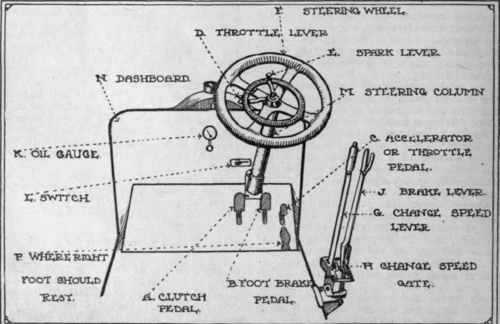
The various parts of a car which confront the driver as she takes her seat. The mechanical contrivances of the modern car are almost perfect, and the veriest beginner should find but little difficulty in learning how to use them
Continue to:


My Books

