


7. The Home Kindergarten '
Description
This section is from "Every Woman's Encyclopaedia". Also available from Amazon: Every Woman's Encyclopaedia.
7. The Home Kindergarten '
Stick, Ring, and Thread Laying - How to Use the Sticks - A Gradual Introduction to Reading and Arithmetic - How Designs May be Made Permanent - The Educational Value of Ring Laying Thread Laying a Preliminary Step Towards Drawing
A bundle of plain wooden sticks seems unpromising material, but the genius of a mother teacher is able to use it to open up a veritable fairyland of delight.
With tablets the child made pictures in the solid, but with the material now available the pictures will be in outline only, and thus the child will find greater demands on his imagination in order to complete the picture.
The sticks for stick laying J resemble matches. Indeed, matches robbed of their business ends, and cut to various lengths, may be used, but makers of kindergarten accessories sell proper boxes, containing an assortment of sticks, at 6d. per box, or at is. 6d., including diagrams and directions.
The child should be given the sticks tied up in bundles of ten, so that he may regard the bundle as the whole and each stick as a part.
Withdrawing one stick, the child should examine it, and by conversation adapted to his age learn about the material of which it is composed. The knowledge thus gained will give him a new interest in wood. He will observe other things made of wood, while a visit to a carpenter's shop or a sawmill will be a connecting link between wooden articles and trees, little chats about which can be given during his walks.
The various positions that one stick can assume must be found out, and the child can learn that the letter I resembles his stick when in an upright position. The drudgery of learning to read must be faced sooner or later, and it is well if its first steps are overcome by easy stages.
Two sticks form the next step of the occupation, and the way in which they can be arranged with regard to each other exercises the imagination in discovering objects which resemble the forms made. The letters L T X and V can each be formed with two sticks, and when subsequently three sticks are manipulated, not only can the letters A F H K N Y and Z be arranged, but the word It can be formed. Three sticks afford greater scope for representing forms. With them can be depicted a table, a stool, an umbrella, a flag, a funnel, a tent, and many other things. The number of sticks employed should be increased gradually at each play lesson, and in every case objects should be attempted first, as being more familiar to the child than the artistic forms with which each play lesson should close.
Every figure made affords an opportunity for an interesting and instructive conversation or the relation of a little tale.
The artistic forms, although making a less direct appeal to the child, should not be omitted, and will be tolerably easy, for previous exercises with the other gifts will have developed the child's sense of beauty, harmony, and symmetry.
When the child is familiar with the ten sticks of one length, it is well to introduce variety by giving him sticks of different lengths, which afford greater scope in pattern forming.
The patterns can be formed by the child following the directions of his mother, or he may be given a certain number of sticks, and told to see what he can make with them, but, as with the building cubes and the tablets, whatever is given must enter into the design - there must be none left over.
It is with a sense of disappointment that the child sees his best efforts destroyed at the end of each play lesson, therefore permanence may be given to his efforts by fastening the designs to brown paper with seccotine or strong gum. There is a special reason for this when letters are formed and simple words built up. By pinning the sheets on the nursery wall, the child becomes familiar with the forms of single and combined letters, and thereby reading and spelling are made easier.
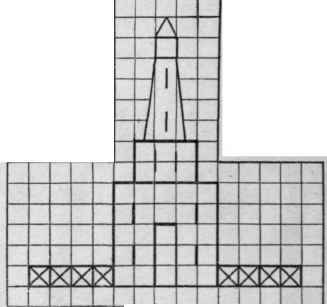
Stick laying. A realistic lighthouse can be constructed by the child with the help of sticks and properly squared paper or cardboard
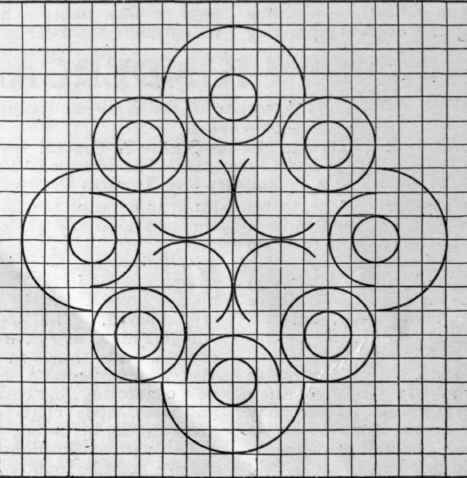
Design for ring laying. This operation marks a distinct advance upon stick laying, and appeals more strongly to the aesthetic instinct
The importance of tying the sticks in bundles of ten is realised when sticks are used as concrete examples in arithmetic. Without difficulty the child realises the relationship between units and tens, and learns by means of bundles and loose sticks to work little examples in addition and subtraction.
Ring laying is a distinct advance upon stick laying. There is greater possibility of beauty of form in the curve than in the straight line, and a stronger appeal to the aesthetic instinct.
In using the ring-laying gift gradual steps must be observed. A ball, a circular disc of cardboard or wood, and a ring should be shown at the same time, that the child may compare them and find out the connection between them. The ball looks like a disc, and if it is made of plastic material such as clay or dough, can easily be transformed into one by pressing it, while the child sees that the ring is merely the outline of the disc.
The rings sold at kindergarten depots are made of iron, and this material lends itself to many interesting conversations. The child can be told about the source of iron, and the little chats should be illustrated by pictures. The discussion of the new material leads the child to notice ironwork, and to find out all that he can about it. This newly aroused interest will prove a source of unfailing pleasure. The child will find interest in the common things of everyday life, and this will act as an antidote to the restless seeking after pleasures and excitements which cost money out of all proportion to the good they bring.
Boxes of rings can be bought at 6d. and is. per box. These contain rings in three assorted sizes, likewise a corresponding selection of half rings, and from these two forms a kaleidoscopic number of "designs can be built up.
When the whole ring has been examined and its properties discovered, two rings of like size should be given, and then three, four, etc. They may be arranged either to touch or to overlap, and in this way beautiful designs may be evolved.
Next follows a combination of rings of unequal sizes, and here there is the new experience of being able to place one within the other. Later come the half rings to increase the scope for originality.
A yet further step towards the more difficult art of drawing is found in the occupation of thread laying, which, although the least costly, is not the least valuable.
A thread bears a strong resemblance to the line of an outline drawing, and being soft and flexible it can be manipulated by little fingers which have not yet gained sufficient strength to govern and direct the course of a pencil over paper. The zest with which children carry out this occupation is doubtless due to the subtle fascination which thread exercises over young minds. No boy's pocket is complete without pieces of string, for which he finds countless uses, and coloured wools and silks are a girl's most dearly cherished possessions, and lure her on to master the intricacies of needlework and woolwork.
Cat's-cradle played with string gives everlasting joy, and while the child is puzzled to know what affects the changes, he sees a variety of pretty forms and cultivates lightness and dexterity of touch.
For the occupation of string laying the requirements are a slate or a piece of board, half a vard of coloured knitting cotton or thick silk, and a wooden skewer.
The two ends of the thread must be knotted together, and the circular piece thus formed must be dipped in water until it is thoroughly soaked. Wet string is more tractable than dry string, and when once placed in position retains it for a long time.
The joined length of string when placed on the surface of slate or wood can then be altered in position, and the manipulation of the thread by the aid of the skewer point will not only give an outline resembling a drawing, but will develop also lightness of touch. He will soon invent some of the simpler forms, and as a sequel to each change of form there should be conversation or story-telling.
The past experiences of the child with the gifts will have stored his mind with ideas of beautiful forms, and upon this store he will be able to draw so that with the thread he will reproduce old patterns and evolve new ones.
Continue to:


My Books

