


A Dance Or Theatre Coiffure. Continued
Description
This section is from "Every Woman's Encyclopaedia". Also available from Amazon: Every Woman's Encyclopaedia.
A Dance Or Theatre Coiffure. Continued
Hold the ends of the strand in the left hand, and insert the fingers of the right hand under the strand near the roots, and over the strand just beyond. Then turn the ends over, and tuck them out of sight in the loop of hair thus made, at the same time drawing the hair, with the fingers of the right hand, into a decided dip on the forehead. The upward turn and lowest point of the dip coincides with the wave in the hair.
Fix this loop or puff firmly with pins, taking care the ends are hidden. In a dressing of this sort, with puffs and a plait coming over the front dressing to bend it in place, side combs are not necessary, and pins answer far better.
Following the puffs round to the left ear, the next to be made is just beyond the parting; and this puff, directly above the left eye, forms a charming variation. It breaks the line across the forehead, and leaves a most becoming piece of skin showing, being lifted back a la Pompadour.
Divide a small strand, French comb and brush it, then lift it back and turn the ends under. Finally, draw the roots, consisting mostly of short hairs, gently forward over the forehead, giving a shadowed, soft effect, in contradistinction to a hard Pompadour roll.
The side piece now remains, and for this style the side hair, on both sides, should be carried rather far round, well behind and beyond the ears. This gives an undulating effect at the side, and serves to narrow the dressing towards the back of the neck.
French comb the side pieces, and lift it into place, leaving it soft and full, and slightly divided from the Pompadour roll. Turn the ends in, and pin it securely.
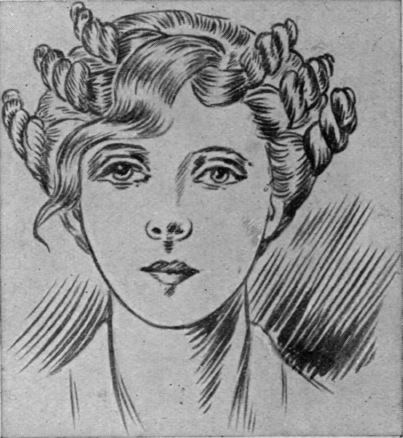
Six puffs are to be worn across the forehead. Those on the left side should be smaller and lie in a different position from those on the right. The lock in the centre will form the large Louis XV. Duff which will droop towards the middle of the brow
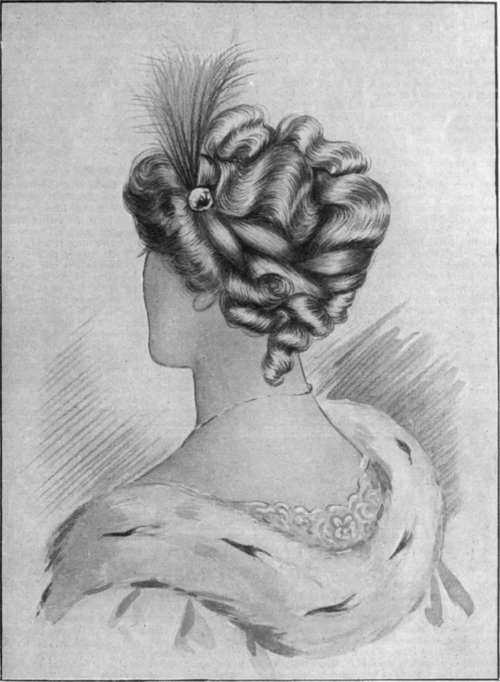
The arrangement of the theatre coiffure as seen from the back. The lines are graceful, and the general effect one of lightness and charm
The puffs going from the centre to the right are made in the same manner as the centre dip described above, but just a little smaller. Each puff must be kept decidedly apart, but unsightly gaps are, of course, not desirable.
The side piece is arranged exactly as on the left, and when that has been done there should be six undulating puffs across the ears and face securely fixed with hairpins. The making of the first puff is illustrated.
As I have pointed out, the novelty of this style is in the front arrangement, which should suit almost any face, as it is a happy combination of a parted and a raised dressing, and can be pulled out, flattened, or heightened to suit individual taste.
With regard to the back, the chief novelty lies in the arrangement of the curls, which should lie just on the neck, below the roots of the hair, and well below the puffs and plait. (See illustration.)
Such a style needs a long, graceful neck and a pretty, upturned chin. Neither a long, heavy face, nor a short, fat neck would look well with such a mode. In that case I would advise that the whole of the puffs, plaits, and curls are lifted, till the lowest curl rests on the hair, instead of below it.
Having fixed a pad over the foundation, divide that tail of hair into six portions, one being rather larger than the others. This strand must be allowed to drop below the pad, as it will afterwards make the neck-curls.
There are five large, light puffs, fixed gracefully up and down on the pad, and five curls on the neck to correspond with those above. The five strands must then be waved on pins, French combed, and arranged tastefully. Let them remain exactly as they lie, encouraged by the wave. It will be found that puffs fall differently each time they are dressed, and they should never be forced out of their natural "line." Three puffs should be placed towards the front of the pad and head, and two towards the back, completely hiding the pad.
Arranging The Curls
The curls are next arranged, being first rolled in five papillotes to make them curl naturally and look like ringlets. Full directions for curling en papillote will be found in the article on curls. (See page 3597, Vol. 5.) When the curls are unfastened they should be lightly rolled round the fingers, and left as they fall, with the curling ends slightly pulled out. Some of them will hang shorter than the others, and these must be fixed, above each curl, with a fine hairpin. Do not pin through these curls, but above them, to keep them from falling together untidily. Four ends should lie just on the nape of the neck, lightly attached to the hair, and one should be allowed to drop below them on the bare skin. (See illustration of back view.)
Jewels In The Hair
Lastly, the plait is made and fixed round the puffs, resting between them and the curls. It is tied round the hair, rather like a cravat, and serves to bind and hold the entire dressing in place. It makes the curls fall naturally and gracefully by tightening them from above, and supports the larger puffs. The plait should start above the left ear, and be brought round to the same place, where the crossing and turning in of the ends can be hidden by a jewelled ornament or brooch, so attractive an addition to an evening coiffure.
Jewels in the hair catch the light, and give added lustre to the tresses they adorn. An aigrette, fixed so that it points upwards (to moderate the length of the coiffure at the back), would also be in keeping, and could be held in place by the same brooch that finishes the plait.
Continue to:


My Books

