


Beautiful Wmen In History - Queen Louisa Of Prussia. Continued
Description
This section is from "Every Woman's Encyclopaedia". Also available from Amazon: Every Woman's Encyclopaedia.
Beautiful Wmen In History - Queen Louisa Of Prussia. Continued
Gathering Clouds
They spelt exile to her and her family. The following years found them established at a little farmhouse, living frugally, sometimes almost entirely without ready money. Yet the King, when he sold his gold plate, did so for the poor, not for himself nor even for his children. The Queen was almost happy. This quiet domestic life was what she was born for.
Her famous interview with Napoleon at Tilsit will never be forgotten. She constrained herself to be pleasant and gracious with him, and humbled herself to plead for her conquered country. He translated her manner characteristically - thought he had made a conquest. But he admitted that had she been present when peace was first discussed the issue might have been different.
The life in the farmhouse at Memel, outside Berlin, was by no means empty of outside interests. Louisa spent her time encouraging young men of genius in the arts. She wrote essays herself, and sang patriotic songs in a sweet, pathetic voice.
It was at this time that she wrote to her father, the Grand Duke of Mecklenburg-strelitz, a very long and very beautiful letter, of which the following is only a small portion:
"You will learn with pleasure, dear father, that the misfortune which has overtaken us has not penetrated into our domestic life; it has rather made it more steadfast and precious. The King, the best of men, is kinder and more loving than ever. I often think I see in him the lover and the betrothed. Only yesterday he said to me simply, and looking me straight in the face with his honest eyes, 'dear Louisa, you have become dearer and more precious to me in misfortune. Now I know from experience what I am to you. Let storms rage without, if only in our married life there is good weather and a continuance of it. I called our youngest daughter Louisa because I love you so much. May she become a Louisa!'
"This kindness moves me even to tears. It is my pride, my joy, my happiness, to possess the love of the best of men; and because I love him from the heart in return, and we are so one with each other that the will of the one is the will of the other, it is easy for me to preserve this happy harmony, which becomes more inward as the years go on."
Borowsky, preacher in Neuriss-garten Church, said of her:
"Joyful our dear Queen is not at this time, but the clearness and calm which God gives her diffuse a grace over her whole personality which is full of dignity. Her eyes have, of course, lost their former vivacity, and one sees that she has wept, and still weeps much. They have, however, a milder expression of melan.-choly and calm longing that is more attractive than any delight in life. The bloom of her countenance has faded, and a soft pallor has overspread it, but it is still beautiful.
. . . A gentle quivering of the lips is observable at times instead of her former gentle smile. It indicates pain, but not bitter pain. Her dress is extremely simple, but choice of colours is determined by her mood." In 1810 she went to visit her father, the King following her in a few days' time. Before he joined her she was standing near the Grand Duke's writing-table, and on a sudden impulse she sat down, and wrote a little note to him:
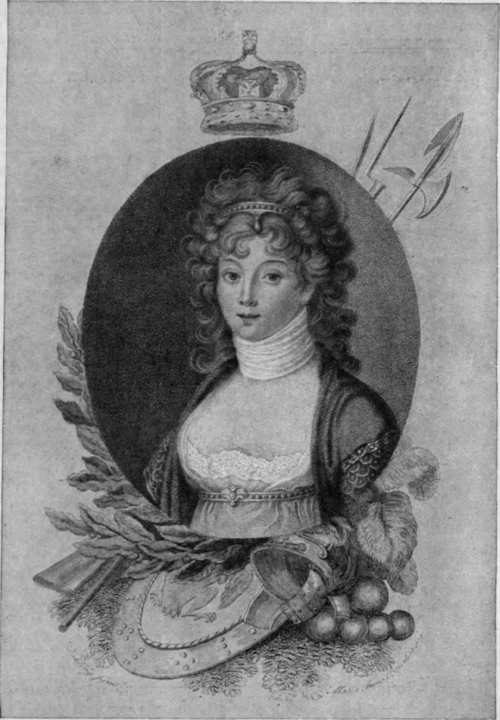
Louise, the beautiful and heroic Queen of Prussia, who was the idol of the German nation during the dark days that followed the disaster of Jena. She humbled herself to plead for her country with the victorious Napoleon, but without success From the painting by Dahling, 1805
"My dear father, I am very happy to-day, as your daughter and the wife of the best of husbands." That was her last letter. She was taken ill that evening, and though she rallied, it was not for long. She died very quietly, with her hand in her husband's, and her body was taken back to Berlin on the seventeenth anniversary of her entry there.
She was mourned as a daughter and a saint in every home in Prussia. Thirty years afterwards, when the King died, it was found that the cover of his Order of the Black Eagle concealed a portrait of his young wife, which he had worn all those years unknown to anybody. He founded two orders in her memory - the Luisen Order, for services rendered by women to the sick and wounded in time of war; and the famous Order of the Iron Cross, the V.c. of Germany.
Far away in England a young duke nearly followed her from sheer grief at her death; and among men of genius she was lamented indeed. Rauch's monument was inspired by his attachment to her. Novalis wrote that all mothers ought to hang her portrait in the rooms of their daughters: "So shall the young girls have continually before them a lovely reminder of the ideal whereto they should seek to conform their lives. So shall likeness to the Queen become the chief characteristic, the national feature, of Prussian women."
Once she visited some mines, and the old miner who took her through the cavern, describing her in her miner's dress, said:
"I sat at the rudder, and I could see the Queen's sweet face well by the light of the lamp. In all my life I never saw such a face. She looked grand, as a Queen should look; but she was gentle as a child, and had the sweetest smile I ever saw. . . . She gave me with her own hand a little paper with two new Holland ducats, and I gave them to my wife, and she wears them for a necklace when she goes to church, or to take the Sacrament, for what that Queen had touched was holy."
And the old miner's eyes were streaming with tears.
Continue to:


My Books

