


Beautiful Women In History. The Lovely Duchess Of Tyrconnel
Description
This section is from "Every Woman's Encyclopaedia". Also available from Amazon: Every Woman's Encyclopaedia.
Beautiful Women In History. The Lovely Duchess Of Tyrconnel
Of all the brilliant, beautiful women who made the glory of the Stuart Courts at Whitehall, none was more lovely than Frances Jennings, sister to the first Duchess of Marlborough.
Frances Jennings was born in 1648, and brought at a very tender age from the quiet of her country home at Holywell House, St. Albans, to be Maid of Honour. "Nature had endowed her with all those charms which cannot be expressed, and the Graces had given the finishing strokes to them. The turn of her face was exquisitely fine, and her swelling neck was as bright and as fair as her face. In a word, her person gave the idea of Aurora, or the goddess of spring, 'such as youthful poets fancy when they love.'"
A girl of sixteen thus endowed by Nature, and placed in the centre of the dazzling gaieties of Europe, might well have made shipwreck. The men were all handsome, spirited, witty, and unscrupulous. They were all impregnated with the importance of obtaining at whatever cost whatever they desired, either for the gratification of their tastes or the swelling of their pride. Miss Frances Jennings possessed, in addition to the already catalogued charms, an amount of hard commonsense and a knowledge of the world far in advance of her years. The rule of conduct she laid down for herself at Court she thus wrote for our amazement:
A Wise Maiden
"A lady ought to be young to enter the Court with advantage, and not too old to leave it with a good grace. She could not maintain herself there but by a glorious resistance or by illustrious foibles; and in so dangerous a situation she ought to use her utmost endeavours not to dispose of her heart until she gave her hand."
This is, indeed, the wisdom of the ancients. Opportunities of testing the strength of her character and the efficacy of her rule of conduct were not long in coming. Her advent to the gay circle at Court caused much stir in many hearts, and the Duke of York became constant in the siege to her prudent defences. She was utterly unresponsive. She missed no occasion of humiliating the ardour of the Royal gallant. Daily billets of the most melting douceur and the most lavish promise were slipped by the King's brother into the pockets of her gown or into the folds of her muff. Whenever she perceived this, "the malicious gipsy," as Grammont calls her, "took care that those who saw them slip in should likewise see them fall out, un-perused and unopened. She only shook her muff, or pulled out her handkerchief; as soon as ever his back was turned his billets fell about her like hailstones, and whosoever pleased might take them up."
She laughed at him, and teased him. And as no lover can well stand ridicule, let alone a dull Royal duke conscious of his dignity, he soon forsook the campaign in a huff and sought for conquests more comfortable and holding fairer promise of victory.
Then came for a brief moment the King himself to the pursuit of the fair Frances. He, with his gay charm, might have wrung surrender where his brother aroused laughter had he not capitulated to La Belle Stuart.
Handsome, dare-devil, roystering Dick Talbot then came swaggering along, and for the first time Frances appears to have been touched with the love which she so successfully aroused in others. He, too, fell in love with her at first sight, and, whatever his faults - and he had many - he redeemed them all with lifelong constancy.
The Future Duchess as an Orange Girl
Among his defects was a raging temper and a domineering spirit, which was the cause of constant interference and quarrelling, and ended in Frances telling him, with more spirit than tact, that he had best attend to his own affairs, and that if he only came from Ireland to read her lectures about her conduct, he might take the trouble to go back as soon as he pleased. He did, and his place was soon filled by Henry Jermyn, fop, coxcomb, but handsome and witty as were the fops of the Stuart period. He was heir to the Earl of Arundel and £20,000 a year. The wooing was ardent, and it was only in the hour of acceptance that Henry Jermyn began to cool. The final rupture was again caused by the very free-and-easy conduct of Miss Jennings. The escapade which finally brought matters to a head is characteristic of the times, and enjoys a lasting fame. The Earl of Rochester, with more wit than sense, had written upon the door of the King's bedchamber the lines which will keep his memory alive long after his other verses are forgotten:
Here lies our sov'reign lord the King, Whose word no man relies on; He never says a foolish thing, Nor ever does a wise one.
He was exiled for this joke, and amused himself on his return by masquerading as a great German astrologer and physician. Few knew the secret of his disguise, and, thanks to his knowledge of Court life, he achieved no small fame as a fortune-teller.
Miss Prior, one of the Maids of Honour, persuaded Frances to seek out the German astrologer to ask him why a man who was in love with a handsome young lady was not urgent to marry her, since, by so doing, he would have an opportunity of gratifying his desires. The question was one which faithfully represented her relations towards
Jermyn, and she went into the adventure with her usual fun and spirits. The two donned hoods and the rough serge petticoat of the lower classes, and, armed with baskets of oranges, set off to the abode of the soothsayer disguised, as they hoped, effectually as orange girls. On passing the Duke of York's Theatre, where the Duke and Duchess were paying a State visit, the daring idea occurred to them to enter the theatre and test their disguise by selling oranges under the Royal box.
Nell Gwynne has shown us that the standard of beauty among the orange girls was high, and we know quite enough of the manners of the times to appreciate the sort of reception accorded to these two quite remarkably lovely orange girls.
Tom Killigrew, wit, playwright, and always to the fore when a pretty woman was in the case, made in their direction immediately they appeared, and, chucking Frances under the chin, endeavoured to snatch a kiss from her lips. Others soon followed his example, and the two girls fled, much alarmed lest they should become the centre of a disturbance which would lead to the discovery of their identity.
A Gentleman of the Bedchamber to the Duke of York, and, as ill-luck would have it, a friend of Jermyn's, had noticed the commotion, and, on going to the door of the theatre, saw the two humble orange girls hailing a coach. While the two were trying to get their coach, a crowd gathered, and as they got into it the street boys stole their oranges, the coachman lashed at them with his whip, and Jermyn's friend caught a glimpse of most patrician silk stockings underneath the humble serge skirts of the two girls. It was enough to confirm his dawning suspicions, and the next day the story, with names and full details, was all over the Court.
Jermyn took the matter very ill. He felt that his dignity had been compromised, and took steps to affront his betrothed in the most open manner by making in secret his arrangements to leave with Prince Rupert's expedition to New Guinea. Frances, however, had got wind of his purpose through a friend, and when Jermyn came to bid her farewell she received him, not with sighs and tears, reproaches and regrets, but with laughter and with ridicule. She wrote a parody of one of Ovid's Epistles so deadly in its humour that he saw that if he went to New Guinea he would be followed by the laughter of the whole Court, and decided to stay behind and make his peace with his fair tormentor. She, however, would now have nothing whatever to do with him.
Her next suitor, though by no means so eligible a party as others who had failed, was George Hamilton, fourth son of the first Earl of Abercorn. He was one of those mortals Fate has decreed shall for ever be in love. He had been snubbed by La Balle Stuart, and came to Frances really to have his ruffled feelings smoothed. This time no inconvenient escapades threatened the course of true love, and as Hamilton, who died in the service of France on an Alsatian battlefield, left her with a large family, it may be taken for granted that Frances had given him her hand and her heart.
Days Of Splendour
After three years in Paris, she again met her first suitor, Richard Talbot. He, in the first moment of pique at his refusal, had been caught on the rebound; but his wife had died in the intervening years, and he gave proof of his constancy by marrying Frances Hamilton in 1679. He was then in exile as the result of the anti-papal agitation in England.
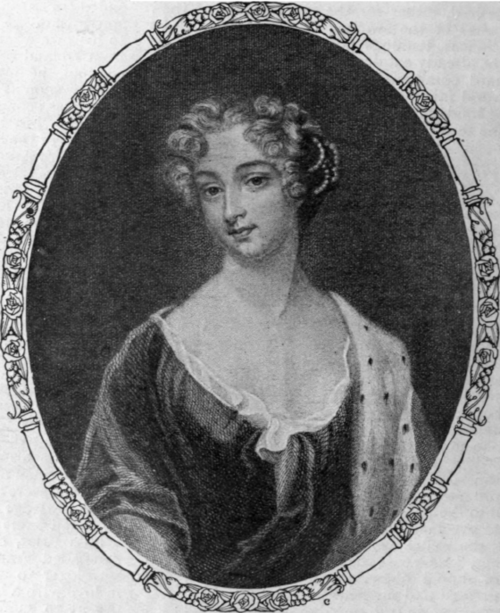
The beautiful Duchess of Tyrconnel, who as Miss Frances Jennings was one of the most charming and popular "beauties" of the Court of Charles II. She remained to the end the most loyal of loyal Jacobites From the original picture in the possession of Earl Spencer at Althorp
On the accession of James II., he was created Earl of Tyrconnel, and his wife was made Lady of the Bedchamber. When James abandoned the throne, Tyrconnel gave proof of the political constancy of his character by refusing to take the oath of allegiance to William. He went to Ireland, and placed himself at the head of the Jacobite rising there. His exiled King created the dukedom of Tyrconnel, and made him Viceroy and Commander-in-chief in Ireland. The Duke and his still lovely Duchess reigned in great style at Dublin Castle. They maintained great state, and dispensed truly Irish hospitality to Jacobite supporters.
The battle of the Boyne then came with its sledge-hammer blow to shatter the magnificence of their existence. All Dublin was in the greatest suspense. With the news of the defeat of the Jacobites, the Duchess received the death-knell of her hopes and ambitions. Her courage rose triumphant to the needs of the hour, and when, twenty-four hours later, the King and her husband arrived, hot, perspiring, and bespattered with their flight from the stricken field, the King was received with all the honours of his rank. Though she knew that all was lost, that they must fly for their lives that very night, she awaited the King at the head of the grand staircase superbly gowned, her beauty adorned with the finest of her jewels, and conducted the defeated King, who had once been her slave, to a State banquet.
The flight took place that night. The Duchess took up her abode at St. Germains, while her husband made desperate attempts to uphold the broken cause of the King across the water. He died of apoplexy brought on by a defiantly merry banquet during the siege of Limerick.
And his widow was left to share the irksome splendour of the exiled Court in Paris.
Continue to:


My Books

