


Dress - Lace Flowers. Continued
Description
This section is from "Every Woman's Encyclopaedia". Also available from Amazon: Every Woman's Encyclopaedia.
Dress - Lace Flowers. Continued
Such a border as described above makes an exquisite trimming for a scarf. The narrow sleeve border is worked down each side, the deeper border with fringe at either end. A powdering of the main fabric with groups of beads, which give a spot effect matching the borders, would greatly enhance the beauty of the scarf.
Narrow Bodice Trimmings
Very pretty bodice or hat trimmings can be made with pale-coloured ribbons and a few bugles and beads. One of the most successful
Dress would be of inch-wide watered ribbon of a thick, corded make, down the centre of which is sewn a decorative line composed of two gold beads, a white bugle, two gold, a pale green round bead, opaque, and about the size of a pea, repeating then the two gold beads, a white bugle, and so on. This very simple line has a good effect.
To make the edge, fasten the No. 50 white cotton on the backs of the ribbon edge, and bring the needle to the front exactly at the edge. Now thread two white bugles on the needle, and sew with two stitches to the edge of the ribbon; then thread on two more bugles, and so continue for the length required. When one edge is finished, turn and ornament the other edge in the same way. It is fascinating to see how the two bugles form themselves into a vandyk by the simple means of stitching and fastening at regular intervals. Such an edging, worked with gold bugles on a brown velvet, and with golden russet beads as the centre line, would give a note of distinction to a best day dress, or, in green and silver, would make a beautiful evening-dress trimming.
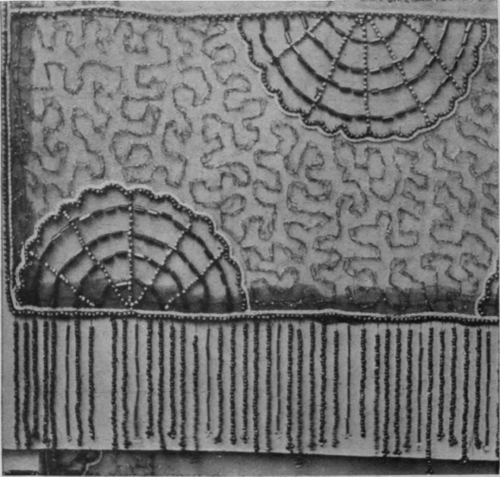
A wider border, worked as described, should be supplemented with a fringe of mixed bugles and round beads
The moss-green velvet border, with simple outline of pale rose-pink bugles, with tiny gold beads between, was made as a hat trimming for a shady leghorn shape whose sole garniture was this green velvet, with handsome curved running pattern.
The curves were made with a wineglass, and so receptive was the pile of the velvet, that, by firmly pressing the rim of the glass on to the ribbon, a sufficiently distinct mark was impressed to guide the eye when sewing on the beads.
The same plan was used in the decorating of a cherry - red velvet strip with black bugles, the impress of a teacup in this case making the outline for some garlands. This pattern is repeated with only enough room between the garlands for a pendant string of small beads which hangs with tassellike and telling effect. This pattern could be made elaborate by placing a fuller bunch of beads - in fact, a veritable tassel - between each garland.
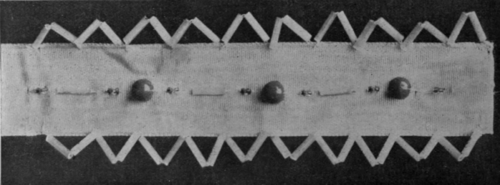
A ribbon with a vandyked edging of bugles and a centre line of bugles and beads, makes a pretty trimming for a corsage or a hat
The chain is threaded and then stitched to the velvet so that the labour of sewing on each bead is avoided. Even the threading of the beads need not be done by the worker; it is possible to buy strings of beads, simply sewing them on, and passing the cotton through the velvet and fastening off firmly.
We can imagine the beauty of grey satin ribbon, with garlands of clouded gold glass bugles and some cut gold beads in tassels, or of a navy blue and black shot taffeta, with dull gold garlands and blue-and-gold tassels.
There is, indeed, no limit to the capabilities of ribbon velvet treated with bugles and beads. The result of such combinations in the hands of a skilled craftswoman are in no way commensurate with the cost of the materials.
The Entre-Deux Of Bugles
In dressmaking, it is often desirable to join the edges with ornamental stitching, therefore the bugle entre-deux is a very useful expedient, and, though effective, is very quickly worked.
Another highly practical advantage which may be claimed for this ornamental trimming is that it can be widened to any extent. All that is required is to continue the bugle pattern to the required width before joining to the other piece of material.
To begin the bugle insertion, fasten the cotton firmly to the upper edge of the material to be joined, then thread on one bugle, one ordinary round glass bead, and a second bugle. Fasten this on to the edge of the material, one bugle's length away from the first fastening. Continue the whole length of the material to be joined, when a vandyked edging will be seen similar to that shown in the blue-and-white bugle border before described.
For the second row, fasten the cotton to the fabric, thread the needle through the bugle already sewn on, then through the bead, and pick up one bugle, one bead, one bugle. Pass the cotton through the next small, round bead, already sewn on. Continue thus, using the bead at the apex of each vandyk to secure the new vandyk in place. Continue the whole length of the work, and recommence in the same way if a third, fourth, or fifth row is required to make the bead insertion wider.
The beauty of this work may be greatly enhanced by using handsome, larger at the point of each vandyk. Thus, with green bugles and gold beads, a beautiful insertion can be made for a green taffeta dress trimming.
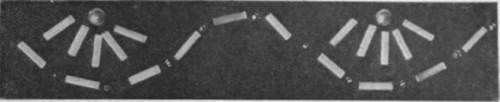
A border of moss-green velvet, worked with rose-pink bugles and small gold beads, would form a simple garniture for a leghorn hat
Pearls with milk-white bugles, or clear glass bugles with silver beads, look charming as a network trimming for the dress of a debutante. Such a network may form a whole sleeve and a wide border across the front of the dress, or, as in our pattern, show simply between two pieces of inch-wide ribbon velvet.
If those who are inclined to try their 'prentice hand on this subtly fascinating handicraft, which utilises so wonderfully their gifts of colour-blending and artistic design, cannot find any opportunity of using the product of their skill upon garments or millinery belonging to themselves, let them not be deterred thereby from pursuing their hobby. They assuredly will have friends or relatives who are blessed with small daughters, and these will welcome eagerly a gift of suitable trimming for the little maiden's outdoor or indoor wear.
It is so easy nowadays to dress a child both well and prettily, and in no way can it be better done than by lavishing upon its little garments beautiful and appropriate handwork. It is this beyond all else that gives a cachet to the little wearer, and the mother or aunt, endowed with skill but possessed probably of limited means, can vie successfully for once with her who can command the highest-priced output of the fashionable atelier which caters for those children who may be said to be born with the proverbial silver spoon in their rosy mouths.
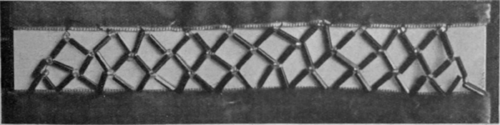
An entre-deux of bugles and round glass beads between two strips of velvet ribbon. This is an effective and quickly worked pattern, and can be contrived in any width desired
Continue to:


My Books

