


Famous Lady Explorers. Part 2
Description
This section is from "Every Woman's Encyclopaedia". Also available from Amazon: Every Woman's Encyclopaedia.
Famous Lady Explorers. Part 2
" Always when I was on the march I slept with my guns loaded by my side and my revolver under my pillow, as much to intimidate my bearers as to protect myself against wild animals. Sometimes the bearers grew sulky and would not put up my tent, but, on the whole, they served me very well indeed."
Undeterred by the perils through which she has passed, Mrs. Roby intends to start on another African expedition as soon as possible.
An American Explorer
She reminds one very much of Mrs. French Sheldon, also an American lady, who is one of the most daring women living. Mrs. Sheldon enjoys the distinction of being the first woman to be appointed a Fellow of the Royal Geographical Society. She has specialised in exploration on the African continent. Unaccompanied by any white person, she has penetrated the country between the Stanley Falls and the Kasai district, and on one of her journeys she marched more than 6,000 miles on foot, carrying a rifle, and clad in attire that closely resembled that of a man.
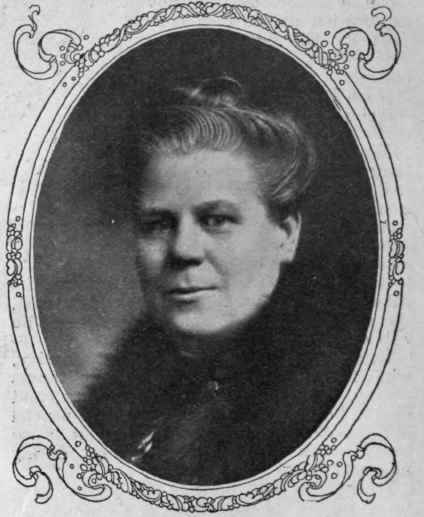
MlissA. D. Cameron, an intrepid lady who undertook a ten-thousand' mile journey from Chicago to the Arctic regions
Photo, Elliott & Fry
For days she would tramp along without seeing a human being. She has camped in the midst of cannibals, been through regions where the men ranged upward in height from 6 ft. 4 in., and in order to learn all about fetishism and cults and secret societies in East Africa and the Congo, actually entered into a blood brotherhood with about thirty tribes with whom she came into contact during her travels.
The African natives called her Bibi Baana Pemba, meaning White Women Master, or. Bibi Bula Matari, meaning the Rock Breaker. And she deserved those complimentary designations, for no difficulties daunted her. Often she would wade waist deep through dangerous, unhealthy swamps, and once her tent was invaded by myriads of ants, which crawled all over her, and entangled themselves painfully in her hair. On another occasion a wild leopard-cat leaped right on her head, and was with difficulty dislodged. Her various journeys resulted in some valuable ethnological discoveries, which are recounted in detail in her books.
Reference has already been made to the journey from the Cape to Cairo accomplished by Miss Mansfield. The journey was also undertaken and completed some time before by Miss Mary Hall, who, in her book, "A Woman's Trek from the Cape to Cairo," gives a striking description of the perils and hardships which such a journey entails. She travelled through thousands of miles of forests, plain, rivers, and lakes, and was known to the natives as the "Jungle Woman." Curiously enough, Miss Hall was first led to pursue the adventurous calling of explorer through a voyage which she undertook in search of health after a prolonged illness.
The last British lady to journey through African wilds was Miss Olive Mcleod, a daughter of Sir Reginald Mcleod, late Permanent Under-secretary for Scotland. It was not, however, for the glory and honour to be won as a lady explorer that Miss Mcleod traversed 4,000 miles through savage Africa and won for herself the applause of scientific societies. The primary object of her mission was to visit the grave of Lieut. Boyd Alexander, the explorer, to whom she was engaged to be married, and who had been treacherously murdered by natives in the French Soudan.
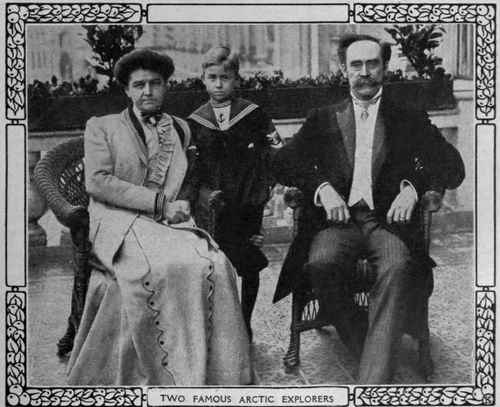
Mr, and Mrs. Peary and their little son. No woman has been so far north as Mrs. Peary, whose little daughter was born in the heart of the Polar regions Photo, G. Haeckel
She fulfilled her mission, and decorated her lover's grave with a wreath of English flowers which she had carefully preserved through all the vicissitudes of that long journey; but from that hour she was a genuine and enthusiastic explorer, fired with a desire to add to the world's knowledge of the Dark Continent. Speaking of her experiences with natives, Miss Mcleod said : "From start to finish we never experienced the slightest difficulty with them, although many of the tribes we visited were wild, and contained people the great majority of whom were little known, and certainly had never seen a white woman. At first they ran away, but afterwards returned, and their chief excitement seemed to be caused by the appearance of my hair."
During her journey Miss Mcleod collected a large number of curios, which included many quaint musical instruments, while a botanical collection of several thousand specimens has been sent to the British Museum, and a number of birds, beasts, and reptiles, including two fine lion cubs, tothelondonzoo. It was a motive somewhat similar to that which incited Miss Mcleod to undertake her dangerous mission which led another young woman of equally gentle and retiring disposition - Mrs. Leonidas Hubbard - to penetrate unknown frozen Labrador, where her husband succumbed to cold and starvation in 1903, a doom which has overtaken so many brave Arctic explorers. She, too, returned to find herself in the front rank of women explorers. With a couple of companions Mr. Hubbard had pushed into the utterly barren country, when provisions gave out, and the party were faced with starvation. Mr. Hubbard was the first to collapse, and his companions, leaving him in a tent, went in search of food to a provision depot, which they had previously established. They got back too late to save Mr. Hubbard's life.
Two years later, Mrs. Hubbard decided to visit her husband's grave and complete his work. Fearing opposition, she kept her intentions secret, setting out with three Indian - guides and an Eskimo boy. It was her secret disappearance which led to the report of her death, but ultimately she returned, after passing through some thrilling adventures.
Continue to:


My Books

