


Heroines In History - Flora Macdonald
Description
This section is from "Every Woman's Encyclopaedia". Also available from Amazon: Every Woman's Encyclopaedia.
Heroines In History - Flora Macdonald
Flora Macdonald has taken her place for over a century and a half among the most romantic heroines known to our history. And yet, beyond the main fact that she helped Prince Charlie to escape, few people know very much about the details of her life.
She was the daughter of Ranald Macdonald, a farmer in one of the islands of the Hebrides, her mother being also by birth a Macdonald. In 1728, when Flora was six years old, her father being already dead some years, her mother rejected the addresses of a certain Hugh Macdonald of Armadale, in Skye. He promptly abducted her. Thereupon, apparently thinking it better to be a friend than an enemy to so energetic a gentleman, Mrs. Macdonald "composed herself to the situation," and sent for Flora and her brother to live at Armadale.
No further romantic affairs happening in the clan Macdonald, Flora lived quietly for seven years, when she was taken into the mansion of the Clanranalds, of which her family were cadets. She was not particularly good-looking, although she had regular features and a pretty complexion. But she was graceful, modest, and of an extremely sweet disposition. Four years afterwards, she went to Edinburgh with Sir Alexander Macdonald and his wife, to pursue her studies. For six years she lived very happily in Edinburgh, and then returned to Skye.
This was the year of the troublous happenings in Scotland, of the disastrous battle of Culloden and the flight of Prince Charles Edward. Flora Macdonald was staying with the Clanranalds in Benbecula, another Hebridean island, when the Prince arrived there, in imminent danger of capture. The only chance of his escaping lay in his leaving the island disguised as a woman. Captain Neal, the companion of the Prince, talked it
World Of Women all over with Lady Clanranald. A woman must be found to act as guide to the disguised Prince, and, as a result, the loyal lady went in search of her young guest.
"Flora dear," she said, "just consider for the moment the dignity, honour, and glory of saving the life of your lord the Prince."
Flora was not of the emotional type of heroine. She looked at the plan all round, trying to decide if it were practicable, and, further, if she felt within herself the power of carrying it through to a successful conclusion.
"It is difficult, perplexing, and dangerous," she said, "and must be well considered. Moral courage will never fail me, never; yet moral courage may not be able to work impossibilities. I care not to endanger or even sacrifice my valueless life if I can but see my way to saving the valuable life of the unfortunate Prince."
No one was allowed to leave the island without permission. Luckily, Captain Mac-donald, her stepfather, who was supposed to be hunting for the Prince, but seems to have done it with both eyes carefully shut, was able to grant his stepdaughter, without asking her too many questions, a passport for herself, her manservant, an Irish "spinning-maid" "Betty Burke," and a crew of six.
On the afternoon of June 22, 1746, the Prince and Flora met for the first time. At ten o'clock that night the party set sail across the Minch to Skye. Flora's anxieties were much increased by the ungainly appearance and awkward manners of her spinning-maid. This lady, who wore a flowered linen gown, sprigged with blue, with a coloured quilted petticoat, a large hat, broad apron, and grey mantle with a large hood, took such strides that it seemed likely she would attract more attention than if the Pretender had simply walked about in the broad light of day in his own clothes.
The boat encountered a terrible storm - thunder, rain, and wind. The sea was a mass of foam. The Prince behaved very well, and Flora, when she had done all that was possible to help, considering that she was likely to have a very tiring day, went very sensibly to sleep.
The next morning, when they tried to land, a party of militia appeared, and greeted them with bullets. It was all they could do, as they had no boat, so the fugitives put out to sea again, and landed at Kilbride, near Monkstadt, where Flora's very good friends, Sir Alexander and Lady Macdonald, lived.
Leaving the Prince and her servant to take shelter in a small cave, Flora hastened to the mansion of the Macdonalds. Sir Alexander was absent with the Duke of Cumberland at Fort Augustus, but Lady Macdonald was at home, and had with her a number of guests. One of these was Captain John Macleod, in command of the militia. Flora had to undergo a very searching examination from him but with great self-possession, she answered his queries so well that his suspicions were lulled.
As soon as she had an opportunity, Flora spoke to the factor, whose name was Kingsburgh, and quietly he told Lady Macdonald. At first she was greatly alarmed. It was arranged, however, that the Prince should spend the night at Kingsburgh's house with Flora and her servant. Word was sent to the Prince, and about midnight they all went to the factor's house. The factor's wife was in bed, and on being told that her husband had brought visitors, and required her presence, she refused to get up at such an hour. However, when she was told that one of her husband's visitors was a great big girl, she got up in some haste, and came to inspect the lady. She was welcomed by an embrace from the Prince, which rather surprised her, but not so much as the roughness of his cheek, which soon told its own tale.
The next day the fugitives set out for Portree, where the Prince dropped his pilot, and sailed to Raasay. He took leave of Flora with tears in his eyes, and said that his gratitude would be eternal. He gave her a portrait of himself and a gold locket, but from the moment when his little sail dipped below the horizon, Flora neither heard from him nor saw him again, and he never so much as inquired of her fate.
The boatmen were allowed to return to Benbecula, where they were arrested, and confessed. The result was that on returning home, Flora received a summons from Captain Macleod. She was advised by her friends to flee, but with her own determination and straightforwardness of character, she resolved to attend. The interview resulted, as anyone might have foreseen, in her being imprisoned in the Tower. On the passing of the Act of Indemnity, she was set at liberty.
In 1750, she married Allan Macdonald, but after some years his estate was so impoverished that he was forced to emigrate to North Carolina, and on the outbreak of hostilities he was appointed Brigadier-general. Flora accompanied him, but when he was captured, on his advice she returned to Scotland. On the voyage the vessel was attacked by a French privateer. Flora displayed great bravery, and insisted on remaining on deck, where she got her arm broken in. the fight. She reached home safely, and settled down to await her husband's return.
She was evidently a woman of great charm. Dr. Johnson, when he visited her before she went to America, described her as a woman of soft features, gentle manners, and elegant presence. He was very much struck with her, and left on one of her tables a Latin motto, which Boswell translates as "With virtue weighed what worthless trash is gold!" He slept not only in the room, but between the sheets that had sheltered Prince Charlie, and when Flora died, in 1790, at the age of sixty-eight, by her own request her body was wrapped in the sheet on which the Prince and the great Doctor had slept. The original marble slab erected over her grave was chipped to pieces, and carried away in souvenirs, and subsequently an obelisk was erected by public subscription.
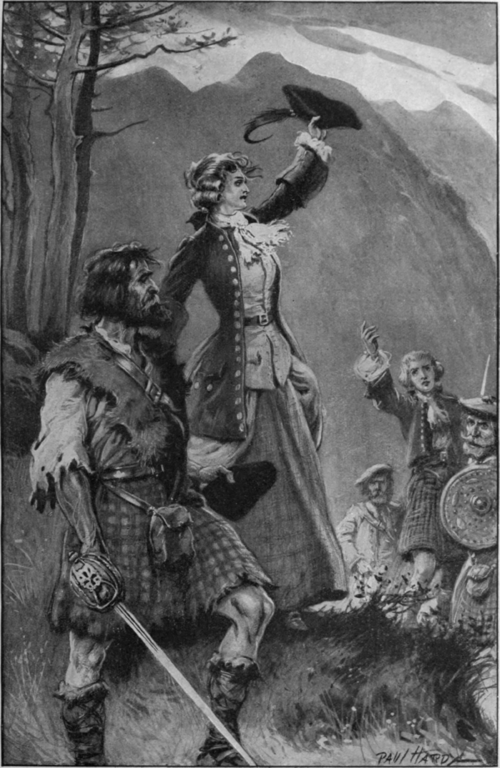
Flora Macdonald, whose heroism and devotion secured the escape of Prince Charles Edward (the young Pretender), bidding farewell to the hapless Prince as he left Scotland for ever
Continue to:


My Books

