


Lady Jersey. Continued
Description
This section is from "Every Woman's Encyclopaedia". Also available from Amazon: Every Woman's Encyclopaedia.
Lady Jersey. Continued
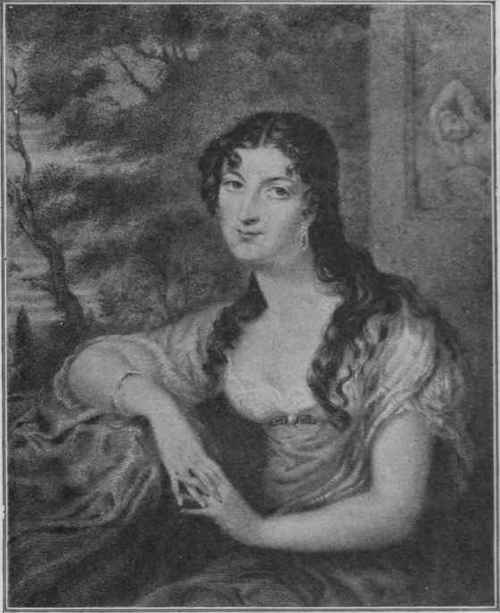
The Right Honourable Sarah Sophia. Countess of Jersey, the reigning Society beauty, and the richest heiress of her day. She ardently espoused the cause of the luckless Queen Caroline, wife of George IV., and was the friend and protector of 3yron during his social ostracism.
Engraved by f. Cochran, from a miniature by G. Hayter
Indeed, as a leader of fashion she displayed positively ferocious activity. She changed every article of clothing from head to foot four times a day, and her gowns were the talk of London.
Countess Granville says, " She is really wonderful, and how she can stand the life she leads is still more wonderful. She sees everybody in her own house and calls on everybody in theirs. She begins the day with a dancing master at nine o'clock, and never rests till midnight." Byron, after paying a tribute to her courage and kindness in "protecting him, says, " Poor, dear Lady Jersey ! Does she still retain her beautiful cream-coloured complexion and raven hair ? I used to long to tell her that she spoiled her looks by her excessive animation ; for her eyes, tongue, head and arms were all in movement at once, and were only relieved from their active service by want of respiration."
Lady Jersey had three daughters and five sons. The former did not see very much of their mother. They lived in a separate wing of the house at Middleton, and had a separate establishment. Regularly every day they paid a visit to their mother, when they repeated the Catechism, and were told how the day was to be employed and how they were to be attired in the evening. She insisted on her children speaking French only when they were with her. She took a great deal of interest in their progress in their studies, but unfortunately it was not of a very helpful kind. She set an examination paper for them every week, and among the questions put to the poor children was, " How long did the Romans stay in America, and what were their encampments ? ' The governess felt obliged gently to remonstrate with the Countess on this weekly "examination," and it was discontinued.
Beauty As Banker
Though she was the chief partner in Child's bank, and dined every week with her co-partners, she really had not much business capacity, at any rate where her household was concerned. She was robbed in every conceivable manner by her servants. Champagne and Tokay were the table wines in the servants' hall. Her maids wore her silk stockings at four guineas a pair. The tradesmen's accounts were cooked. She knew nothing about all this, but imagined her establishments were run in an admirable manner. Fortunately, Lord Jersey believed his wife was as good a manager as she herself did, and never troubled to look into things, so her business reputation never suffered where he was concerned.
In social matters, however, she displayed considerable ability. She was the Queen of Almack's, where her restless energy and somewhat tyrannical nature had fine opportunities. Byron says of her that "she was the veriest tyrant that ever governed fashion's fools, and compelled them to shake their caps and bells as she willed it." She herself acted upon the maxim that it is necessary in society to treat people as fools, and to treat them firmly. She frequently made herself ridiculous by her rudeness, and the air she affected of a tragedy queen. She it was who originated the aristocratic practice of clipping the final " ing," and this and other similar barbarities were used as the shibboleth for the exclusion of parvenus from the upper world. She it was who introduced waltzing, which was at first considered a highly indecent form of dancing. Prince Esterhazy instructed her, and her superb skill made the dance fashionable.
A Composite Character
She ruled Almack's with great severity. She insisted on receiving ocular proof of the dancing powers of all would-be members. A disappointed applicant once tried to soothe his feelings by challenging Lord Jersey, who said that if all persons who did not receive tickets from his wife were to call him to account for want of courtesy on her part, he should have to make up his mind to become a target for young officers, and he, therefore, declined the honour of the proposed meeting.
Lady Cowper, afterwards Lady Palmer-ston, was the Countess's only rival, and opinions were divided as to which of the two really was the queen of that brilliant little circle. Perhaps Lady Cowper was the most popular, for Lady Jersey's behaviour was not always of the sort to make her beloved. Her husband, who was perfection in his temper, according to Lady Granville, had fortunately a restraining influence over her, but she invariably got into trouble when away from him.
All her children died in their prime, and her misery as one by one they passed away was unspeakable. She allowed no one but her husband near her, and even he was not permitted to say a word to her. His presence, however, soothed her agitation somewhat. But in 1858 Clementina, her father's darling, died. It broke his heart, and a year later he followed her to the grave. Three weeks after that the Countess's eldest son died, and then it was not long before her one remaining daughter was lost to her. Her last child, John Francis, died in 1862. She herself lived for five years more, still brilliant, still admired. At the age of sixty she outshone all the younger beauties of the time at a ball, where, in the dress of a sultana, she was the most striking figure in the room.
To sum up, she was tyrannical, without the soft charm of woman ; she possessed neither wit nor imagination, she was rude and impetuous, prejudiced in her understanding, tiresome and quarrelsome. On the credit side, she was beautiful without being a coquette, prejudiced but without rancour, neither proud nor conceited, immensely active, and exceedingly kind-hearted. To the throne from which she ruled English society she attracted the Tsar Nicholas I., the Kings of Prussia, Hanover, Holland, and Belgium, Byron, Creevey, Greville, Wellington, and many others. She was indeed the most wonderful woman of her time.
Continue to:


My Books

