


Living Statuary
Description
This section is from "Every Woman's Encyclopaedia". Also available from Amazon: Every Woman's Encyclopaedia.
Living Statuary
A New Idea for a Children's Party at Trifling Cost of Time and Money - How to Mutilate a
Statue - Nursery Rhyme Statuary - The Accessories Required - Lighting and Posing - Pedestals and
How to Make Them - Whitening the Statues - Some Pretty Poses
Statuary tableaux vivants make a highly novel entertainment for a birthday party or for a "side show" for a bazaar, where they will prove a tremendous " draw," owing to the mystery which enshrouds their manufacture and the impossibility of finding out how the " mutilated fragments of antique sculpture" are made.
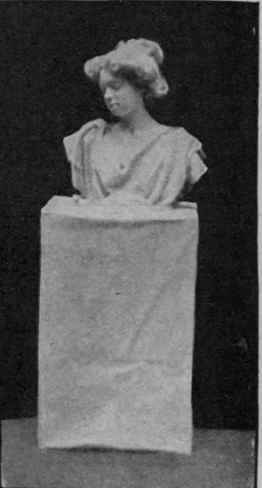
Then, also, the curiosity of those of the audience who suddenly recognise the familiar features of a near relative or friend in some armless and semi-headless marble bust standing upon a pedestal can better be imagined than described !
Statuary tableaux have many advantages. The long waits between each item on the programme generally associated with ordinary tableaux vivants are non-existent. The tableaux take very little space to arrange, and cost practically nothing to dress. Almost all the classical draperies may be contrived from sheets, and the cheapest white duck or drill will make up excellently for the remaining costumes. The accessories for the most part are manufactured from cardboard and white paper and a little whitewash.
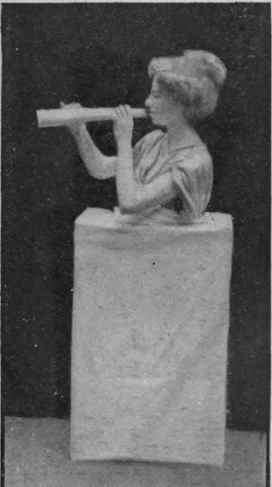
Bust of a flute player. The flute is made of white paper or cardboard
The performers may be children, and the subjects chosen may range from copies of antique sculpture - some of which should be "mutilated," with arms or legs missing - to modern advertisements, as they would appear if rendered in plaster.
Scenes from the life of a pierrot - in which a pierrette would, of course, be included, and perhaps, too, a wee pierrot baby - and white Dresden china figures are excellent subjects to portray. Where children are concerned, a set of tableaux to illustrate nursery rhymes would be delightful. " Jack and Jill went up the hill," with their downfall depicted in a second tableau, ' Little Miss Muffet," or "Where are you going to, my pretty maid?" are subjects which suggest themselves at once.
For antique statuary, unless the performers will consent to flour their hair thoroughly, white wigs should be hired, for they are almost impossible to make at home. When writing to order them from the wig-maker, the head measurements of the destined wearers should be stated.
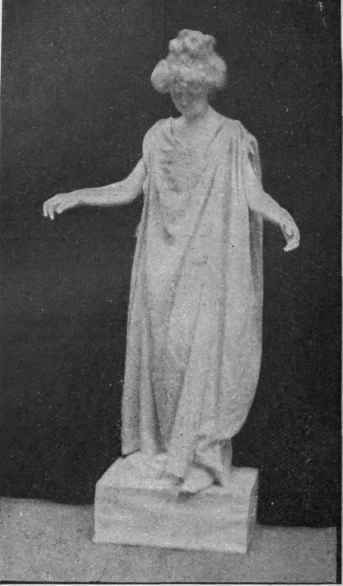
Galatea sleeps. The feet of a living statue should be whitened after the correct pose has been taken up
A pair of black stockings will be needed to draw over the arms of a mutilated statue, so that when the figure is posed against a black background and properly lighted the limbs are completely blocked out. A small square and a large oblong packing-case, to make pedestals for full-length figures and busts, several single-bed sheets for draperies, will be required also, as well as strong paste and liquid glue, together with plenty of white cardboard and white kitchen paper - from which to manufacture such accessories as a lyre for Music, or a flute for Pan.
If any particular antique statue is to be copied accurately, a piece of tree-trunk, whitewashed over, will probably be needed as a support ; and in order to mutilate a statue still further, a black-skull-cap should be provided,
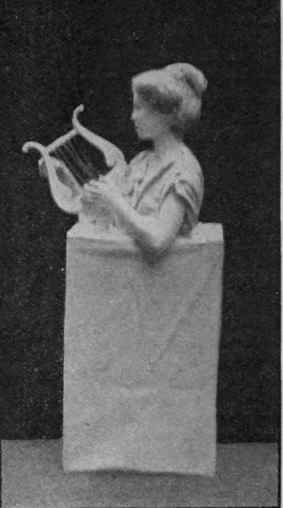
A bust to represent Music should hold a lyre in the hands to be drawn over the top of the head, and thus slice it off.
Pierrot and pierrette costumes, dresses for white Dresden china figures, or for the characters for nursery rhymes, can all be made from the cheapest white drill or duck.
Any tables and chairs introduced must be of the simplest possible outline, with white kitchen paper carefully fitted thereon so as to cover their arms and legs. They could, of course, be painted white if preferred, or even whitewashed over.
A big zinc pail for Jack and Jill, for instance, might be treated in this way.
The most important feature to consider in arranging statuary tableaux is the background, for upon this the artistic success of the whole performance greatly depends. The illusion, as regards the manufacture of
"antique fragments," rests entirely on a special arrangement of lighting.
For ordinary statuary a red, purple, or dark green curtain, hanging in straight folds to the ground, and met by a floor-covering of exactly the same colour, makes a pleasing background.
Red, or purple, is perhaps the best colour for classical sculpture, and green for other kinds, as it gives the idea of statuary arranged in a garden.
Such a background may be lighted from either side of the stage by powerful standard lamps with reflectors behind them.
Where broken or mutilated statues are to be introduced, a specially lighted background, consisting of a large threefold screen, covered with tightly drawn dull black material, must be employed. The two sides of the screen must be arranged to slant slightly outwards. The enclosed floor-space must also be covered with black, and, if possible, an upward tilted, black-lined roof should be fastened to the top of the screen, so that the statue is completely enclosed.
Continue to:


My Books

