


Showlng Children The Wonders Of The World. Part 3
Description
This section is from "Every Woman's Encyclopaedia". Also available from Amazon: Every Woman's Encyclopaedia.
Showlng Children The Wonders Of The World. Part 3
By Mrs. F. Nevill Jackson
Author of "A History of Hand-made Lace"
Needlework an Educative Factor in the Training of Children - The Value of Plain Needlework in
Teaching Care and Discipline - Of Fancy-work in Educating Taste - Intelligent Work to be
Preferred to Mechanical Accuracy - Some Suggestions for Suitable Needlework for Children
One can hardly begin too soon to teach the little ones to sew. It is great fun for baby to stick a needle and thread in and out of a shred of flannel, and to see the funny bundle curl up at last into a tight ball with the cobbled stitches.
That is generally the beginning of work with a needle for both sexes, and happy the wielder of the sharp point if rosy fingers are un-pricked. More often than not baby finds the "business" end of the needle by painful experience. It is thus we learn our lessons. Let no mother refrain from teaching her daughter to sew lest, like Goldilocks, she should hurt herself. Mercifully, no such dire results come from a pricked finger as befel the heroine of the fairy tale.
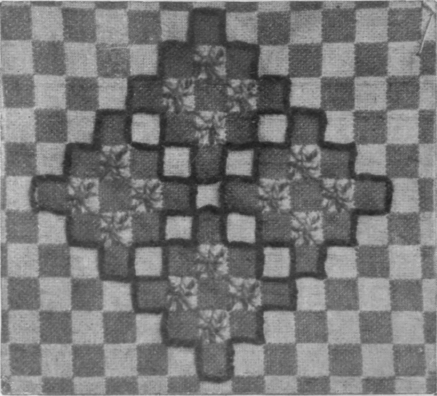
A canvas woven in squares is quickly and easily worked in numerous patterns and designs by children
White Sewing First
There is a virtue and discipline in "the long white seam" which is unequalled. The steady care necessary, the perseverance, the effort, renewed time after time as each stitch is set, all these make for character-building as well as the training of a good seamstress. Hemming, felling, running, and back stitching should each be taught with thoroughness, so that the little daughter may one day look back on the sewing lessons, and, by the light of a later experience, see that here was a foundation-stone well and truly laid. Buttonholing and feather stitching, stem, satin, and tent stitches, all come easily to the child who has been taught carefully the rudiments
Children of sewing by having the A B C of it well drilled into her.
There is so much training of eye and hand needed for the completion of a finely wrought hem or an evenly sewn seam that all the embroideries and fancy stitches of after years come easily, owing to the skill thereby acquired in hand and eye. A very important aid to any fancy-work for a child is the drawing lesson, or training of the eye or mind in colour.
The Colour Sense
It is for this reason that it is well to teach the child some kind of fancy-work, as well as white sewing. The attractiveness of a brightly coloured selection of wools, silks, or flax threads delights children, and we all know what a valuable addition to any kind of knowledge is the happiness and joy of acquiring it. Long and heavy is the task which does not appeal to the child's taste, wearisome the endless repetition which needs no stimulus of mind.
Consider The Whole
When children are being taught needlework, they should always be encouraged to show an intelligent interest in the work as a whole. Ten inches length of evenly set stitches is not the ultimate goal. But the making of a little workbag for mother, or the hemming of a soft duster for Mary - these are achievements which, however humble, should be held up to the child when the ten inches are accomplished.
Those who are interested in any sort of needlecraft, and whose opinion is sufficiently valued for the purposes of judging, award prizes for general intelligence in working as well as evenness in stitching. For instance, however well a sock were knitted, no judge would award a prize to the knitter who had made a heel out of proportion to the size of the foot. Therefore, while details receive due attention, the object as a whole must never be lost sight of.
Begin With An Easy Pattern
It is discouraging to give a child too difficult a piece of fancy-work. Far wiser is it to provide a simple pattern, and allow the worker to make slight deviations which show thought and ingenuity. For example, in the simple spotted muslin illustrated, round each spot long stitches are set, in white silk, to simulate the petals of a daisy, the spot being worked over with yellow to increase the illusion. An original worker, only seven years old, took upon herself to work petals only half way round some of the spots. She then covered the spot with green for the calyx, and worked a few stitches for the stalk. The result was a very creditable bud, and a most intelligent variation on the original design.
Encourage Originality
It is a good plan to give a child a plain piece of canvas, such as is shown in the illustration, and tell her to ornament it as she likes. Some restrictions, however, as to working only in squares will be wise. If several children are working together, the interest will be greatly increased. At the end of the time allotted for the task, the different pieces of work should be criticised, and their good and bad points shown and explained to the workers. It is thus that needlework time may be made interesting.
Cretonne Embroidery For Children
An excellent exercise in coloured embroidery can be given by procuring some simply designed cretonne, printed in one colour only, and giving the child a handful of silks to use as she desires.
In an illustration we see a piece of stuff printed in china-blue only, on which the child has worked roses in pink and crimson, with green leaves and other objects in natural colours.
Such needlework is very interesting; it is very inexpensive, as only small pieces of embroidery silk are required, and it affords the child an endless opportunity for showing observation and artistic achievement in colour at a time when she is not yet sufficiently expert to make a pattern without assistance.
From such a scrap of material a pretty bag or mat can be made, and the child unconsciously imbibes another lesson - that homely articles can be beautified with a little care and patience, and that a very simple piece of stuff enriched with industry and thought may be made twice as valuable.
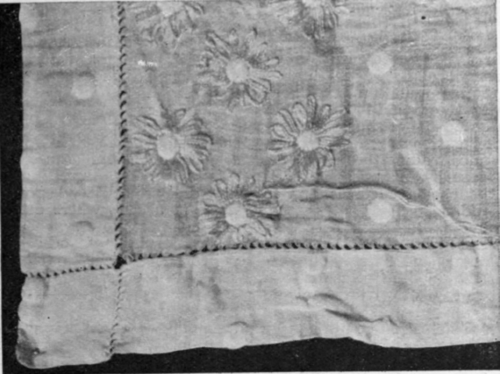
Round each spot in the muslin long stitches are placed in white silk, the spot worked over in yellow silk representing the centre of the flower
Hand labour still has its value in this age of machinery; the eye, the hand, the brain, the skilled and trained fingers, give value to what is otherwise valueless. Children should learn in their training that everything must not be made too easy for them, they must do something for themselves. Why should they be denied the joy of achievement?
Huckaback Threading
There is another type of needlework which is excellent practice for children. Darning is not easy work, the manipulation of a stocking-heel is hardly the mending one could place in inexperienced hands, but the darning of huckaback is extremely good practice. The picking up and threading through of the little lines at regular intervals is soon mastered, and the needle becomes apt at finding the outstanding lines.
Different coloured flax threads or coarse coloured cottons are highly decorative when used in various designs, and a strip of huckaback well begun should be a pleasure to a child, who will love to see a pattern growing under the hand.
Such embroidered strips can be utilised for blouse fronts, collars, or cuffs, for bags or cushion strips. Coarse lace should unite the hemmed strips, and when the darning is done in bright colours a very pretty effect, almost Oriental in character, is obtained.
By all means let the child hem the strips before or after ornamentation. Show her how to join the work with insertion of a coarse Saxony or torchon pattern. Here there might be a lesson on seaming made interesting because of the darned strip. The sense of having done it all herself should be a real delight. She sees that by perseverance, well directed, she has made an object of real beauty.
Thus the combination of plain sewing and fancy-work teaches the child discretion in the use of either type, and her interest is awakened and sustained in the making of objects simple but beautiful, homely yet individualised, by means of the intelligent thought which has been spent upon it.
Needlework Classes
An excellent way of awakening and sustaining interest is to collect a little sewing circle, and arouse emulation in the young workers. Every only child knows how dull are solitary lessons compared with those in a class where other children meet and compare notes. The same joy in the companionship of other learners is experienced when children sit and sew together. There are peeps at other people's work, and queries such as, "How have you got on since last time?" "Have you finished the seam we were set to do?" "What are you making for your mummy's birthday?" "I wonder if our teacher will let me make that, too?" The impulse to work hard and do sewing as pretty and artistic as the others is coming from the heart of the worker by this time. No need to urge ambition in the sewer who once looks at the work of more expert needle-workers and longs to do the same. The desire is there, the will to do, and soon accomplishment will reward pupil and teacher.
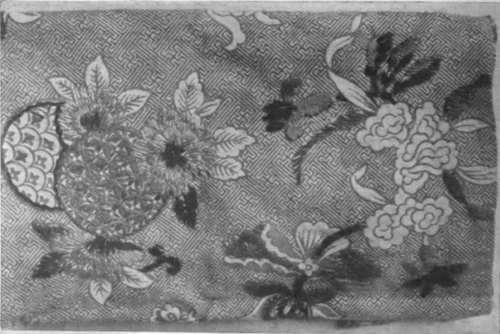
An excellent idea is to give a child a piece of patterned cretonne, and let her work over portions of the design in coloured silks. The task gives plenty of scope for original ideas and is not tedious
Continue to:


My Books

