


Spectacular Weddings. Part 2
Description
This section is from "Every Woman's Encyclopaedia". Also available from Amazon: Every Woman's Encyclopaedia.
Spectacular Weddings. Part 2
A military wedding, the bride and bridegroom passing under an arch of swords, formed by men of the bridegroom's regiment. The music is usually supplied by the regimental band, and the regimental colours are often represented in the wedding favours
Photo, Topical
There is also a pretty little custom of the southern counties, the mention of which will not seem out of place at this juncture.
When the happy pair have returned from their wedding-tour, they give a little house-warming in their new home, and the bride's mother breaks a cake of shortbread over their heads, expressing the hope that they may never want.
All the above wedding descriptions belong to the upper and well-to-do members of society, but there are a good many classes beneath these, and they also have the habit of getting married; but perhaps there is only one class of which a wedding description would be of any interest.
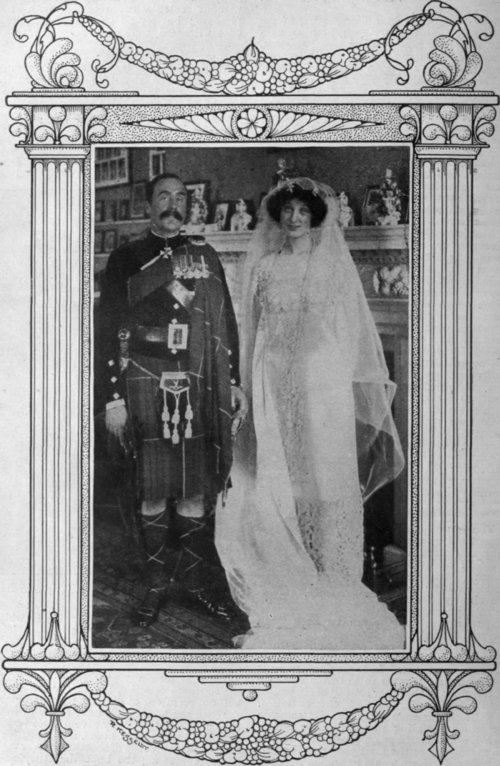
The wedding of Lord Lovat and the Hon. Laura Lister was distinguished by the fact of the bridegroom and his friends being in full Highland dress. The famous Lovat's Scouts were present and emphasised the picturesqueness of the ceremony
Photo, L. N. A.
A Costermonger's Wedding
It was a coster wedding, at which, by lucky chance, I once happened to be present.
There were, I believe, no formal invitations issued for the ceremony, which took place in a church in one of the most populous districts of Whitechapel, but the sacred edifice was crowded. No West End ceremony ever drew so interested or so interesting a congregation, the two indelible impressions left on the mind being buttons and feathers.
It took place on a Sunday, when trade was slack; and of all the coster men and maidens, the two married must have been the chiefest.
A long queue of coster carts and donkey barrows was drawn up outside the church. The owners and occupants were all grouped about the pathway waiting for the auspicious hour to arrive; while the actual wedding group was standing, boisterously nervous, outside the door. At the right time someone pushed in, and the whole party thronged into the church.
It was difficult at first to distinguish which were the bride and bridegroom-elect; but there was one lad the splendour of whose tie and the redundance of whose buttons proclaimed him to i be the happy man; and on his arm there leaned a maid whose face shone with soap and happiness, and the feathers of whose hat, stood out several inches further over its brim than those on the headgear of her companions, and therefore marked her as the bride.
A Practical Parson
The ceremony itself was very short, shorter than I, who have been accustomed to West End weddings, could have believed possible, but yet not quite so short as others of which I have heard, in which as many as twenty couples come up to be married at the same time, and over whom one service alone is read, and to whom at its conclusion the injunction is given by the officiating clergyman: "Go outside and sort yourselves."
There may appear a want of individuality about this method, but it seems to work out all right, and the mistakes made by the minister - and it is admittedly difficult to avoid joining wrong couples - are rectified on the church steps. Everybody is quite satisfied, so it is nobody's business to complain. All's well that ends well. And the result usually is satisfactory.
But to return to our costers. When the ceremony is over, a brand-new cart, drawn by a brand-new pony and well adorned with ribbons, appears as if by magic at the church door. The newly-wed pair step in and seat themselves, smiling the happy, sheepish smile that has long since been lost to us of the upper classes; slippers and rice are showered upon them, and they drive off to spend a joyous day in the country - probably on Hampstead Heath! And this is the honeymoon.
A Fireman's Wedding
Nor is a fireman's wedding less impressive. It certainly is a ceremony which deserves to be included in this article. In its humbler fashion it is as picturesque as either the military or the naval wedding, both of which it resembles in many of its features.
The comrades of the bridegroom make it a point of honour to muster in full force, of course, in uniform. The engine, as far as I know, has not been used for a bridal carriage, but there is no reason why the bridegroom at least should not arrive thereon.
The pretty custom of passing under an arch of swords is modified most suitably into walking between two rows of sturdy firemen with uplifted and interlocking axes, and there is the same feeling of comradeship and esprit de corps.
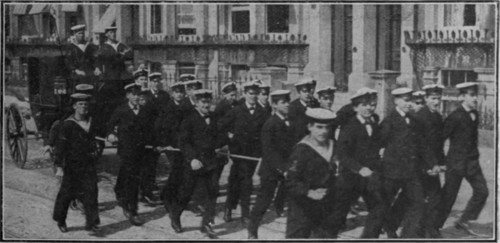
In a naval wedding the ship's company act as coachman, footman, and drawers of the bridal carriage. Such weddings can only take place, therefore, at naval stations
Photo, Stephen Cribb
Village Wedding Bells - A Sense of Omission in a Splendid Function - The Antiquity of Bell-ringing - A Ghostly Peal - Bells of Other Ages - The Importance of Bells in Olden Times
I was present recently at a wedding cele-brated in a small country church.
It was all quite simple and unostentatious. The bride was dressed in a pretty white frock, innocent of priceless lace and undecked with any wonderful pearl ornaments, but her face shone with the light of happiness, and the depths of her great love was mirrored in her eyes.
The service was also simple, with no ornate ceremonial, merely a wedding hymn and a wedding march; but when it was over, and the little party came down the aisle, suddenly above our heads the bells began to peal, and it seemed as if a paean of joy were being rung out to inaugurate the beginning of a new and happy life.
Continue to:


My Books

