


Third Group Of Wand Exercises Advanced
Description
This section is from "Every Woman's Encyclopaedia". Also available from Amazon: Every Woman's Encyclopaedia.
Third Group Of Wand Exercises Advanced
For these exercises the wands should be 4 ft. in length, and held at the ends.
Exercise 1
Count I, 2. Raise wand forward and up. 3, 4. Rise on toes, wand across shoulders; bend head back.
5, 6. Remain in position.
7, 8. Lower wand behind, lower heels, head raise.
9, 10. Raise left arm, curving it overhead; right arm straight, wand vertical on right.
11, 12. Lower left arm, wand behind.
13, 14. Raise right arm, reversing position at 9, 10.
15, 16. Recover, wand in front.
Exercise 2
Count 1, 2. Bending right knee, carry left foot back, toe on ground, wand to chest.
3, 4. Thrust wand up. (Fig. 3, side view).
5. Straighten right knee, point left toe forward, wand to shoulders.
6, 7, 8. Slowly bend trunk back (Fig. 4, side view).
9. Place left foot astride, wand overhead.
10. Wand to shoulders, bending slightly forward.
11, 12. Continue slowly forward bend of trunk, and lower wand behind.
13, 14. Join left foot to right, straighten trunk, wand to shoulders.
15, 16. Recover.
Explanation, and faults to be avoided. At I the body should be inclined forward, so that it is in line with the leg. The bending back at 6, 7, 8 must take place in upper part of spine, from head and shoulders, and not from the waist. At 12 the arms should be straight and horizontal, the wand a little above the back.
Exercise 3
Count 1, 2. Raise wand and lower it obliquely across back, left hand to neck, right arm by side.
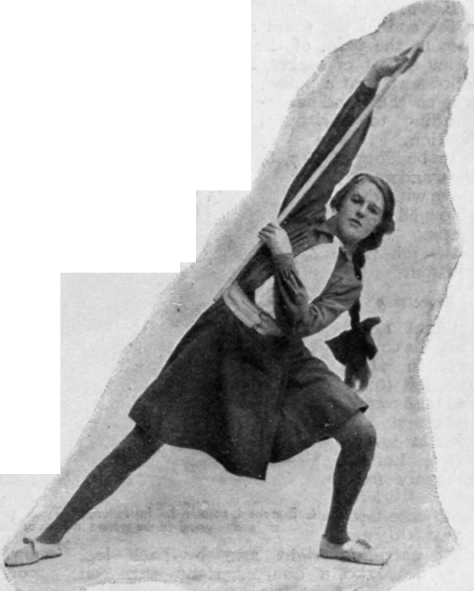
Fig. 5. Exercise 4: Wand vertical on the right, trunk bent to the left. This illustration shows the side lunge, but the position of the wand is different
3, 4. Bend left knee up.
5. Point left toe forward, touching ground, and change wand to the other side. Right hand to neck, left arm by side.
6. Raise left leg sideways.
7, 8. Left foot behind, toe on ground.
9, 10, 11, 12. Wand horizontal and across shoulders. Raise left leg slowly backwards till horizontal.
13, 14, 15, 16. Recover.
Explanation, and faults to he avoided. The balancing at 9, 10, 11, 12 is difficult. The back must be kept rigid and slightly hollowed, leg and foot well stretched, and head up. As the foot is raised, the body must be allowed to incline gradually forward.
Exercise 4
Count.I. Extend wand on left, bringing right hand across to left shoulder, and let wand slide through left hand.
2. Keeping the right hand still, describe a circle downwards, with left end of wand (left hand slides up and back again).
3, 4. Lunge sideways to the left, wand extended to the left, (Fig. 5 shows lunge, position of wand different.)
5. Wand across shoulders, right arm extended, left arm to neck.
6, 7, 8. Bend slowly to the left.
9, 10, 11, 12. Straighten trunk, and turn, bending over left knee. Lower right hand to touch in front of left foot. Stretch right arm straight forward. (Fig. 6.)
13, 14. Straighten trunk, wand over head.
15, 16. Recover.
Explanation, and faults to be avoided. At
2 the end of the wand must be allowed to turn in the palm of the right hand, which forms a sort of socket, and the lunge at 3 follows without a pause, just as the wand is descending to horizontal position.
In bending at 6, 7, 8, the wand must move with the shoulders, keeping the same relative position.
Exercise 5
Count 1, 2. Turn the trunk left to face over left foot, and raise wand forward to shoulder-level.
3, 4. Lunge obliquely forward with left foot, raise left hand over right shoulder, right arm by back leg.
5, 6. Make a quarter right turn on heels, bending right knee and straightening left. (Oblique lunge position, right foot forward.) Lower left hand backwards, wand behind.
7, 8. Kneel on back knee.
9, 10. Join back foot to front, and come to squatting position.
11, 12. Rise, straighten knees, keep on toes, wand to shoulders.
13, 14. Raise wand overhead.
15, 16. Recover. Repeat this 3 times with left foot; then repeat whole, starting with right foot.
Explanation, and faults to be avoided. At
3 the left arm is curved over the head. At 7 the back foot must be kept in its place, and the heel allowed to rise. At 9 the heels should be together, the knees well apart and fully bent, as though sitting on the heels, the body erect.
Exercise 6
Count 1. Spring on right foot, and point left toe to left side, wand to chest.
2. Spring on right foot, raise left toe as high as right knee.
3. Spring on left foot, bend right knee, raising right heel backwards.
4. Spring on right foot, bend left knee, raising left heel backwards.
5, 6, 7, 8. Reverse 1, 2, 3, 4.
9. Spring on right foot, raise left leg sideways.
10. Bringing left leg down, hop on it, and raise right leg sideways.
11. Spring feet together.
12. Spring.
13, 14, 15, 16. Spring four times, making a quarter turn with each spring. At 16 lower wand. Repeat once, starting the other side.
Explanation, and faults to be avoided. This step should be done with great neat-n e s s, the toes stretched. At 3 the knees must be kept down, and the heels raised as high as possible. With each spring the knees must straigh te n, and yield slightly o n alighting.
Breathing Exercise
Count 1, 2, 3, 4. Raise wand slowly forwards and up, breathing in.
5, 6, 7, 8. Lower wand slowly backwards and down, breathing out. 9. 10, 11, 12. Raise wand slowly backwards and up, breathing in.
13, 14, 15, 16. Lower wand forwards and down, breathing out.
Each exercise, having been learnt, should be done to music; then the whole group may be gone through continuously. These difficult exercises should only be attempted when the easier ones have been mastered. They will then be of great value in giving control of the mind over the muscles, and so lead to grace and ease in movement.
These groups are only examples of what may be done. Innumerable combinations can be arranged, so that when one set has been learnt a completely fresh group can be taught. The pupil's interest and attention is thus kept, her brain learns to make different groups of muscles work together harmoniously, and her work never becomes mechanical and listless.
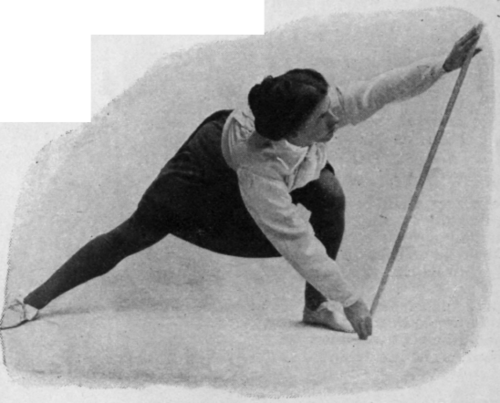
Fig. 6. Exercise 4, position 2. Inside lunge. Trunk turned and bent over the knee. Right end of wand on the ground in front of foot, right arm extended
Continue to:


My Books

