


True Love-Stories Of Famous People. No. 34. Laurence Sterne. Part 2
Description
This section is from "Every Woman's Encyclopaedia". Also available from Amazon: Every Woman's Encyclopaedia.
True Love-Stories Of Famous People. No. 34. Laurence Sterne. Part 2
Tell me where is fancy bred, Or in the heart, or in the head?
Sterne's love, alas! most certainly was an emotion of the head.
He wooed, it is true, with the skill and grace of a true artist. Indeed, he danced attendance on her; refused to accept a "No," showering her with countless little acts of thoughtfulness. But yet the answer was only too clear.
At last, therefore, still uncertain and feeling that she could not resist his importunities much longer, Elizabeth decided to escape for a while from York; to go away from her love and think quietly over the possibilities of her courtship without being dazzled by bewildering, ardent protestations. Accordingly, she retired to Yoxall rectory, the home of her married sister.
As though she could escape thus from Sterne! Why, this very move afforded him just the opportunity for which his senses clamoured. "The hour you left . . ." he wrote, "I took to my bed - I was worn out with fevers of all kinds, but most of all that fever of the heart with which thou knowest well I have been wasting these two years, and shall continue wasting till you quit S. (Staffordshire). The good Miss S., from the forebodings of the best of hearts, thinking I was ill, insisted on my going to her. What can be the cause, my dear L., that I have never been able to see the face of this mutual friend but I feel myself rent to pieces? She made me stay an hour with her. And in that short space I burst into tears a dozen times - and in such affectionate gusts of passion that she was constrained to leave me and sympathise in her dressing-room."
Nor was he content merely with word worship. He even rented his beloved one's lodgings, and here, during her absence, took up his abode, amid a thousand sweet associations, with Fanny, her maid, to tend his wants. And from here he wrote one evening, describing his lonely, loveless life. "Fanny had prepared me a supper - she is all attention to me - but I sat over it with tears; a bitter sauce, my L., but I could eat with no other. For, the moment she began to spread my little table, my heart fainted within me; one solitary plate, one knife, one fork, one glass! I gave a thousand penetrating looks at the chair thou hast so often graced in those quiet and sentimental repasts, then laid down my knife and fork, and took up my handkerchief and clapt it across my face, and wept like a child. I do at this very moment, my L., for, as I take up my pen, my poor pulse quickens, my pale face glows, and tears are trickling down the paper.
"Oh, thou blessed in thyself and in thy virtues, blessed to all that know thee, to me most so because more do I know of thee than of all thy sex. This is the philtre by which thou hast charmed me, and by which thou wilt hold me thine, while virtue and faith hold the world together."
Charming! Effete, perhaps, unmanly, but still very charming; sentiments bewitching in their magic. "One solitary plate, one knife, one fork. . . ." And then, again, "blessed to all that know thee, to me most so because more do I know of thee than of all thy sex."
Let a man but tell a woman of her in-dividuality and surely she will find him lovable. No wonder, then, Elizabeth melted towards her absent lover. Her heart ached for him. Yes, she loved him, loved him. She was sure she did.
"I have won a place," he told her, "in that heart of thine on which I depend, so satisfied that time or distance, or change, or anything which might alarm the hearts of little men create no uneasy suspicions in mine. . . . Judge, then, my L., can the valley look so well, or the roses or jessamine smell so sweet as heretofore? Ah, me! Adieu! the vesper bells call me from thee to God."
How wonderful! What devotion! Had he not proved its strength? She delayed no longer, but hastened back to York, stirred pitifully by those emotions which the man himself only imagined. And now, not of him, but of herself, she felt uncertain. She was unworthy of him. It was at this conclusion she arrived. And, poor girl, ill in body, troubled in spirit, she returned in just the state of mind to make what she believed to be an act of heroic sacrifice.
"No, my dear Laurey, I can never marry you," she said - "never." And then, convinced that she had not long to live, she sat down and made her will, bequeathing to him every shilling of her fortune.
"This generosity," Sterne later told his daughter, "overpowered me. It pleased God that she recovered, and I married her." He would have been more truthful had he said, "she married me." It happened like this. One day in March, 1741, they went together to a concert at the Assembly Rooms. And suddenly - perhaps it was the influence of the music - her brave resolutions failed her altogether. She begged, entreated him to marry her. And he took her at her word. Forthwith they left the hall, hastened straight to the dean, obtained a special licence, and were married.
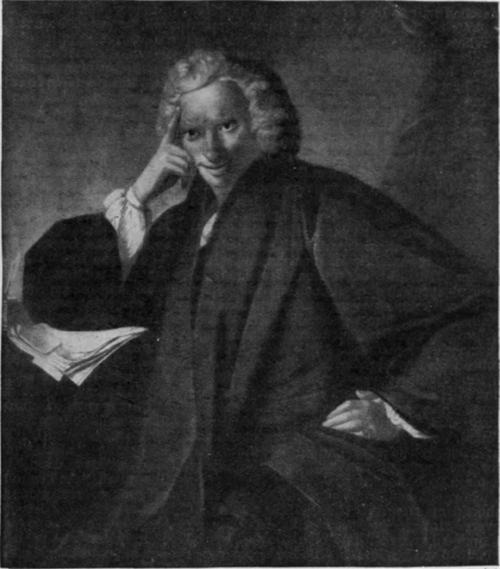
Laurence Sterne, author of "Tristram Shandy" and sentimentalist, was even more eccentric in love than he was in life From the painting by Sir Joshua Reynolds in the possession of the Marquis of Lansdowne, K.g.
Married! Sterne's imagination soared to the dizziest heights of rapture. "Yes! I will steal from the world, and not a babbling tongue shall tell where I am. Echo shall not so much as whisper my hiding-place; suffer thy imagination to paint it as a little sun-gilt cottage on the side of a romantic hill. Dost thou think I will leave love and friendship behind me? No! they shall be my companions in solitude, for they will sit down and rise up with me in the amiable form of my L. We will be as merry and as innocent as our first parents in Paradise before the wretched Fiend entered that indescribable scene. The keenest affections will have room to shoot and expand in our retirement, and produce such fruits as madness, and envy, and ambition have always killed in the bud."
Continue to:


My Books

