


What A Child Can Do With Bricks
Description
This section is from "Every Woman's Encyclopaedia". Also available from Amazon: Every Woman's Encyclopaedia.
What A Child Can Do With Bricks
Gift 4 and How to Use It - The Importance of Conversa-tion During a Lesson - Balance and Motion Explained - Gifts 5 and 6 Explained
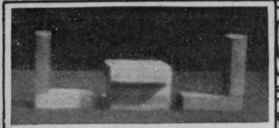
A table and two chairs
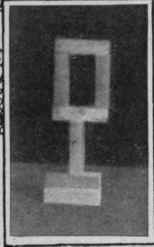
A pigeon house
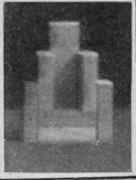
A throne
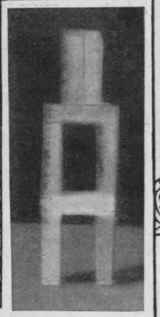
A bell tower
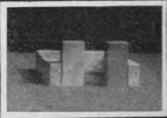
A walled garden
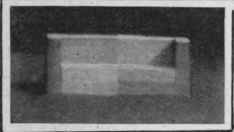
A garden seat
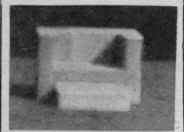
A settee with footstool
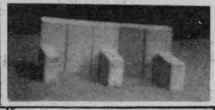
A stable for two horses
To the superficial observer Gift 4 bears a strong resemblance to Gift 3, for each is a cube divided into eight parts, and contained in a small wooden box. A comparison of the two soon shows that there is a distinct advance in difficulty, for the new forms obtained by the dividing of the cube are less simple than the already familiar cube.
Gift 3 is a cube divided once in every direction to form eight smaller cubes, while Gift 4 is a cube identical in size with the other, but divided once through, its height, and three times through its thickness, so as to form eight oblong blocks or bricks.
In building with the cubes it matters not on which face each rests, but different results are obtained from the blocks of Gift 4, according to the face on which they rest, whether the largest one, the smallest, o r the one of medium size. The greater variety of surfaces gives greater possibilities of form and affords greater scope for originality on the part of the child. The method of using Gift 4 resembles that described fully with reference to Gift 3 (page 3239, Part 27). The child must become acquainted with the cube as a whole, and then divide it into its parts and become familiar with the new forms before turning them to their various uses. In introducing Gift 4 it is well to have Gift 3 also at hand, so that any differences may be shown. Two cubes cut from potato should be used also, so that the child may see how the two cubes are divided differently so as to bring about different results.
The next step is to show the relationship between the two forms. Thus, two cubes will stand on a large face of a block ; two blocks standing on their smallest surfaces cover the face of a cube ; and two blocks can be so placed together as to be of "equal" size to two cubes placed side by side.
The difference of form is still further impressed if the child is called upon to name familiar objects resembling each in shape.
The blocks must then be examined carefully, and the child led to find out for himself that three different positions are possible with the block, whereas one is the utmost that a cube can assume. The fact becomes very vivid to the child when he has made the brick lie down or stand up. Having discovered thus far the possibilities of the blocks, he is prepared to carry out the exercises which the gift involves.
As in Gift 3, object forms precede the forms of beauty, and the possibilities of both are more varied. The illustration shows a few of the many forms which can be built up, and others are not difficult to find.
How To Use The Gift
The same rules must be carried out as with the previous gift. Neatness, order, precision, and beauty are to be insisted upon ; while it is equally important to use up all the material at hand, in order to give a more definite purpose to the work, encourage thought, and prevent waste.
Every encouragement should be given to differences of form which depend on slight modifications and do not require the pulling down of the whole structure.
Thus, five blocks lying one over the other on their large surfaces and bounded at each end by a block standing on its smallest face, with one block standing at the back of the pile on its medium face, makes a wash-stand. By removing the top block of the pile and standing it side by side with the back block, both on their ends, there is a dressing-table with a mirror at the back.
By removing another block, and adding it to the top of the two which form the mirror, there is a well-shaped easy-chair.
In object form building there should be plenty of conversation and story-telling. Here the mother has an advantage over the kindergarten teacher, for, through being much with her child, she knows best what are the actual experiences of his everyday life.
She can so arrange the talk that affairs of current interest are brought to the fore, so that what a child sees on any particular day can be represented in his next play lesson.
It is only by simple stories and chat that the play can be prevented from becoming so mechanical as to be performed without any effort of the mind. Conversation makes handwork vivid and real, and by arousing the child's interest in his surroundings lays the foundation of the habit of observation.
The Mother's Part
As Jean Paul Richter says in "Levana," " The mother can never talk too much to the child during play or by way of amusement, nor say too little in the way of punishing and preaching."
Before proceeding to the forms of beauty, there are certain items of useful knowledge which can be demonstrated by the use of the blocks. Thus one block may be made to balance on another one placed upright or on its medium face. The child will be delighted with his "pair of scales," as he will call the new combination of blocks, and as the outcome of his experience will find that equal weights are required on either side to produce equilibrium.
An even more popular play lesson will show how motion can be transferred from one body to another. Thus, when the eight blocks are standing up like soldiers at a small distance apart, a tap given to the end one will cause the whole series to fall over. The next time that the child sees a long goods train starting off or being brought to rest suddenly, he will take an intelligent interest in what he sees, and try to work out the connection between this strange sight and his play lesson.
Forms of beauty can be built up exactly as with the cubes, but in greater variety. The chequered foundation should likewise be used with the new forms, in order to ensure precision and symmetry. Begin by showing the various positions which two blocks can take up with regard to each other, and when these are thoroughly understood, proceed to pattern forming.
Place two blocks side by side on their large surfaces to form a square, arrange the eight blocks into four squares, and join them into one large square. Four blocks can be abstracted from the four corners and arranged in a variety of ways around those that remain.
Gift 3 and Gift 4 may be used at the same time, and by means of the sixteen solid bodies more elaborate object forms and more complicated forms of beauty can be built up.
The Elements Of Arithmetic
Either Gift 3 or Gift 4 can be used for concrete examples in the teaching of elementary arithmetic. The child has already been made familiar with numbers by counting his bricks as he returns them to the box, and accordingly he can count any number up to eight. Simple sums in addition and subtraction may be worked with the bricks, and the child becomes familiar with these two simple processes of arithmetic at a very early age. When he goes to school, and has to deal with abstract figures instead of his concrete objects, he experiences no difficulty, but grasps at once the significance of figures which afford an insuperable difficulty to the child who attempts to deal with the abstract without experience with the concrete.
Gifts 5 and 6 are very rarely used in modern kindergartens on account of their difficulty. As devised by Froebel, Gift 5 consists of a wooden box containing a large cube divided into twenty-one whole, six half, and twelve quarter cubes. With this large number of objects and with the three forms very beautiful structures and forms can be built, and anyone who has thoroughly mastered the method of using Gifts 3 and 4 can turn Gift 5 to good account, as it bears a strong resemblance to Gift 3.
Gift 6 is more akin to Gift 4, being a further development of it.
Continue to:


My Books

