


How To Carve Meat. Part 2
Description
This section is from the book "The Illustrated London Cookery Book", by Frederick Bishop. See also: How to Cook Everything.
How To Carve Meat. Part 2
Loin Of Veal
This joint is sent to table served as a sirloin of beef. Having turned it over, cut out the kidney and the fat, return it to its proper position, and carve it as in the neck of veal,, from b to a ; help with it a slice of kidney and fat. The kidney is usually placed upon a dry toast when removed from the joint.
Shoulder of Veal is sent to table with the under part placed uppermost. Help it as a. shoulder of mutton,, beginning at the knuckle end.
Calf's Head
There is much more meat to be obtained from a calf's head by carving it one way than another. Carve from A to b, cutting quite down to the bone. At the fleshy part of the neck end you will find the throat sweetbread which you can help a slice of with the other part; you will remove the eye with the point of the knife and divide it in half, helping those to it who profess a preference for it, there are some tasty, gelatinous pieces around it which are palatable. Remove the jaw bone, and then you will meet with some fine flavoured lean; the palate, which is under the head, is by some thought a dainty and should be proffered when carving.
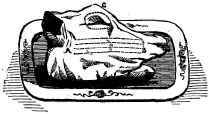
Half of Calf's Head.
Leg Of Mutton
The under or thickest part of the leg should be placed uppermost and carved in slices moderately thin from b to C. Many persons have a taste for the knuckle, and this question should be asked, and if preferred should be assisted. When cold, the back of the leg should be placed uppermost, and thus carved; if the cramp bone is. requested, and some persons regard it as a dainty, hold the shank with your left hand, and insert your knife at d, pass-ins it round to e, and you will remove it.
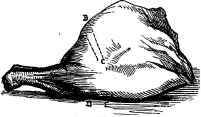
A Shoulder Of Mutton
This is a joint upon which a great diversity of opinion exists, many professing a species of horror at its insipidity; others finding much delicacy of flavour in certain parts. In good mutton there is no doubt but that if properly managed it is an excellent joint, and if judiciously carved will give satisfaction to all who partake of it. It should be served and eaten very hot. It is sent to table lying on the dish as shown in the annexed engraving. Commence carving from a to b, taking out moderately thin slices in the shape of a wedge; some nice pieces may then be helped from the blade bone, from c to b, cutting on both sides of the bone. Cut the fat from d, carving it in thin slices. Some of the most delicate parts however lie on the under part of the shoulder; take off thin pieces horizontally from b to c, and from a; some tender slices are to be met with at D, but they must be cut through as indicated.
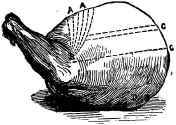
A Shoulder of Mutton.
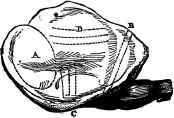
A Shoulder of Mutton.
The shoulder of mutton is essentially a joint of tit-bits, and therefore when carving it, the tastes of those at table should be consulted. It is a very insipid joint when cold, and should therefore be hashed if sent to table a second time.
The Loin of Mutton, if small, should be carved in chops, beginning with the outer chop, if large, carve slices the whole length. A neat way is to run the knife along the chine bone and under the meat along the ribs, it may then be cut in slices as shown in the engraving of the saddle of mutton below; by this process fat and lean are served together; your knife should be very sharp and it should be done cleverly.
Neck of Mutton, if the scrag and chine bone are removed, is carved in the direction of the bones.
The Scrag of Mutton should be separated from the ribs of the neck, and when roasted the bones assisted with the meat.
Continue to:


My Books

