


How To Make Cake
Description
This section is from the book "The Pure Food Cook Book: The Good Housekeeping Recipes, Just How To Buy, Just How To Cook", by Harvey W. Wiley. Also available from Amazon: The Pure Food Cookbook.
How To Make Cake
N cake-making, correct measurements are particularly necessary. Good judgment and experience have taught some cooks to measure by sight, but the majority need accurate guides. Use standard measuring cups, preferably glass, the regulation tea- and tablespoons, and a case-knife to level the measures. For the mixing and beating, a wooden spoon with slits is good.
Only the best ingredients are worthy to be made into cake. Economize on the quantity, but never on the quality, of materials. Coarse granulated sugar is apt to give a coarse texture, so choose the fine granulated for cakes. Bread flour contains more of the sticky gluten than pastry flour, therefore cake made with it is never so light and tender. All baking-powder mixtures are better when the more easily raised pastry flour is used. But if bread flour must be used, measure two tablespoonfuls less for every cupful called for in a recipe. Never try to put a cake together until all the ingredients are measured and ready, the pans are properly buttered, and the fire is attended to. The fire must last without replenishing until the baking is completed.
Sponge Cake
Sponge cakes depend for their lightness upon the amount of air which is beaten into the mixture before baking. The following is a safe general rule. It is often varied, and with good results, provided a larger amount of air is entangled in the batter. Never stir a sponge cake batter, as the air already entangled is thus allowed to escape. Beating, cutting, and folding are the correct strokes.
Separate the eggs and beat the yolks until very thick and lemon-colored; beat the whites until stiff and dry. Add the sugar to the yolks and beat again, then add the flavoring. Beat in the whites and finally cut and fold in the flour sifted with the salt. For this stroke use a case-knife, adding the flour gradually and cutting it in. Never stir it. Three eggs, one-half cupful of sugar, one-half cupful of flour, a pinch of salt, one teaspoonful of lemon juice, and grated rind from one-half a lemon are the correct proportions for a small loaf.
Butter Cakes
Butter cakes depend for their lightness upon the gas carbon dioxide obtained from baking powder or soda and cream of tartar. There are almost as many methods for putting together a batter as there are cakes. The following is not the only correct method, but any butter cake may be put together with success by just this method. It is a safe one to learn and use when only proportions are known. Measure the dry ingredients and mix and sift all save the sugar together. Measure the butter, and cream it with the sugar. Butter may be softened by leaving it in a warm room; measure by packing it solid and level into the cup or spoon. Beat with a wooden spoon until light and creamy. Add the yolks of the eggs or the whole eggs, beaten until light, the liquid, and then the flour, or the two latter may be added alternately, always beginning with the flour. Add the whites last if they alone are used or if they are beaten separately, in order not to lose the air beaten into them.
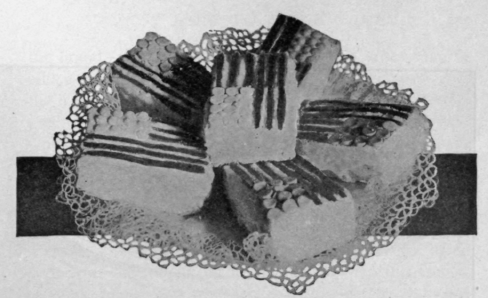
Flag Cakes: Any Cake may be cut in Oblongs and iced in Plain White, then decorated with red Candies to form the Stripes and blue Candies to form the Stars of The Flag.
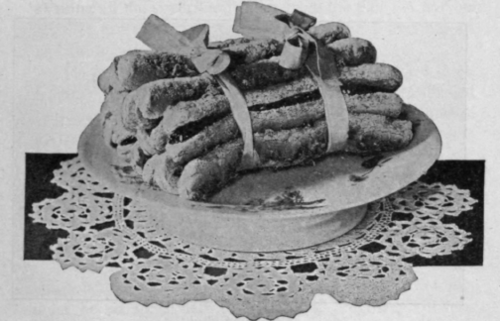
Date Sandwiches: Lady Fingers with a Filling of Chopped Date and Nut Meats. For the Afternoon Tea Tray.
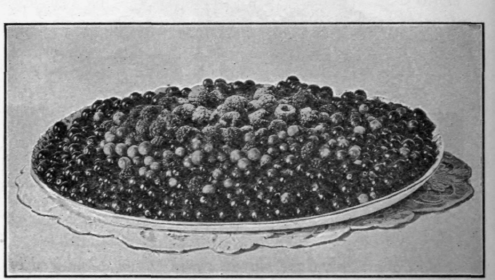
Red and White Currant and Raspberry. Recipe on Page 274.
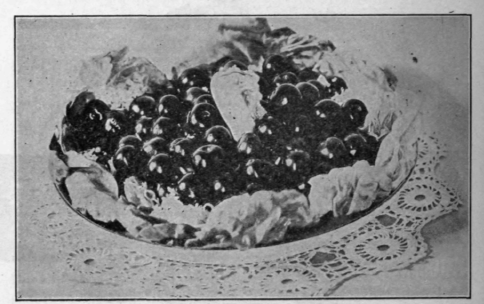
Cherry Salad. Recipe on Page 273.
Beating alone makes a cake fine-grained, but a cake may be light and tender, thoroughly eatable, with but little beating. Never stir a cake after the final beating, because, as with the sponge cake, the air is thus allowed to escape.
Fruit, when added immediately after the sugar, as in dark fruit cake, need not be floured. When this cannot be done on account of discoloring the batter, the fruit must be floured and beaten in last. Another good way is to fill the pans half full with plain batter, then add the floured fruit to remaining batter and put in pans.
Butter the pans thoroughly, then dredge with flour, shaking all the superfluous flour from the pan. A narrow strip of buttered paper, reaching over the sides, may be used in a well-buttered pan.
In filling, be especially careful to fill corners and sides, leaving a slight depression in the center. When baked the cake will then be flat on top. Many blame the oven or the batter for a " hilly " cake, when it is merely the way the batter was heaped in the pan.
Continue to:


My Books

