


Arbors, Summer-Houses, Pergolas, Other Garden Features. Part 2
Description
This section is from the book "Amateur Gardencraft", by Eben E. Rexford. Also available from Amazon: Amateur gardencraft.
Arbors, Summer-Houses, Pergolas, Other Garden Features. Part 2
It often happens that there are ravines or small depressions on the home-grounds over which a rustic bridge could be thrown with pleasing effect, from the ornamental standpoint, and prove a great convenience from the standpoint of practicality. If there is a brook there, all the better, but few of us, however, are fortunate enough to be owners of grounds possessing so charming a feature, and our bridges must be more ornamental in themselves than would be necessary if there was water to add its attraction to the spot.
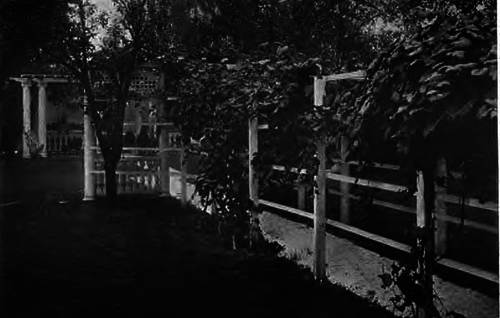 A PERGOLA SUGGESTION
One of the most delightful summer-houses I have ever seen was largely the result of an accident. An old tree standing near a path was broken down in a storm, some years ago, and a portion of its trunk was made use of as a support for one side of the roof. On the opposite side, rustic arches were used. The roof was shingled, and stained a dark green, thus bringing it into color-harmony with its surroundings. Over the roof a Wistaria was trained, and this has grown to such size that but few of the shingles are to be seen through its branches. About this spot the home-life of the family centres from April to late October. "We would miss it more than any part of the dwelling," its owner and builder said to me, when I asked permission to photograph it. I could readily understand the regard of the family for so beautiful a place, which, I have no doubt, cost less than one of the great flower-beds that we see on the grounds of wealthy people, and see without admiring, so formal and artificial are they, and so suggestive of professional work duplicated in other gardens until the very monotony of them becomes an offence to the eye of the man or woman who believes in individuality and originality.
Rustic fences between lots are great improvements on the ordinary boundary fence, especially if vines are trained over them. They need not be elaborate in design to be attractive. If made of poles from which the bark has been taken, they should be stained a dark green or brown to bring them into harmony with their surroundings.
Screen-frames of rustic work, as a support for vines, to hide unsightly outbuildings, are far preferable to the usual one of wood with wire netting stretched over it. They will cost no more than one of lattice, and will be vastly more pleasing, in every respect.
Gateways can be made exceedingly pleasing by setting posts at each side of the gate, and fashioning an arch to connect them, at the top. Train a vine, like Ampelopsis, over the upper part of the framework, and you make even the simplest gateway attractive.
A garden-seat, with a canopy of vines to shade it, may not be any more comfortable, as a seat, than any wooden bench, but the touch of beauty and grace imparted by the vine that roofs it makes it far more enjoyable than an expensive seat without the vine would be to the person who has a taste for pleasing and attractive things, simply because it pleases the eye by its outlines, thus appealing to the sense of the beautiful. Beauty is cheap, when looked at from the right standpoint, which is never one of dollars and cents. It is just these little things about a place that do so much to make it home-like, as you will readily see if, when you find a place that pleases you, you take the trouble to analyze the secret of its attractiveness.
The pergola has not been much in evidence among us until of late. A rapidly increasing taste for the attractive features of old-world, outdoor life in sunny countries where much of the time is spent outside the dwelling, and the introduction of the "Italian garden" idea, have given it a popularity in America that makes it a rival of the arbor or summer-house, and bids fair to make it a thing of permanence among us.
The question is frequently asked by those who have read about pergolas, but have never seen one, as to wherein they differ from the ordinary arbor. The difference is more in location, material, and manner of construction than anything else. They are generally built of timber that can be given a coating of paint, with more or less ornamental pillars or supports and rafters, and are constructed along definite architectural lines. They are, in fact, ornamental structures over which vines are to be trained loosely with a view to tempering the sunshine rather than excluding it. The framework of the arbor, as a general thing, is considered secondary to the effect produced by it when the vines we plant about it are developed. But, unlike the Americanized pergola, the arbor is almost always located in a retired or inconspicuous part of the home-grounds, and is seldom found connected with the dwelling. To get the benefit of the arbor, or the summer-house we evolve from it, we must go to it, while the pergola, as adapted by most of us, brings the attractive features of out-door life to the house, thus combining out- and in-door life more intimately than heretofore. One of the illustrations accompanying this chapter shows a very simple pergola framework - one that can be built cheaply, and by any man or boy who is at all "handy with tools," and can be used as a plan to work from by anyone who desires to attach a modification of the pergola proper to the dwelling, for the purpose of furnishing shade to portions of it not provided with verandas. It will require the exercise of but little imagination to enable one to see what a charming feature of the home such a structure will be when vines have been trained over it. There are many homes that would be wonderfully improved by the addition of something of this kind, with very little trouble and expense. It is to be hoped that many a housewife can prevail on the "men-folks" to interest themselves on pergola-building on a small scale, as indicated in the illustration, for practical as well as ornamental reasons. Anything that will take the occupants of the dwelling out of doors is to be encouraged. Especially would the women of the household enjoy a vine-shaded addition of this kind, during the intervals of leisure that come during the day, and the head of the family would find it an ideal place in which to smoke his evening pipe. In several respects it can be made much more satisfactory than a veranda. It can be made larger - roomier, and there will be more of an out-door atmosphere about it because of its airiness, and the play of light and shade through the vines that clamber overhead. Pergolas of elaborate design need not be described here, as they properly belong to homes not made attractive by the individual efforts of the home owner. They are better adapted to the grounds of wealthy people, who are not obliged to consider expense, and who are not actively interested in the development of the home by themselves.
Continue to:


My Books

