


Methods Of Marketing - II. More About Packages----How Fruit And Vegetables Are Shipped----Good And Bad Packages
Description
This section is from the book "The American Garden Vol. XI", by L. H. Bailey. Also available from Amazon: American Horticultural Society A to Z Encyclopedia of Garden Plants.
Methods Of Marketing - II. More About Packages----How Fruit And Vegetables Are Shipped----Good And Bad Packages
RATES are by all means the most popular packages in the New York markets and with nearby shippers. They are easily handled, and produce can be -packed in them closely and in such a manner that it will not bruise. From the time they are first used for strawberries, blackberries and raspberries, till the close of the season, all sorts of fruits and vegetables are packed in crates. For shipments of vegetables and orchard fruits a cheap crate is constructed which answers the purpose nicely. It is simply made of cheap rough material, the ends being made solid and slats nailed on at distances apart suitable to the fruit they contain.
Plums are frequently packed loosely in these cheap crates, and in such cases, of course, the slats are placed closer together. By the use of his strawberry and raspberry crates for other fruits the grower is able to save considerable expense for packages. The 32-quart strawberry crate shown in figure one is but one of a dozen different makes. The difference in construction lies almost wholly in their strength and the variation in prices. A cheap strawberry crate can be manufactured and sold complete for 75 cents, but they will not stand much hard usage. It is a good plan when using these cheap crates to go over them with a few nails, strengthening the corners, and fastening clasp and hinges more firmly. These are, as a rule, the weak parts.
All fruits which sell by the quart, blackberries, cranberries and Seckel pears are shipped and sold in the standard 32-quart strawberry crate.
The 45 or 60-pint basket raspberry crate, figure 2, is probably more applicable to all purposes than the strawberry crate. It will hold 8 to 12 ten-pound baskets of grapes, which can be better handled in this manner than separately. A cheaply constructed crate of the size and capacity of a 45-pint raspberry crate is, in many cases, cheaper to handle.
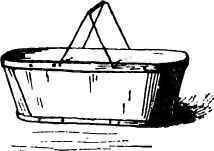
Fig. 4. A good scheme.
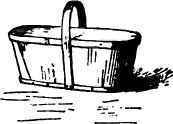
Fig. 3.
Fancy peaches are put up in pony baskets and crated as shown in our previous paper. Pears are also put up in the same manner. Of course this method of packing is expensive on account of the increased cost of transportation, but the price secured by the fancy and attractive packing, as well as by their superior condition on arrival is usually sufficient to more than equalize things.
As stated in our first article, it would be almost impossible to describe the many different packages in which produce is brought into the New York markets. Grapes seem to receive the best treatment both in regard to uniformity of packages and the manner of packing. The grape basket is usually made in two sizes, one holding 5 pounds, the other 10 pounds. The manner of construction is similar in all cases, the top of the basket being a solid piece of light wood, fastened at either end with a wire or piece of tin, as the case may be.
It is interesting to note in this connection how sharply the commercial world are learning to look after the waste. Some of these grape baskets have the cover fastened to the basket by a strip of tin which is tacked to the cover and bent over so that the end catches at the under side of the hoop which goes around the top of the basket. This makes a fastening at once secure, yet one that may be easily loosened when necessary. It is easy to see that these fastenings are made from waste pieces of tin, so small that they cannot be well used by the manufacturer who makes the waste, yet they come into play in this connection to great advantage.
The illustration, figure 3, shows the style of grape basket now in almost universal use for native grapes shipped to the New York market. While we will treat more fully the question of marking packages, it is plain to see that grape growers and packers are more progressive in this respect than others, and we will touch on the subject just here for a moment. In a thorough search of the markets of New York we failed to find a single basket of first class grapes but what had the name of the variety marked plainly on the basket. By far the larger portion were not only so marked, but in addition bore the grower's name and address in a conspicuous position.
This is encouraging, showing as it does a disposition to advance with the rest of the world. Of course it will be understood that to the force of competition is largely due this reform, for it forces the grower to raise, pack and ship a superior quality of produce in order that his name may be a guarantee of value. It may be considered a general principle in the fruit business that the grower who takes pains to mark the packages with his name and address, does so believing that his packages contain a superior article with which he desires the consumer to become familiar.
The question of packages is an important one, yet so wide in its scope and so dependent on the grower and shipper more than as anyone else, that it is impossible to much more than generalize on the subject. Still, the necessity of reform is most important.
Said a prominent New York commission man to the writer: "A United States law determining the size of packages for different fruits would be a blessing to dealers and consumers. A dealer at present is compelled to buy a package and weigh or measure the contents before he can judge at what price he should sell them".
"Once peaches were all sent to market in a basket holding 5/8 of a bushel; now they come in all sorts of packages from a barrel to a grape basket.
"The strawberry producer has succeeded in maintaining an honest quart, pint and third, but the 'side-walk venders' buy a basket holding about 2/3 of a quart and retail from this, giving the purchaser the basket rather than running the chances of letting him see how few berries he has received for the money.
"There has been a change for the better in the grape packages. The shipper in the interior of the state makes use of 5 and 10-pound baskets, which go with the fruit. Growers in the counties along the Hudson river use a package called the 'gift crate.' This is a light skeleton case containing 8 small baskets in two tiers. The baskets are sold with the fruit and only the weight of the case deducted".
The case last mentioned is patterned after the California grape case described and illustrated last mouth. We have mentioned the majority of the "standard " packages used in the New York markets. Other fruits not referred to are usually sent in the same packages as those already described. For example, choice currants come in quart strawberry baskets. Inferior fruit, being used more for preserving, is shipped in any box or crate which is returnable ; this last grade of fruit is sold by the pound.
Cherries are sent in 10-lb. grape baskets. Choice plums are marketed in quart baskets and 5-lb. grape baskets; the inferior kinds in kegs and half-barrels. Cranberries are received in quarts, grape baskets, bushel boxes and barrels. Gooseberries are usually marketed in quart berry boxes.
Vegetables come in all kinds of shapes. We see potatoes in barrels, boxes, baskets and bags; peas in the same sort of packages; onions generally in crates; beets, carrots, turnips and other root crops in boxes and barrels. Naturally, large quantities of vegetables are brought to the markets of New York on wagons, and in such cases they are usually transferred to the most convenient package at the command of the dealer.
As a matter of course, in such a market as New York, receiving shipments from so many different people in different localities, there is more or less of bad packing in poor packages. Dealers who are familiar with all sorts of packing claim that they have great difficulty inducing growers to use proper packages. A small, tight box, which is most frequently used for a dozen quart baskets of fancy berries, is sometimes filled with pears or other orchard fruits ; the box contains no given quantity and both dealer and customer guess at the quantity. This of course frequently loses a sale.
Bad packages means both packages that are not suited for the produce and also those which are in bad shape, broken or worn out. Our illustration shows a good package and a poor one ; no comment is necessary - it shows for itself. For the originals of these sketches we have but to go through Washington Market in New York at any time.
As an illustration of packing fruit in unsuitable packages, we recently saw a large crate of pears delivered at the store of a commission man. As the crate was taken from the wagon, the odor and feathers which enveloped it led us to suppose it held live poultry as it had evidently been used for that purpose before. When the covers were removed all bystanders were surprised to find that the box contained pears. To say that the commission merchant was disgusted hardly expresses the feeling. To save the fruit he had each specimen carefully wiped with a cloth and, after being well aired, repacked in proper baskets; by this means they • brought a good price. Yet such is the stubbornness of the human family, that the chances were nine against one of any reform by the grower.
The merchant will explain by etter what he was obliged to do in order to sell the fruit. The grower will read the letter, wink an eye and slyly remark. "Oh, that's all right; he is trying to make me think he is serving me extra well." Along goes another box in the same shape, and, should it so happen that for any cause the merchant could not dispose of them as he did the first lot, up goes the wail from the grower, of fraud, cheat, roguery, etc.
It hag been made most evident to the writer, who by the way has grown and shipped many crates, baskets, barrels, etc., of fruit to the New York markets, that if the average grower would pay more attention to suggestions made by his commission merchant he would realize far better returns than at present.
[to be continued].
Continue to:


My Books

