


Tools - We Have Too Much People And Too Few Tools
Description
This section is from the book "The American Garden Vol. XI", by L. H. Bailey. Also available from Amazon: American Horticultural Society A to Z Encyclopedia of Garden Plants.
Tools - We Have Too Much People And Too Few Tools
ALL of the wheel-hoe people, apparently, have got our range, and are showing their sympathy by firing circulars at us from all points of the compass. This is as it should be. But while the good work of weed destruction goes on with all the weapons the law allows us, Mrs. Tarryer wishes an irregular line of demarcation drawn between wheel-hoes and the elegant and deadly hand-weeders she prefers to patronize. She has a few wheel- hoes up garret that would be in use, no doubt, were our rig suitable for that running-gear. Had we a ten-acre lot sowed with onions, I might go down to Castle Garden and select some unfortunate foreign brother, with a mild aspect and an upper lip capable of stiffening, who wanted to learn our language at a cheap rate, and turn him into that lot with the wheel-hoes, and keep him going over and over those onions all summer. That broad field work is the function of the wheel-hoe. We should calculate to furnish a case of off-year, filler tobacco, the same that we put a little of into hens' nests (hoping it would not be accepted), and that his friction and trampling to and fro would keep the weeds down and have a tendency to crush fungii and scare insects.
The rattle of the machine would tell when the man was sweating himself, and he wouldn't be disturbed in his studies (except during showery weather in haying) till he chose to graduate or the onions were fit to harvest.
The careful reader, several times over, of the preceding Tarrytown Letter, will have discovered that the above wheel-hoe system, though profitable and easy for the master, and tolerable, when he can't help himself, for the man who comes to this country without any letters of introduction or affiliations with our international secret societies, would not be social enough for Mrs. Tarryer. The onion-field aforesaid may be regarded as a state of probation - quarantine ground - and the wheel-hoe as a kind of out-doors treadmill, well calculated to test the quality of the Prince Hamlets of Denmark, who land on our shores incog., but not fit for the elect. Mrs. Tarryer would be sure to know of any distinguished merit being in her neighborhood in humble circumstances. In fact, I have just pictured, between my lines, the early career in this country of a fair-haired and blue-eyed Scandinavian - a descendant of old Snorro's Harold, perhaps - who was one of our first favorites some years ago, and is now, with one of her graduates, occupying a place of trust, where they will laugh long when they see this allusion to themselves.
Our sketch shows a young woman using one of Mrs. Tarryer's thrust-hoes in the strawberry garden ; extirpating every weed; transplanting or planting or cutting off what runners she pleases without touching a finger to the soil; gently lifting and breaking, around the young plants as well as in the alleys, every particle of the crusted loam after a puddling rain, leaving it a crumbling, cooling mulch, fit to withstand midsummer heats or showers for one while, and without a footstep showing.* This is a very different thing from any wheel-hoe operation, planting purslane with every step as it goes. You would think the fairies had done it, or it had done itself, it seems so little laborious and so much the work of culture and grace.
Perhaps the engraver will not be able to show all the details. Some things may as well be left to the imagination of the student. Mrs. Tarryer looks over my shoulder and says that a "Mr. Kit" is to be understood facing this way, just the other side of "Miss Kitty," and that he hears every word she says, which could not be if they were rattling and jamming wheel-hoes into that baked earth and gravel.
Wheel-hoes won't work everywhere. What would those two young people do if they had a stiff row of raspberries, blackberries or currant bushes between them - what in a garden of roses with only wheel-hoes for the tangled tillage,? As it is, with those erect, stand-at-ease implements, we may imagine them smiling the little-or-nothings at each other that mean so much in such cases, and carrying on more of the world's necessary business above than under the raspberry bushes, while weeding the latter most thoroughly.
Or suppose the case of a neighbor's fence next our garden, and he growing Agropyrum repens under it to run through our potatoes, what could we do with a wheel-hoe there in the latter part of the season ? But one of those pointed hoes could be shoved under the neighbor's rails or pickets, and hoe half a row on his side of the fence easier than he could do it with a wheel-hoe. So among running cucumber, melon or squash-vines, where any other hoe would be ruinous, it is nothing but play, with one of those fourteen-inch blades, to go over all the spaces inclined to weediness, not only among the vines, but around a hun-dred other things in every w e l l -appointed kitchen garden, that cannot be reached by any other hand or horse cultivation with one-tenth the speed, accuracy and power.
*[The sketch ought to have shown all this; but the artist gave up in despair of bringing out all the excellent points of Mr. Tarryer's description, partly for fear of offending Mrs. Tarryer, and so contents himself with trying to represent the soil in its hard and unhoed condition. - Ed].
Scores of times during the season, the ten or fifteen minutes one has to enjoy in the flower, fruit and vegetable garden - and that would suffice for the needful weeding with the hoes we are celebrating - would be lost in harnessing horses or adjusting and oiling squeaky wheel-hoes, even if everybody had them.
The Garden is not big enough, nor my patience long enough, to give more than an inkling of the unspeakable merits of these weapons of society and civilization. When Mrs. Tarryer was showing twelve or fifteen acres of garden with never a weed to be seen, she valued her dozen or more of these light implements at five or ten dollars daily ; whether they were in actual use or adorning the front hall, like a hunter's or angler's furniture, made no difference. But where are these millennial tools made and sold ? Nowhere. They are as unknown as the Bible was in the dark ages, and we must give a few hints towards manufacturing them.
One of Mrs. Tarryer's Girls with Her Hoes.
First, about the handles. The ordinary dealer or workman may say those knobs can be formed on any handles by winding them with leather ; but just fancy a young maiden setting up her hoe meditatively and resting her hands and chin upon an old leather knob to reflect upon something that has been said to her in the garden, and we shall perceive that a knob by some other name would smell far sweeter. Moreover, trees grow large enough at the butt to furnish all the knobs we want - even for broom-sticks - though sawyers, turners, dealers and the public seem not to be aware of it. Yet it must be confessed we are so far gone in depravity that there will be trouble in getting those handles. The three o r four hundred that were procured by C------s Co.
(that was in Maj. W-------d's time), the whole United States were scoured for. Mr. S-----e, now president, travelled or wrote far and near, and the only available ash logs were "cut and hauled twelve miles over the mountain to the saw-mill," in Kentucky somewhere. This was a great engineering feat, but what man has done man may do. Timber and ideas have been growing since that time, and experiment-stations have been started in every state.
In a broadcast prayer of this public nature, absolute specifications would not be polite. Black walnut and butternut are fragrant as well beautiful timber. Cherry is stiff, heavy, durable, and like maple takes a slippery polish. For fine, light handles, that the palm will stick to, butt cuts of poplar or cottonwood cannot be excelled, yet straight-grained ash will bear more careless usage.
The handles of Mrs. Tarryer's hoes are never perfectly straight. All the bayonet class bend downward in use half an inch or more; all the thrust-hoe handles bend up in a regular curve (like a fiddle-bow turned over) two or three inches. 'Unless they are hung right, these hoes are very awkward things. When perfectly fit for one, they may not fit another - that is, a tall, keen-sighted person cannot use the hoe that is just fit for a very short one.
Until young people become aware of these eternal fitnesses they are not much good in the garden. Those curves in the handles throw centers of gravity where they belong. If a fresh weeder (during vacation, perhaps) pushes heedlessly ahead of his business, the expert young women on either side of him may simultaneously drop considerable pebbles from their deft hoe-blades into each pocket of his flannel jacket! Lack of ballast can be readily hinted in this way, when thrust-hoe handles are curved as aforesaid. Good timber generally warps in a handle about right, only implement-makers and babes in weeding may not know when it is made fast right side up in the hoe. There are plenty of thrust-hoes in market, such as they are. Some have malleable iron sockets and bows - heavier to the buyer and cheaper to the dealer - instead of wrought-iron and steel, such as is required for true worth.
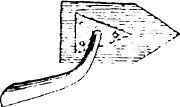
There is a clumsy, imported, fish-spear pattern, wrought or welded in one piece, which does fairly for trimming flower border turf edges. It has evidently fallen from grace in the hands of obfuscated mechanics and the trade that "sells" the buyer with its goods.
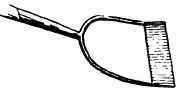
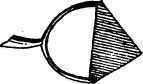
Mr. Loudon has a number of obsolete old emblems of the "Dutch" or "scuflfle-hoe" that suggest better things for our Edens. Here are two relics which prove that the ancients understood the virtue of pointed steel in the garden. How many of Loudon's pictures have been patented in this country ? But he don't seem to know that a broad blade produces more friction and will clog vexatiously with soil when it is sticky with dew or rain. The blades of Mrs. Tarryer's thrust-hoes - please take notice - are fastened to the small feet of their slim bows with loose rivets, like mower-knife sections, so that any one can readily replace a worn-out blade upon occasion, while favorite handles, sockets and bows will last, with care, for a lifetime.
Hidden in part by the lady's dress in the photograph, unless the engraver has seen to it, is an omnipotent digger which must not be overlooked. I don't see how women, or men either, can be thoroughly independent in the garden without it. For turf, or any hard, rooty digging or light grubbing, the cutting of bogs or the handling of tough clay or hard-pan, nothing in the world can compete with it. Put a malleable "D" handle on it, and we have a wonderful swing shovel, capable of tossing a hundred loads of stiff earth in a day easily. It is a man's hoe - one that any man strong enough to be gentle might be proud to know the use of, and worth more to a woman than a bad husband.
Continue to:


My Books

