


Two Good Labels (Figs. 11 And 12)
Description
This section is from the book "The American Garden Vol. XI", by L. H. Bailey. Also available from Amazon: American Horticultural Society A to Z Encyclopedia of Garden Plants.
Two Good Labels (Figs. 11 And 12)
After considerable experimenting with field labels for vegetables and small fruits, I have adopted a soft and clear white pine label 2 ft. long, 3½ in. wide and 1½ in. thick, sharpened at the mill. These labels are primed with white lead, and the name is written on with a carpenter's pencil. The name is then more permanent than when painted on with a brush, while the pencil writing is expeditious, and it can be made neat. The labels which are used for annual plants are taken up in the fall, and during the winter the name is shaved off with a plane, another priming is given, and the label is new again; or the reverse side of the label can be used the second year. These make the cheapest and best garden labels and stakes I have ever found. They are large enough to be conspicuous, and are not easily displaced or broken by horse labor. In priming, it is important that the labels should be piled on their edges to dry, for if the faces come together they will dry so rough that they will not take the pencil. A neat little label for specimen plants is made from the commercial primed garden stakes, as shown in Fig. 12. For the post I use Judson's 12-in. garden stake or label, and the cross-piece is made from his package label.
The two pieces are put together with 3/8-in. brass escutcheon pins. I at first used iron pins, but they soon rust and discolor the label. These labels are frail, and are worth little for permanent use in our work.
Cornell Experimen Station. L. H. Bailey.
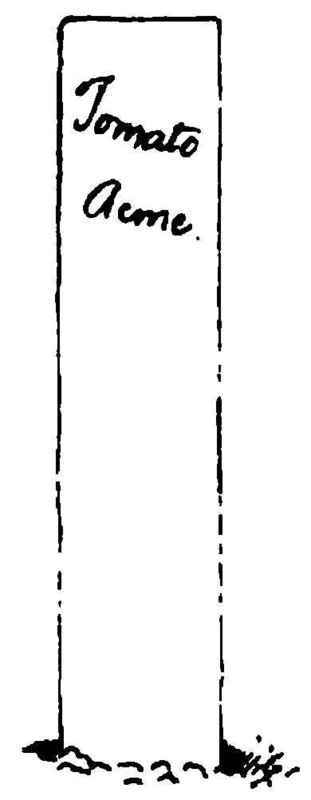
Fig. 11.

Fig. 12.
Continue to:


My Books

