


Hyacinths. Continued
Description
This section is from the "Bulb Gardening" book, by Mary Hampden. Also see Amazon: Bulb Gardening.
Hyacinths. Continued
They become too lanky when in pots or glasses placed too far below the window's chief light. They lean sideways unless often turned round in their receptacles.
Massed beds of self-coloured Hyacinths yield dazzling displays in garden landscapes; beds of two colours or one brilliant hue with white, are especially striking, and they submit themselves well to pattern forming if the varieties are judiciously chosen, a task in which the bulb vendors should be consulted.
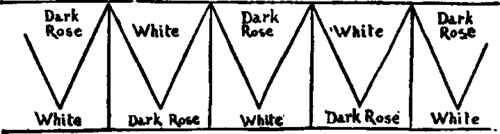
Bold Colour Border.
Many varieties are unsuited to culture in water, or fibre and shell.
Single Hyacinths, in addition to Romans and Miniatures, are more popular as cut flowers than formerly, so may be grown fairly close together, in frames, or sunk beds protected by mats or 'lights,' or in large boxes in greenhouses, for this purpose.
Porch tops are suitable for glorious spring displays: a fact of which town dwellers would do wisely to take notice. Window boxes and ornamental tubs and urns can have no fairer fillings. I know one house where, annually, white Hyacinths make a magnificent show thus employed, all the receptacles being of red terra-cotta. Other arrangements could combine blue and lilac flowers and yellow pottery, rose and carmine with grey, orange, salmon, and scarlet, with white.

Bold Colour Bed. Bold Colour Bedding Out.
Instead of commonplace beds, in poor grass surrounds, in front gardens, how charming would be sunk beds of stone sides or rockery, between breadths of crazy paving, with every spring made brilliant by the Oriental Hyacinth, to be followed by summers and autumns of Iris, Ranunculus and Gladioli displays!
Our summer-houses ought to be adorned by Hyacinths, in window boxes and door tubs, also closely environing borders, for the perfume in the open is always appreciated.

A Summer Bulb Border.
To attempt to recommend the best varieties for the garden would be merely to provoke contradiction, but gardeners who want a few admirable specimens might do worse than order the following:
Double Outdoor Hyacinths
The First
Dark rose.
Sir Joseph Paxton
Early deep carmine.
President Roosevelt
Deep pink.
Grootvorst
Blush.
Margot
Pure white.
Bouquet Royal
White, extra double.
Isabella
Blush-white.
Garrick
Brilliant blue.
Prince Albert
Black-purple.
Lord Wellington
Light blue, with dark centre.
Delicata
Pale blue.
Sunflower
Salmon-yellow.
Minerva
Orange.
Jaune Supreme
Gold.
Single Outdoor Hyacinths
City Of Haarlem
Primrose.
King Of The Yellows
Deep yellow.
Sonora
Apricot.
Marchioness Of Lorne
Salmon-orange.
Sir William Mansfield
Purple-mauve.
Distinction
Maroon.
Sir Edwin Landseer
Deep violet.
Lord Mayo
Dark violet, with white eye.
Laura
Pale mauve.
King Alfred
Plum purple.
Princess Wilhelmina
Bright blue.
Masterpiece
Dark blue.
Schotel
Light blue.
Christmas Blue
Azure. Early.
Arentine Arendsen
White. Early.
Queen Of The Whites
Pure white.
General Vetter
Cream.
Queen Of The Pinks
Rose.
Orange Queen
Orange-rose.
Pink Perfection
Pale pink.
King Of The Reds
Carmine, with white eye.
General Pelissier
Bright crimson.
Christmas Red
Early red.
A Few Special-Colour Hyacinths For Pots
Linn’Us
Light scarlet. Single.
La Victorie
Real scarlet. Single.
Solfaterre
Orange - red. Single.
Vuurbaak
Dark crimson. Single.
Cavaignac
Salmon, with rose stripe. Single.
Gigantea
Rose. Single.
Regina Victoria
Salmon. Double.
Prince Of Waterloo
White. Double.
Alba Superbissima
White. Single.
Grandeur A Merveille
Pale blush. Single.
Blondin
Silvery blue. Single.
Ivanhoe
Very dark blue. Single.
Van Speyk
Lilac. Double.
Blocksberg
Light blue. Double.
Ida
Yellow. Single.
King Menelik
Nearly black Single.
The beds and borders of Hyacinths ought to be given a mulch of decayed manure, preferably cow manure, in February: the old coco-nut-fibre refuse being drawn aside first, then returned, with some fresh, as a cover for the unsightly manure.
It is an admirable plan to grow Hyacinths in what are known as basket-beds, raised beds, that is to say, surrounded by lattice wood, strips of painted wire netting, or held up by stakes of rustic wood. Sloping beds and borders are also excellent, to ensure perfect drainage.
For room ornaments Hyacinths can be grown in wicker, or rush, baskets, that are first lined with old turves, inverted, to prevent the compost from escaping.
Hyacinth bulbs from the garden may be stored for any purpose.
Many bulbs will be found to have made offsets: these should be broken away, at re-planting season, and planted by themselves, in rich, warm borders, or nursery beds (see Chapter XVII (Begonias, French And Persian Ranunculuses, Ornithagalums, Calochorti, Commelinas, Etc)). They will flower in two or three years, in all probability.
It is not likely that many gardeners will desire to grow Hyacinths from seed. However, in case advice on the subject may be welcome to the few I will quote from an antique Garden Guide.
'Seed being rarely procured from double Hyacinths must be saved from those which are single, or semi-double, saved from such plants as have good characters, and should not be gathered till it has become black and ripe, indicated by the yellow colour of the seed vessel and its beginning to open. Sow immediately, in pots or pans, and place these in a hotbed. As soon as the young plants have produced two leaves, they should be potted singly into thumb pots, or "small sixties" (sixty to a cast of pots). Leave the summit of each young bulb on a level with the surface of the soil. They must then be watered, and shaded for a few days. When the bulbs begin to go deeper into the soil, they should be repotted into large sixties. The shiftings must be repeated when necessary till the plants are at length established in twenty-four sized pots.'
A more modern plan is to sow in boxes of sandy soil in cold frames, or out of doors, in September.
Yet another is to sow directly seed ripens, in sandy rich beds out of doors, protect from all extremes of weather, and mulch with fresh compost occasionally, until the third year, when bulbs are lifted and replanted elsewhere to blossom. Some may bloom before they are four years old, though a Hyacinth bulb is not reckoned mature till it is seven.
Late supplies of Hyacinths can be gained by 'retarding' the October-bought bulbs, by shutting them in air-tight tins, without bran, chaff, or any other covering substance, and standing the tins in cold cellars, or a refrigerator, till January or February, when potting should be done by the usual methods.
It is interesting to recollect that old gardeners of renown used to insist on using extra deep pots for this flower, believing that great length of root is needed to support fine foliage and bloom-spikes.
Roughened, or 'scrubby'-looking Hyacinth bulbs are often more satisfactory and valuable than are smooth, silky ones.
Continue to:


My Books

