


Irises. Continued
Description
This section is from the "Bulb Gardening" book, by Mary Hampden. Also see Amazon: Bulb Gardening.
Irises. Continued
Irises For Damp Soil Beneath Trees
Iris Foetidissima
The Gladwyn Iris.
Iris Pseudo-Acorus
The tall Yellow Flag.
Iris K’Mpferi
Japanese - if grown in pots elsewhere and sunk in the soil when budding.
Iris Germanica
Similarly treated for the majority of the plants, but some planted permanently in slightly raised beds.
It will be observed that the individualities among Irises are as great as among human families or nationalities. Generally speaking, the Iris is a sun-lover, and there is danger of bulbs decaying when they are exposed to wet during winter as well as during the summer-time in which many species require it. But every chance of beautifying the worst places in our gardens ought to be tried: for which reason flower enthusiasts should experiment with bulbs, and not grudge the cost of a few failures when a few fresh triumphs will win them renown as well as pleasure.
The gardens that give trouble are not always wet and shady; there are those of light soil, sun-baked, perhaps on hill-sides where moisture runs away, or hill-tops that are nearer fierce sun than are valleys. Well - the Iris family can send individuals to even their aid.
Irises For Hot Arid Gardens
Iris Tectorum. The Japanese Roof Iris. Blue, also white.
Crimean Irises
These vary in height from a few inches to half a yard, the variety Venacensis (violet) often reaching that stature, but the majority are about 10 inches, and the most suitable for flat ground in heat. The lesser varieties prefer a rockery, where the soil does not become too sand-like. The following suggest some admirable colours.
Crimean Irises Chamoeiris cyanea, blue-violet, I foot, and Alba, ivory, Formosa, violet-blue, x foot; Gracilis, grey-heliotrope, 9 inches ; Lu-tescens, yellow, 15 inches; Melpomene, claret-red, 9 inches; Albiensis alba, cream, 18 inches; Orange Queen, gold and orange, I foot; Uranus, violet-blue and crimson, 12 inches.
As for the Irises that can be grown in the sunny, well-drained borders in most localities, and in sunny rockeries with even greater security, their name is legion. We all know the Poor Man's Orchid, or Spanish Iris, one of the cheapest of all floral charmers, so there is no need to say more, except to advise the trial of the best named varieties, which any renowned bulb merchant will supply upon request. This Iris is finest when left out for three years, yet it is not absolutely certain to survive winters, so is often lifted and stored each autumn. I never treated my 'Spaniards' so, because I hold the theory that all flowers that can be induced to live entirely out of doors should be made to do so; and I am convinced that any failures with mine resulted from the loosening of the roothold by fork or hoe, an indignity that the Iris will not endure. English Irises are larger, handsomer, and longer lasting both on the plant and in the cut state. Their bulbs ought to be lifted every second year, unless soil and climate conditions are perfect, and, even so, the overcrowded clumps will not throw the best blooms.
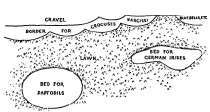
A Spring Nook.
There is interest in some remarks made on the English Iris by M'Intosh, the famous gardener, in 1840:
'The flower is coming into repute, both from the beauty of its blossoms and their great variety, for, from the natural blue of the wild flowers, it has sported into every shade of white, violet, rose, blush, lilac, blue, purple, red, cherry, and crimson, both self colours and shaded, mottled and striped, in the most beautiful manner. It is very easy (according to Mr. John Salter, in the Horticultural Journal) to manage this Iris, as it will grow in almost any soil, but succeeds best in a well-sweetened compost, formed of sandy loam, with a portion of leaf-mould or very rotten manure from an old melon-pit. The beds should be exposed to the east or the north-east. Every corm has one, two or more offsets, and in a general way it is advisable for the roots to remain two seasons in the same ground. It produces abundance of seed, which ripens at the end of July and beginning of August, when it may be gathered, dried, and sown in September or October in drills in a very light sandy soil. The following spring the young plants will appear above ground, and will form, during the first season, corms about the size of garden peas.
These should not be disturbed till the third year, when they may be removed to the bed where they are to bloom, which will sometimes be in the fourth, but more usually in the fifth or sixth year, from the time of sowing. It will forward the bulbs to top-dress the beds with fresh earth in August.'
This long extract from an old-world gardening book will serve as sufficient instruction for the seedling-raising of Irises in general, though modern culture is more often pursued in cold frames than in the garden ground.
Irises For Sunny Well-Drained Borders Or Rockeries
Iris Tuberosa
Quaker's Head Iris. Green and black.
Iris Susiana
The Mourning Iris. Deep purplish-brown and black.
Iris Missouriensis
China blue.
Iris Monspur
Cambridge blue, light blue. Tall.
Iris Monspur Premier
Violet. Tall.
Iris Monspur Dorothy Foster
Violet-blue. Tall.
Iris Setosa
Violet.
Iris Flavescens
Yellow.
Iris Spuria
Blue. Three feet.
Iris Pallida
Purple and lavender. Tall.
Iris Versicolor
Lilac-purple. Also Florists' Varieties.
Iris Florentine
White, lilac shaded.
Iris Persica
White, blue, purple, gold blend. Early.
Iris Histrio
Blue - purple. Early.
Iris Reticulata
The Netted Iris. Violet and gold. Early.
Iris Sindjarensis
Light blue. Early.
Iris Alata
The Scorpion Iris. Pale blue and yellow. Winter blooming.
Iris Stylosa-Speciosa
Blue and gold.
The last six Irises are winter or earliest spring flowers, and can be hastened by having glass shading of any kind over them when their buds are just appearing and till the blooms fade. Or these, also Spanish Irises, may be potted, from September to November, five bulbs, 2 inches deep, in a six-inch pot. The compost should be a blend of equal parts of loam, peat, leaf-mould and sand, but Spanish Irises can do without peat. So too, if necessary, can English Irises, which should go three into a seven-inch pot, or singly in a five-inch one.

A Winter Border, with small shrubs.
The pots should be put into frames, windows, or cold greenhouses, the soil in them only just covered by coco-nut fibre refuse to keep it from drying too rapidly. When flower spikes are forming the Irises may be put in a greenhouse where the temperature is moderate. As the flowers fade, water must be lessened, discontinued as the last bloom dies, and then the pots should be placed on their sides on sunny shelves for a few weeks. The old bulbs can be dropped into corners in the rockery, but fresh ones must be bought for next season's potting.
Continue to:


My Books

