


Dyckia
Description
This section is from the book "The Standard Cyclopedia Of Horticulture Vol2", by L. H. Bailey. See also: Western Garden Book: More than 8,000 Plants - The Right Plants for Your Climate - Tips from Western Garden Experts.
Dyckia
(after Prince Salm-Dyck, German botanist, and author of a great work on succulent plants). Bromeliaceae. Succulents, grown under glass and in the open far South.
Dyckias somewhat resemble century plants, but with smaller spines, as a rule, and flowering regularly. They are usually stemless, and the leaves form dense rosettes. - About 60 species in S. Amer. for cultivation, see Agave. They are rarely cult, in Fla. and Calif., and in a few northern collections. Following have showy yellow flowers
A. Infloresence amply branched or panicled.
Altissima
Lindl. (D. princeps, Lem.). Leaves spiny at the margin: floral bracts small, all manifestly shorter than the flowers Brazil.
AA. Infloresence not branched, a raceme or spike.
B. Filaments forming a tube: flowers with scarcely any pedicel.
Rariflora
Schult. Fig. 1369. Leaves with small spines on the margin, shorter than in D. altissima: sepals not emarginate at the apex: upper sheaths of the scape shorter than internodes. Brazil. B.M.3449. B.R. 1782.
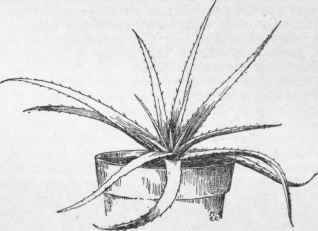
Fig. 1369. Dyckia rariflora.
bb. Filaments not forming a tube all the way: flowers with a short but conspicuous pedicel.
Sulphurea
C. Koch, not Baker. Leaves with small spines at the margin: sheaths of the scape longer than the internodes, the higher ones entire: bracts lanceolate, the lowest conspicuously longer than the pedicelled flowers: blades of petals wide and longer than stamens. Brazil.
Wilhelm Miller.
Continue to:


My Books

